
What Is Civil Process Service and Why It Matters

Over 85 percent of American civil lawsuits rely on process service to uphold basic rights in court. Every step in this process ensures that defendants are given their fair chance to respond to legal claims, making it one of the most vital protections in the justice system. By understanding the core principles behind process service, you gain insight into how American courts safeguard due process and prevent costly errors that could jeopardize a case.

Table of Contents

Key Takeaways

Point Details
Civil Process Service Definition It is a legal mechanism that formally notifies defendants of legal proceedings, ensuring their right to respond.
Types of Civil Process Major methods include personal service, substituted service, mail service, service by publication, and electronic service, each having specific requirements.
Process Serving Workflow The workflow includes document preparation, location verification, delivery execution, and proof of service, ensuring compliance with legal protocols.
Roles and Risks in Process Serving Process servers must perform their duties accurately, as mistakes can lead to legal complications and jeopardize cases.

Civil Process Service: Definition and Core Principles

Civil process service represents a fundamental legal mechanism ensuring constitutional due process by formally notifying defendants about legal proceedings. Service of process is the critical procedure through which plaintiffs communicate legal actions to opposing parties, guaranteeing their right to respond and participate in judicial proceedings.

At its core, civil process service involves the official delivery of legal documents that inform an individual or entity about a lawsuit filed against them. This procedural step is not merely a bureaucratic requirement but a constitutional safeguard that protects defendants’ fundamental legal rights. The primary objective is to provide proper legal notification, enabling the served party to understand the nature of the legal action, prepare a defense, and exercise their right to be heard in court.

The mechanics of process service involve several key principles. First, documents must be delivered by an authorized process server who is legally qualified to handle such communications. Second, the service must be conducted in a manner that provides verifiable proof of delivery, typically through signed acknowledgments or official documentation. Third, the process must adhere to strict jurisdictional rules, ensuring that legal compliance standards are met throughout the notification process. These principles guarantee that the defendant receives accurate, timely information about pending legal actions, maintaining the integrity of the judicial system.

Ultimately, civil process service bridges the gap between legal paperwork and actual judicial engagement. It transforms abstract legal proceedings into tangible, actionable notifications that respect individual rights while maintaining the structured framework of the legal system. By ensuring transparent, standardized communication, process service protects both plaintiffs seeking justice and defendants seeking fair representation.

Types of Civil Process Served in the U.S.

Civil process service encompasses multiple strategic methods of legal notification, each designed to address unique circumstances and ensure defendants receive critical legal documents. Service of process requirements vary significantly across jurisdictions, reflecting the complex legal landscape of document delivery in the United States.

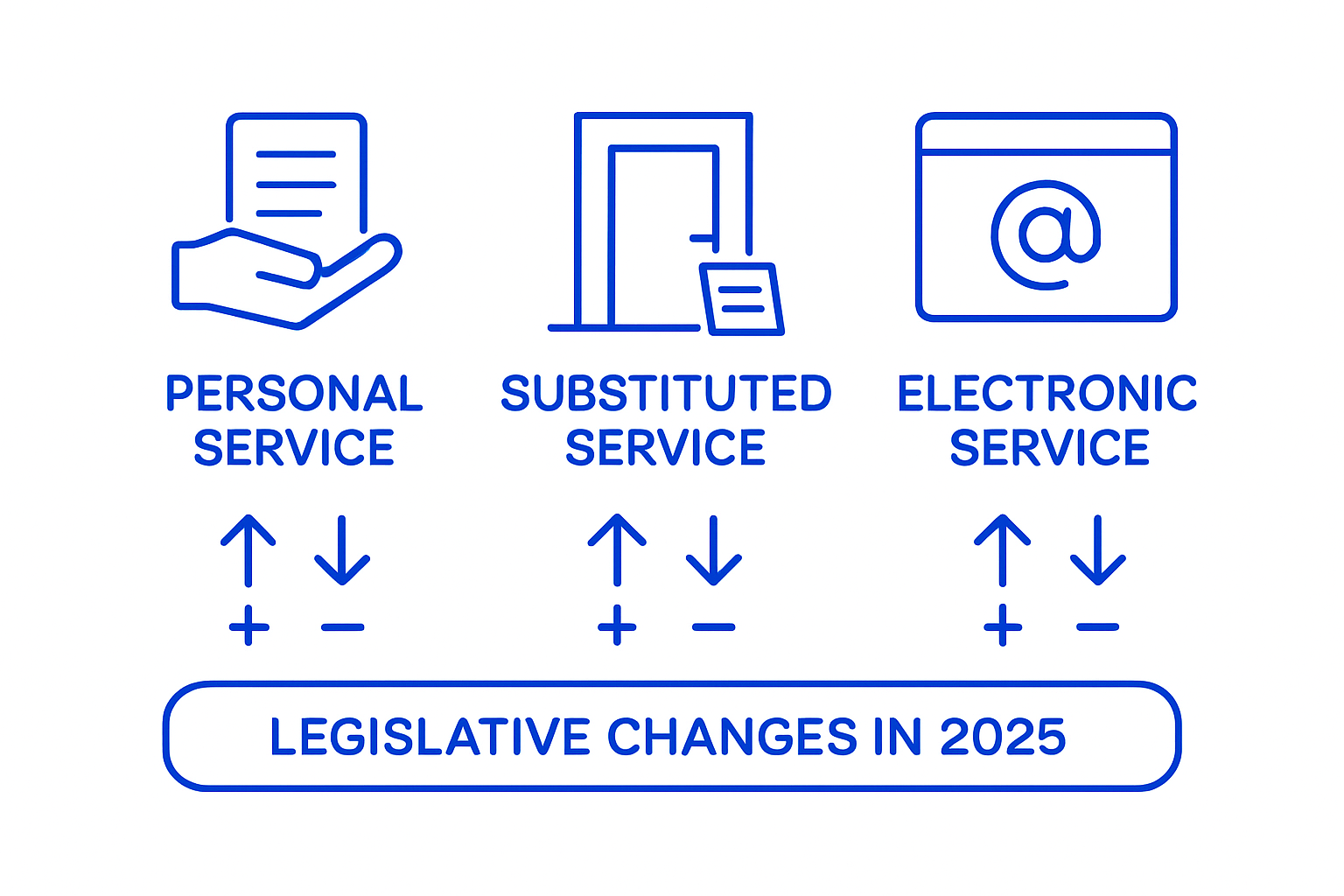
The primary types of civil process service include personal service, which involves directly handing legal documents to the defendant. This method is considered the most reliable and preferred approach, as it provides immediate, verifiable notification. Another common method is substituted service, where documents are delivered to an authorized representative at the defendant’s residence or workplace when direct personal service is not possible. Mail service represents a third approach, where legal documents are sent via certified or registered mail, requiring a signed receipt as proof of delivery.

Process server reviewing paperwork in car

Additional specialized service methods address challenging notification scenarios. Service by publication becomes critical when a defendant cannot be located through traditional means, requiring legal notices to be published in local newspapers or official publications. Electronic service has emerged as a modern alternative, particularly useful in cases involving digital communication. Types of process serving continue to evolve, reflecting technological advancements and changing legal communication standards.

Understanding these diverse service methods is crucial for legal professionals and individuals involved in civil proceedings. Each method carries specific legal implications and requirements, ensuring that defendants are appropriately notified while maintaining the integrity of judicial processes. The goal remains consistent: provide clear, verifiable communication that upholds constitutional rights and facilitates fair legal engagement.

Key Steps in the Process Serving Workflow

The process serving workflow represents a systematic approach to legal document delivery, requiring precision, documentation, and strict adherence to legal protocols. Service of process documentation demands meticulous attention to detail, with specific forms and procedures governing each stage of legal notification.

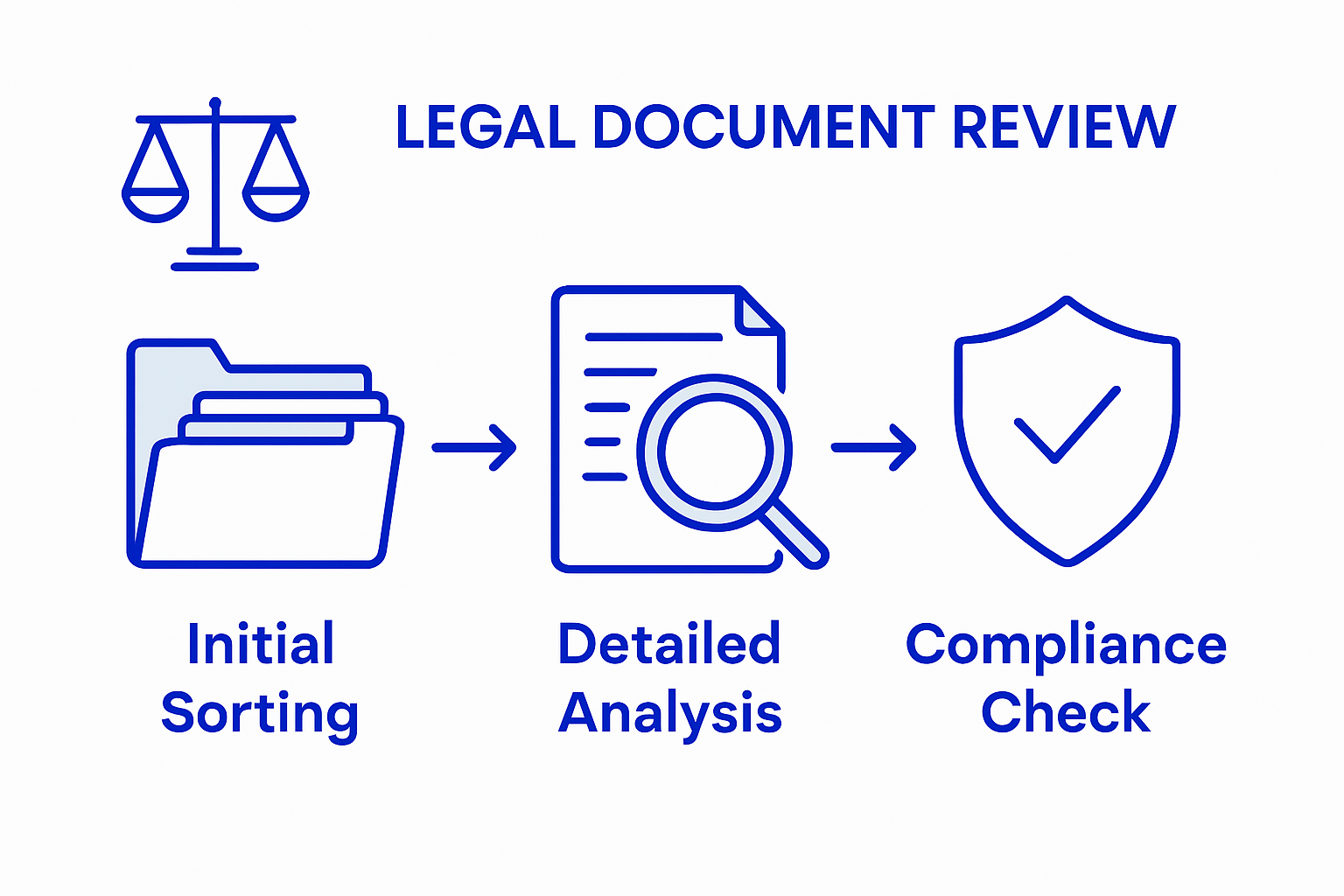
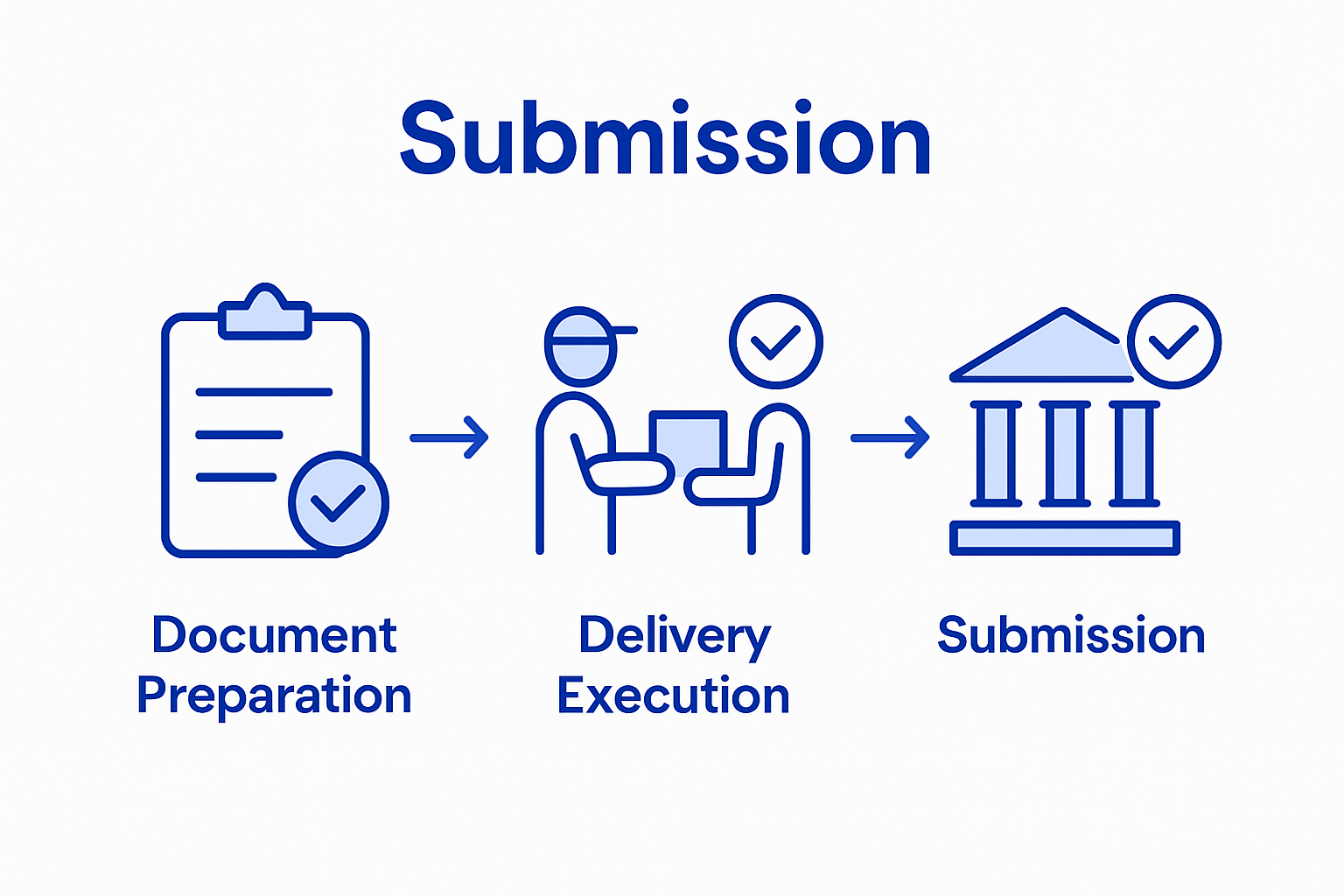
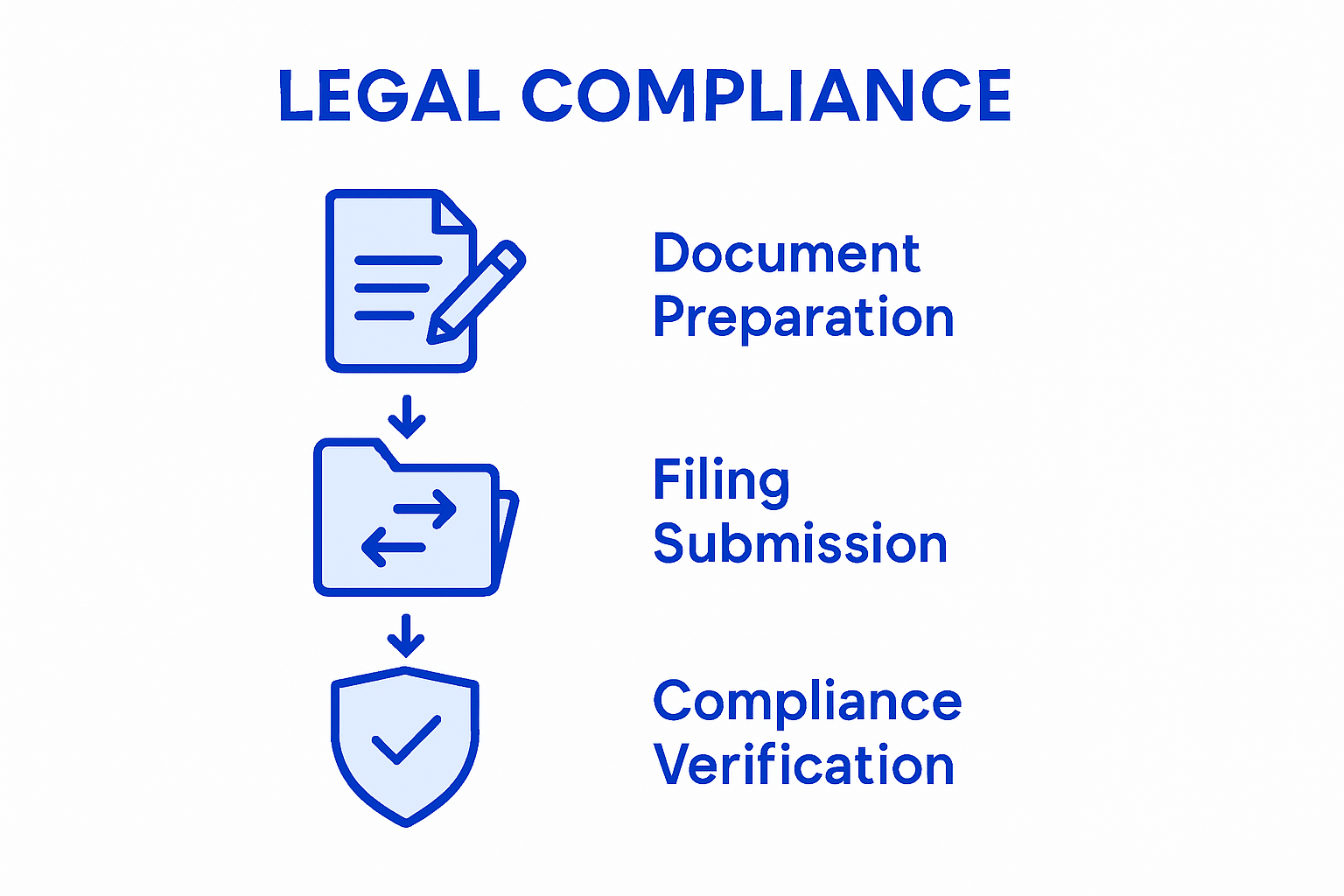
The initial step involves document preparation, which requires collecting and organizing all necessary legal papers, including summons, complaints, and other relevant court documents. Process servers must verify the accuracy of recipient information, ensuring the documents can be delivered to the correct individual or entity. The second critical phase is location verification, where servers conduct thorough research to confirm the exact address and potential alternate delivery locations for the intended recipient.

Delivery execution represents the most crucial stage of the workflow. Process servers must carefully document each interaction, capturing precise details about the time, date, and method of service. Legal process serving guidelines emphasize the importance of maintaining professional conduct and following jurisdiction-specific regulations. After successful delivery, servers complete comprehensive proof of service documentation, which includes sworn statements detailing the exact circumstances of document notification.

The final stage involves formal submission of service documentation to the requesting legal entity, ensuring a complete and verifiable record of the process serving activity. This systematic approach guarantees that legal notifications are executed with maximum efficiency, transparency, and legal compliance, protecting the rights of all parties involved in judicial proceedings.

Three-step civil process service workflow infographic

Legal standards for civil process service are complex and meticulously defined, establishing a comprehensive framework that ensures fairness and due process. Process serving regulations specify precise requirements for document delivery, mandating that legal notifications must be executed by authorized personnel within specific jurisdictional boundaries.

The compliance landscape involves multiple critical components. First, process servers must demonstrate professional certification and undergo rigorous background checks to ensure integrity and reliability. Jurisdictional requirements vary significantly, with each state maintaining unique protocols for legal document delivery. Process server compliance guidelines emphasize the importance of understanding local and federal regulations that govern legal notifications.

Key compliance standards include maintaining detailed documentation, preserving chain of custody for legal documents, and providing verifiable proof of service. Process servers must adhere to strict ethical guidelines, including respecting individual privacy, avoiding harassment, and ensuring accurate recipient identification. The legal system demands transparency, requiring servers to submit comprehensive reports that document the exact circumstances of document delivery, including time, location, and method of service.

Ultimately, compliance in civil process service is about protecting fundamental legal rights. By establishing rigorous standards, the judicial system ensures that all parties receive proper notification, can respond to legal actions, and maintain access to due process. These standards create a balanced framework that respects both the need for efficient legal communication and the constitutional rights of individuals involved in judicial proceedings.

Roles, Risks, and Mistakes to Avoid

Process service notification requirements outline critical responsibilities that demand precision and professional accountability. Process servers play a pivotal role in the legal ecosystem, functioning as crucial intermediaries who bridge communication between judicial systems and individuals involved in legal proceedings.

The primary roles of process servers encompass several key responsibilities. These professionals must accurately locate intended recipients, confirm their identity, and deliver legal documents with meticulous attention to detail. Critical risks emerge when servers fail to execute their duties properly, potentially compromising entire legal cases. Process server compliance guidelines highlight several common mistakes that can derail legal proceedings, including incorrect document delivery, inadequate recipient verification, and incomplete documentation.

Major risks in process serving involve legal and personal liability. Servers must navigate complex scenarios that require professional judgment, such as dealing with evasive recipients, managing potentially confrontational interactions, and maintaining strict ethical standards. Common mistakes include attempting unauthorized entry, misrepresenting their identity, serving documents to incorrect individuals, or failing to maintain comprehensive records of service attempts. These errors can result in case dismissals, legal penalties, and professional sanctions.

Successful process servers must cultivate a combination of investigative skills, legal knowledge, and interpersonal communication. They must understand jurisdictional nuances, respect individual privacy rights, and maintain professional composure in challenging situations. By recognizing potential pitfalls and implementing rigorous professional standards, process servers protect the integrity of legal processes and ensure that fundamental principles of due process remain intact.

Understanding the importance of civil process service is vital for anyone involved in legal proceedings. The article highlights how critical it is to deliver legal documents accurately and on time to protect due process and avoid costly mistakes. If you are facing challenges with properly serving documents or navigating complex legal compliance standards, relying on trusted professionals is essential. Key points like personal service, proof of delivery, and jurisdictional compliance can make all the difference between success and setback in your case.

https://ymdocservices.com

Take control of your legal document delivery with YM Doc Services, where reliability, timeliness, and compliance come together to ease your burden. Whether you need expert process serving, document retrieval, or court filings, our experienced team will ensure all steps meet stringent legal standards and protect your rights. Don’t risk your case due to improper service—visit YM Doc Services now to start your order and safeguard your legal journey today.

Frequently Asked Questions

What is civil process service?

Civil process service is the formal delivery of legal documents that notify individuals or entities about legal proceedings against them. It ensures due process by allowing defendants to respond and participate in judicial processes.

Why is civil process service important?

Civil process service is essential because it safeguards constitutional rights, ensuring that defendants are properly notified about lawsuits, can prepare a defense, and exercise their right to be heard in court.

What are the different types of civil process service?

The different types include personal service, where documents are handed directly to the defendant; substituted service, delivered to an authorized representative; mail service, where documents are sent via certified mail; service by publication, used when the defendant cannot be located; and electronic service, which leverages digital communication.

What are key steps in the process serving workflow?

Key steps in the process serving workflow include document preparation, location verification of the recipient, delivery execution, and completion of proof of service documentation. Each step must be meticulously documented to ensure legal compliance.

Posted in Uncategorized

How to File Legal Forms for Court and Compliance Success

Almost half of American adults will face a legal situation requiring formal documents at some point in their lives. Navigating court forms and legal paperwork can feel intimidating, especially when the rules seem complex or unclear. Getting your documents right from the beginning saves time, stress, and prevents avoidable delays. This guide breaks down each step so you can approach the process with confidence and stay on track throughout your American legal journey.

Table of Contents

Quick Summary

Key Point Explanation
1. Create a Document Checklist Begin by compiling a detailed list of all necessary legal documents to ensure you gather everything required for your case.
2. Fill Legal Forms Thoroughly Complete all legal forms with clear information, addressing every section to avoid delays in the process.
3. Review for Accuracy Carefully check your documents for accuracy, as even minor errors can result in significant legal complications.
4. Understand Submission Protocols Verify the correct submission method for your legal forms, including any required formats and fees.
5. Track Your Submission Status Monitor the status of your filing through online systems or by contacting the clerk’s office to ensure timely processing.

Gathering the right legal documents is your foundational task when preparing for court or legal compliance. You need a systematic approach to collect all necessary paperwork accurately and comprehensively.

Start by creating a detailed checklist of required documents specific to your legal matter. This typically includes identification documents, financial records, relevant contracts, and any prior correspondence related to your case. When compiling these materials, carefully review each document to ensure completeness and accuracy. Understanding the basics of court forms helps prevent common filing errors that could delay your legal proceedings.

Pay special attention to official documentation requirements. Use black ink for all handwritten entries, sign where required, and make multiple copies of each document. Keep originals in a secure location and create organized digital and physical backups. Pro tip: Request certified copies of critical documents from official sources to ensure their legal validity.

As you assemble your documentation, organize them chronologically and create an index that clearly lists each document. This preparation not only demonstrates your thoroughness to the court but also helps your legal representative quickly understand the details of your case. The next step involves carefully reviewing these documents to ensure they meet all legal standards before submission.

Accurately completing legal forms is critical to ensuring your court filing or compliance process moves forward without unnecessary delays or complications. Your precision and attention to detail can make a significant difference in how quickly and smoothly your legal matter progresses.

When filling out legal documents, always use clear, legible handwriting or typed text. Formatting court documents correctly requires using white letter sized paper and writing in black or dark blue ink. Address every section of the form comprehensively even if some fields require you to write ‘not applicable’ or ‘unknown’. Pay close attention to each instruction and read the entire document before beginning to fill it out.

Person completing legal forms at desk

Double check all entries for accuracy including names, addresses, dates, and numerical information. Verify that your signatures are placed in the correct locations and that all required supporting documentation is attached. If you are uncertain about how to complete a specific section, consult with a legal professional or court clerk who can provide guidance. Legal document preparation guidelines can offer additional insights into creating comprehensive and accurate submissions.

Remember that incomplete or incorrect forms can result in significant processing delays or even rejection of your legal filing. Take your time, be methodical, and review your documents thoroughly before submission. The extra care you invest in this step can save you considerable time and potential legal complications down the road.

Step 3: Review Forms for Errors and Compliance

Reviewing your legal documents with meticulous attention is a critical step that can prevent potential legal setbacks or processing delays. Your careful examination ensures that every detail is accurate and compliant with court requirements.

Reviewing court forms thoroughly involves checking each section systematically. Verify that all required fields are completed with precise information and that your signatures appear exactly where needed. Pay special attention to numerical data such as dates, identification numbers, and financial information. Cross reference your entries with original source documents to confirm absolute accuracy.

Minor errors can have significant consequences in legal proceedings. As legal filing experts note, even seemingly insignificant mistakes can potentially invalidate your entire submission. Create a personal checklist that includes verifying names are spelled correctly, addresses are current, and all supporting documentation matches the information on your primary forms. If any section seems unclear, do not hesitate to consult with a legal professional who can provide guidance and prevent potential compliance issues. Remember that a thorough review now can save you substantial time and potential legal complications in the future.

Submitting legal forms requires precision and careful attention to ensure your documents reach the right jurisdiction and meet all procedural requirements. Understanding the specific filing protocols can prevent unnecessary delays or potential rejection of your legal paperwork.

Navigating court filing requirements involves several critical steps. Verify the exact location where your documents should be submitted either by mail, in person at the courthouse, or through online filing systems. Different courts have unique protocols for document submission including specific formatting rules, required copies, and potential filing fees. Contact the clerk of courts in advance to confirm the exact submission method and any additional documentation needed.

Careful research and verification are essential when determining the correct court or agency. Consider factors such as geographic jurisdiction, case type, and specific court division that matches your legal matter. Some jurisdictions offer multiple filing options including electronic submission, mail in forms, or in person filing. Prepare multiple copies of your documents and keep detailed records of your submission including date, method, and any confirmation numbers or receipts. Tracking your submission carefully helps ensure your legal forms are processed efficiently and provides documentation of your timely filing.

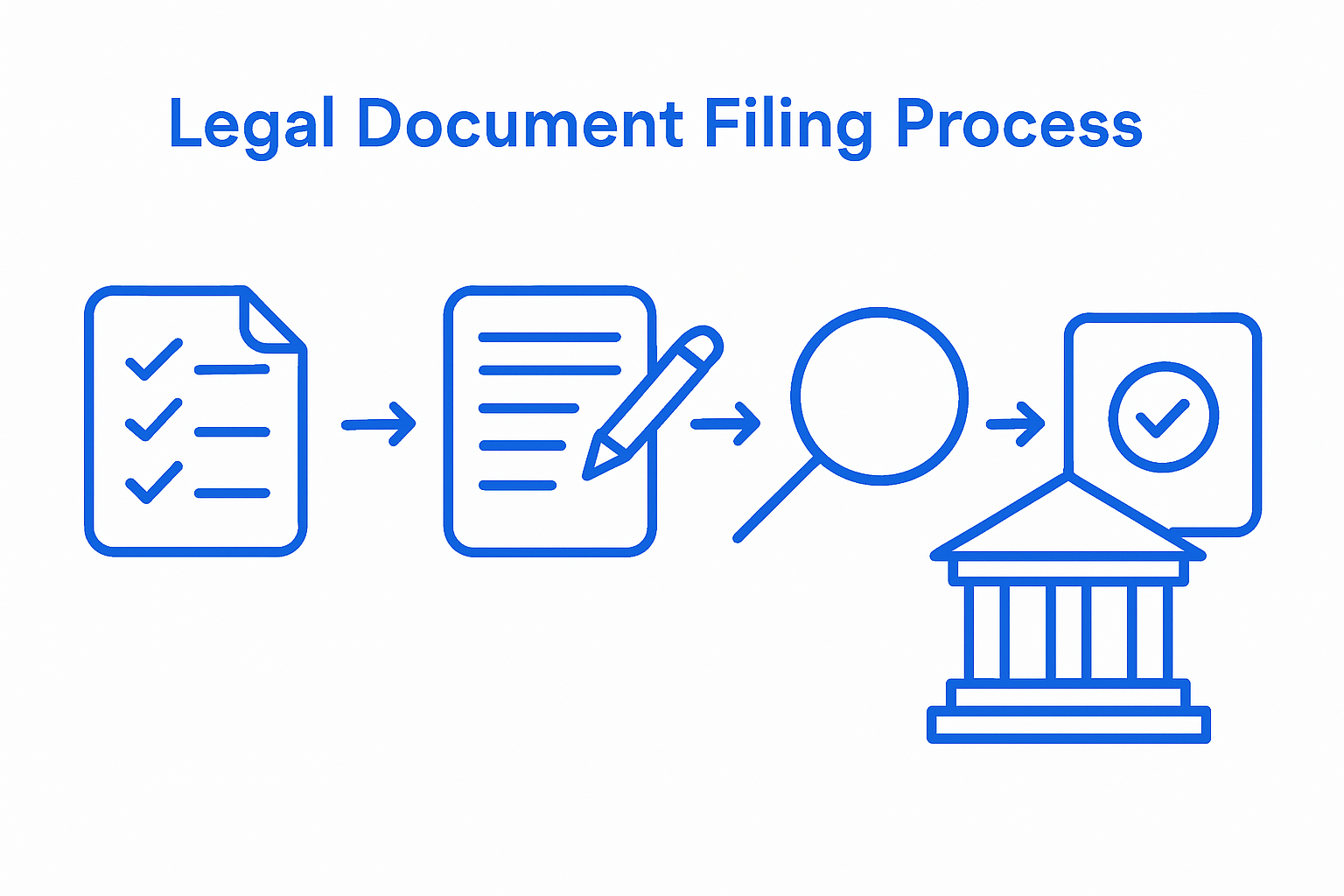
Step 5: Confirm Acceptance and Track Filing Status

Confirming your legal document submission and tracking its progress is a critical final step in ensuring your legal process moves forward smoothly. Understanding how to monitor your filing helps you stay informed and proactively manage your legal proceedings.

Accessing court electronic records provides an efficient way to track the status of your submitted documents. Most courts offer online tracking systems where you can enter your case number or filing details to check current processing stages. Request a confirmation receipt or tracking number when you submit your documents and keep this information readily available for future reference.

Infographic of court filing steps process

Different courts and agencies have varying tracking protocols. Some jurisdictions provide real time online status updates while others require direct communication with the clerk’s office. Maintain a detailed record of your submission including the exact date of filing method used and any reference numbers provided. Follow up promptly if you do not receive confirmation within the expected timeframe. Creating a systematic approach to tracking your legal documents ensures you remain informed and can quickly address any potential issues or requests for additional information.

Filing legal forms accurately and on time can be overwhelming with all the details to track like proper signatures, form formatting, and meeting exact court requirements. This article highlights the importance of gathering the right paperwork, reviewing forms carefully, and submitting to the correct court or agency to prevent delays and compliance issues. Many readers feel stressed managing these tasks alone and seek reliable, efficient solutions to ensure their filings are accepted without unnecessary complications.

At YM Doc Services we understand these challenges and offer professional support in court filings, process serving, and document retrieval to help you focus on what matters most. Our team ensures your documents meet legal standards and are delivered promptly so you avoid common pitfalls that cause rejected filings. Whether you are a lawyer, business, or individual, rely on our trusted services designed to reduce your stress and improve your legal process outcomes.

https://ymdocservices.com

Take control of your legal filings today by partnering with YM Doc Services. Visit our website to learn how we can help you manage document delivery, process serving, and court filing tasks efficiently. Don’t wait until deadlines approach or errors appear. Contact us now to streamline your legal document management and secure your compliance success.

Frequently Asked Questions

You need identification documents, financial records, relevant contracts, and any prior correspondence related to your case. Start by creating a detailed checklist to ensure you have all necessary paperwork before proceeding with your filing.

To complete your legal forms accurately, read each instruction carefully and fill out every section methodically. Use clear handwriting or typed text and verify all names, dates, and numerical data for accuracy before submission.

If you find an error in your legal documents, carefully review the relevant section and make the necessary corrections. Double-check your changes to ensure everything is accurate before submitting the forms to avoid any delays in your legal proceedings.

To submit your legal forms, verify the correct location based on your jurisdiction and case type. Prepare the necessary copies and check the specific submission methods—whether by mail, in person, or online—to ensure proper filing and minimal delays.

You can confirm the acceptance of your legal forms by tracking your filing status through the court’s online system or by contacting the court clerk directly. Make sure to keep your submission receipt or tracking number handy to facilitate this process.

What steps should I take if I do not receive confirmation of my filing?

If you do not receive confirmation of your filing, promptly follow up with the court clerk’s office to inquire about the status. Keeping a record of your submission date and method will help streamline this process and address any potential issues quickly.

Posted in Uncategorized

Role of Legal Documents in U.S. Immigration Cases

Most American immigration applicants are surprised to learn that even a small mistake on legal documents can lead to setbacks or denials. Precise paperwork forms the backbone of every American immigration case, affecting everything from initial entry to permanent residency. By understanding what each key document means and why accuracy matters, you gain the tools to protect your status and avoid costly errors on your immigration journey.

Table of Contents

Key Takeaways

Point Details
Importance of Legal Documents Legal documents are essential for validating identity and immigration status, influencing residency and citizenship opportunities.
Types of Immigration Documents Key document types include visas, green cards, and naturalization certificates, each serving distinct legal purposes.
Consequences of Errors Inaccurate or incomplete documentation can lead to application denials or serious legal repercussions, emphasizing the need for precision.
Best Practices for Document Management A systematic approach to preparing and reviewing immigration documents aids in minimizing errors and enhancing submission success.

Legal documents serve as the critical foundation for navigating the complex landscape of U.S. immigration processes. These critical paperwork artifacts are official records that validate an individual’s identity, legal status, and eligibility for entry, residence, or citizenship. Understanding the nuanced roles of immigration legal documents requires careful examination of their specific purposes and legal implications.

Immigration legal documents typically encompass several key categories that are essential for demonstrating an individual’s legal standing. These include passport documents, visa applications, naturalization certificates, green cards, and immigration petitions. Each document serves a unique function within the broader immigration framework. For instance, a passport establishes international identity, while a green card confirms permanent resident status in the United States.

The procedural significance of these documents cannot be overstated. Immigration authorities meticulously review each submitted document to verify authenticity, track an individual’s legal journey, and make critical decisions about residency, work permissions, and potential pathways to citizenship. Comprehensive immigration law resources emphasize that even minor discrepancies in these legal documents can significantly impact an individual’s immigration status and potential future opportunities in the United States.

Essential Immigration Document Types and Purposes

Immigration documents are complex legal instruments that authorize an individual’s entry, stay, and potential transition within the United States. Comprehensive immigration document classifications reveal a nuanced framework of documentation essential for legal movement and status verification. These documents serve as critical evidence of an individual’s legal rights, permissions, and ongoing immigration journey.

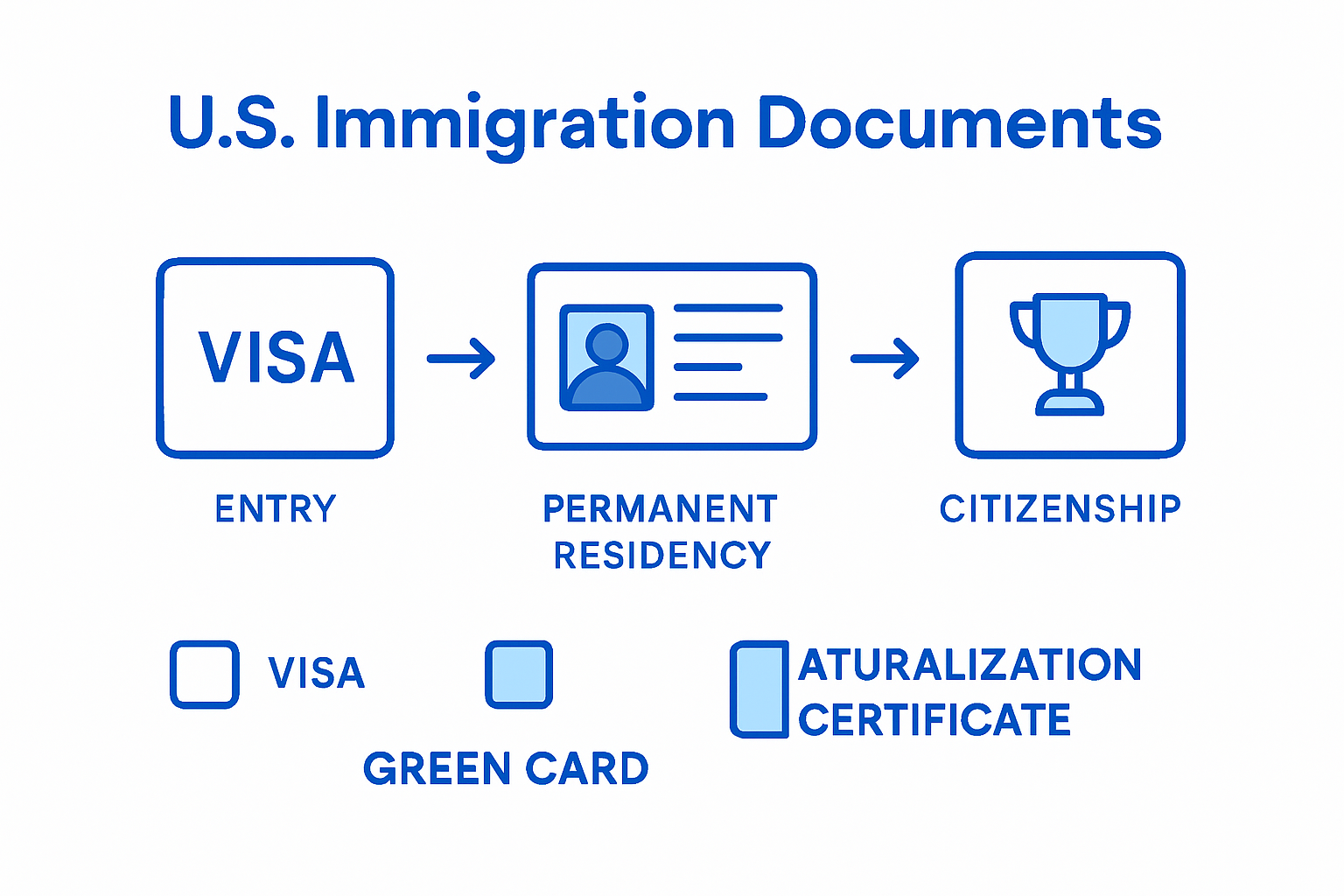
Infographic comparing visa, green card, citizenship

The primary types of immigration documents include nonimmigrant visas, immigrant visas, work permits, green cards, and naturalization certificates. Each document type carries specific legal implications and requirements. Nonimmigrant visas, for instance, permit temporary entry for purposes like tourism, business, study, or temporary work. Immigrant visas represent the first step toward permanent residency, granting individuals the ability to live and work permanently in the United States.

Applicant holds green card documents nervously

Understanding the precise legal requirements and potential pathways is crucial. Detailed immigration law resources emphasize that these documents are not merely administrative paperwork but legal contracts that define an individual’s rights, responsibilities, and potential future in the country. Work permits authorize specific employment opportunities, while green cards represent a significant milestone toward potential citizenship, offering more comprehensive legal protections and opportunities for long-term settlement.

Navigation of these documents requires meticulous attention to detail. Legal document preparation guides recommend comprehensive documentation, accurate information submission, and understanding the specific requirements associated with each document type. Applicants must carefully track expiration dates, renewal processes, and potential transitions between different immigration statuses to maintain legal compliance and protect their rights throughout their immigration journey.

Comprehensive immigration document filing protocols represent a complex legal landscape that demands meticulous attention to detail and strict procedural compliance. The U.S. immigration system requires applicants to navigate an intricate web of documentation, each form and submission carrying significant legal weight and potential consequences for an individual’s immigration status. These filing standards are designed to ensure thorough verification of an applicant’s background, intentions, and eligibility for various immigration pathways.

The core legal requirements encompass several critical components. Accuracy stands as the paramount consideration, with even minor errors potentially resulting in application rejection or significant processing delays. Applicants must provide comprehensive supporting documentation, including but not limited to birth certificates, passport copies, employment records, educational transcripts, and verified identification documents. Each submission must be accompanied by precisely completed forms, translated into English if originally in another language, and authenticated through official channels.

Timelines and deadlines represent another crucial aspect of immigration filing standards. Detailed immigration law resources emphasize the critical nature of adhering to strict submission windows and renewal periods. Immigration authorities maintain rigorous tracking of application timelines, with specific windows for initial submissions, response periods, and potential appeals. Applicants must carefully monitor expiration dates, understand complex processing times, and proactively manage their documentation to maintain legal status.

The complexity of these filing standards often necessitates professional guidance. Legal document preparation guides recommend thorough preparation, including comprehensive document checklists, careful translation services, and potentially engaging immigration attorneys to navigate the most challenging aspects of the filing process. Understanding these intricate requirements is not merely a bureaucratic exercise but a critical pathway to protecting one’s legal rights and potential future opportunities within the United States.

Consequences of Incomplete or Incorrect Documents

Comprehensive analysis of immigration document errors reveals profound legal implications for applicants who submit incomplete or inaccurate documentation. The U.S. immigration system operates with zero tolerance for substantive mistakes, where even seemingly minor discrepancies can trigger significant negative consequences. These repercussions extend far beyond simple application rejection, potentially impacting an individual’s entire immigration trajectory and future legal standing.

The most immediate consequences typically involve application processing delays and potential outright denials. Immigration authorities meticulously scrutinize every submitted document, with even minor inconsistencies potentially triggering comprehensive reviews or automatic disqualification. Common errors such as incorrect personal information, missing supporting documentation, or improperly translated materials can result in immediate application rejection. In more severe cases, applicants might face extended waiting periods, additional screening, or mandatory resubmission with potential financial penalties.

Detailed immigration law resources highlight more serious long-term consequences that can dramatically impact an individual’s immigration prospects. Repeated documentation errors or intentional misrepresentation can lead to legal accusations of fraud, potentially resulting in temporary or permanent immigration bans. Some applicants might find themselves subject to exclusion proceedings, loss of current visa status, or even potential criminal charges for substantial misrepresentations.

Professional guidance becomes critical in navigating these complex legal requirements. Legal documentation tips recommend comprehensive document verification, multiple independent reviews, and potentially engaging immigration specialists to minimize the risk of critical errors. The stakes are extraordinarily high, with documentation mistakes potentially representing the difference between successful immigration and complete legal disqualification. Applicants must approach their documentation with the utmost precision, understanding that each submitted document represents a crucial piece of their legal narrative.

Best Practices for Handling Immigration Documents

Strategic management of immigration document preparation requires a systematic and meticulous approach that minimizes potential errors and maximizes the likelihood of successful processing. Successful applicants understand that immigration documentation is not merely a bureaucratic exercise but a complex legal journey demanding precision, organization, and comprehensive attention to detail. Every document represents a critical piece of an individual’s legal narrative, requiring careful handling and strategic preparation.

The foundational best practices begin with comprehensive documentation preparation. This involves gathering all necessary supporting materials well in advance of submission deadlines, including birth certificates, educational transcripts, employment records, passport copies, and any additional evidence specific to the immigration category. Applicants must ensure all documents are current, legally translated if necessary, and authenticated through official channels. Creating multiple backup copies and maintaining a comprehensive digital and physical record-keeping system becomes essential for tracking and potential future reference.

Detailed immigration document management strategies emphasize the importance of professional review and consultation. Immigration laws and requirements constantly evolve, making expert guidance crucial in navigating complex legal landscapes. Professional immigration attorneys or specialized document preparation services can provide invaluable insights, helping applicants identify potential weaknesses in their documentation, ensure compliance with current regulations, and anticipate potential challenges before submission.

Additional critical best practices include consistent document organization, thorough proofreading, and strategic timeline management. Legal paperwork preparation guides recommend creating a comprehensive checklist, maintaining a chronological record of all submissions, and establishing a systematic approach to tracking application progress. Applicants should develop a proactive mindset, anticipating potential requests for additional information and maintaining open communication channels with immigration authorities. The key is treating immigration documentation as a professional, methodical process that requires patience, precision, and unwavering attention to detail.

Navigating the complexities of U.S. immigration legal documents requires absolute precision, from accurate form submissions to timely filings. The article highlights common challenges such as handling detailed paperwork, avoiding costly errors, and meeting strict deadlines that can affect your legal standing. At YM Doc Services, we understand how critical these documents are for your immigration journey and offer reliable solutions that reduce stress and ensure compliance with legal standards.

https://ymdocservices.com

Don’t let incomplete or incorrect paperwork delay your immigration goals. Our professional legal document services include process serving, document retrieval, and court filings designed to keep your applications on track. Take control of your immigration process today by visiting YM Doc Services to streamline your documentation and meet every deadline with confidence. Learn how our support can make your legal paperwork simpler and more efficient at YM Doc Services. Act now to protect your future in the United States.

Frequently Asked Questions

The main types of legal documents required include nonimmigrant visas, immigrant visas, work permits, green cards, and naturalization certificates, each serving different purposes in the immigration process.

Why is accuracy crucial when submitting immigration documents?

Accuracy is vital as even minor errors can lead to application rejections, processing delays, or even legal consequences. Each document must be precisely completed to ensure compliance with U.S. immigration laws.

What are the consequences of submitting incomplete immigration documents?

Submitting incomplete documents can lead to significant issues, including application denials, extended waiting periods, and potential legal challenges, including accusations of fraud in case of repeated mistakes.

How can I best prepare my immigration documents for submission?

Best practices include comprehensive preparation by gathering all necessary documentation early, ensuring accurate translations and authentication, and consulting with immigration attorneys for professional guidance.

Posted in Uncategorized

7 Essential Document Notarization Tips for Legal Success

Over 50 percent of American adults will need to have a document notarized at some point in their lives. With so many types of paperwork and varying state guidelines, understanding exactly what to bring to a notary is essential. Whether you are buying property, signing legal forms, or handling financial matters, knowing these notarization basics can prevent costly mistakes and speed up your important transactions.

Table of Contents

Quick Summary

Takeaway Explanation
1. Determine needed notarization documents Identify specific legal and financial documents that require notarization to protect your interests effectively.
2. Verify identification requirements beforehand Bring multiple acceptable forms of government-issued ID to ensure smooth notarization and prevent issues.
3. Prepare all necessary documents in advance Gather original documents, ID, and payment to streamline the notarization process and avoid delays.
4. Avoid common signing mistakes Prevent errors by ensuring all documents are filled correctly and signed in compliance with requirements.
5. Confirm notary’s credentials Always verify the notary’s commission and identification to ensure legality and avoid fraudulent practices.

1. Understand What Documents Need Notarization

Notarization serves as a critical legal verification process that transforms ordinary documents into legally recognized instruments. While many assume notarization applies universally, understanding which specific documents require official authentication is crucial for protecting your legal interests.

Most legal and financial documents benefit from notarization, including real estate transactions, power of attorney forms, property deeds, loan agreements, and affidavits. These documents require an official seal to validate their authenticity and prevent potential fraud. Notarization requirements can vary significantly depending on the specific document and jurisdiction.

Special attention is needed with certain documents. Vital records like birth, marriage, and death certificates cannot be notarized directly. For these documents, individuals must contact the originating government agency to obtain certified copies. This distinction is critical to prevent legal complications.

When determining whether a document needs notarization, consider these key factors:

  • Legal significance of the document
  • Potential financial implications
  • Requirements specific to your state or transaction type
  • Potential future use of the document in legal proceedings

Practical tip: When in doubt about a document’s notarization requirements, consult a professional notary or legal advisor who can provide specific guidance tailored to your unique situation.

2. Verify Identity Requirements Before Your Appointment

Notarization demands rigorous identity verification, serving as a critical safeguard against potential fraud and legal complications. Understanding the specific identification requirements can save you time, prevent document rejection, and ensure a smooth notarization process.

Acceptable government issued identification must meet specific criteria. When preparing for a notarization appointment, you need valid documents that clearly establish your identity. Notary services require precise identification standards to protect both the signer and the document’s legal integrity.

Primary acceptable forms of identification include:

  • U.S. passports
  • Military identification cards
  • Permanent resident cards
  • Current foreign passports
  • Valid state drivers licenses

Key identification requirements include:

  • Must contain a clear photograph
  • Include a physical description
  • Bear the bearer’s signature
  • Be currently valid and unexpired
  • Issued by an official government agency

Critical documents to avoid bringing include Social Security cards, birth certificates, student IDs, and credit cards. These documents lack the necessary authentication elements required for notarization.

Pro tip: Call ahead to confirm specific identification requirements, as some states allow notaries discretion in determining acceptable forms of ID. Always bring multiple forms of government issued photo identification to ensure a successful notarization process.

3. Prepare All Supporting Documents in Advance

Successful document notarization hinges on meticulous preparation, transforming a potentially stressful process into a smooth transaction. Gathering and organizing your documents before your appointment can significantly streamline the notarization experience and prevent unexpected delays.

Legal document preparation requires strategic planning to ensure every detail meets official requirements. Critical components to assemble in advance include:

  • Original documents (never photocopies)
  • Valid government issued photo identification
  • Any additional signers who must be present
  • Proof of payment for notarial services

Comprehensive document preparation involves several key steps:

  • Ensure all documents are completely filled out
  • Verify no blank spaces remain
  • Check that all required signatures are in place
  • Confirm document pages are correctly numbered and attached

Before your appointment, discuss potential additional fees such as mobile notary travel expenses. Some notaries charge extra for special services or travel, so confirming these details in advance prevents unexpected financial surprises.

Pro tip: Create a checklist of required documents and review it carefully before leaving home. This simple step can save you time, reduce stress, and ensure a successful notarization process.

4. Avoid Common Signing Mistakes and Omissions

Document signing requires precision and attention to detail, as even minor errors can invalidate legal documents and create significant complications. Understanding and preventing common signing mistakes is crucial for ensuring the legal integrity of your important paperwork.

Notaries play a critical role in validating document signatures, carefully checking for potential errors and omissions. Most frequent signing mistakes include:

  • Signing outside designated signature lines
  • Using pencil instead of permanent ink
  • Leaving sections of documents incomplete
  • Failing to initial document pages
  • Signing with an inconsistent or unclear signature

Signature best practices involve:

  • Using blue or black permanent ink
  • Signing exactly as your name appears on identification
  • Reading the entire document before signing
  • Verifying all required fields are completed
  • Ensuring witnesses are present when required

Pay special attention to document details. Notaries cannot notarize incomplete documents, so carefully review every page and section before your appointment. If you discover errors, request a new document rather than attempting to cross out or modify existing text.

Pro tip: Create a personal checklist of signing requirements and review it methodically before each important document signing to minimize potential errors and legal complications.

5. Confirm the Notary’s Commission and Credentials

Notary credentials are your first line of defense against potential legal complications, serving as a critical safeguard in document authentication. Understanding how to verify a notary’s legitimacy can protect you from fraudulent practices and ensure the legal validity of your important documents.

Notaries play a crucial role in legal document verification, and confirming their credentials is an essential step in the process. Key elements to verify include:

  • Current state commission status
  • Valid government issued identification
  • Official notary seal and registration number
  • Active commission expiration date
  • Professional credentials and training

Warning signs of potentially fraudulent notary practices:

  • Offering legal advice beyond notarial duties
  • Translating their official title into foreign languages
  • Unwillingness to show official commission documentation
  • Inconsistent or expired credentials
  • Lack of professional documentation

When verifying a notary’s credentials, request to see their official commission certificate and government identification. Most states maintain online databases where you can confirm a notary’s current status and validate their professional standing.

Pro tip: Trust your instincts. If something feels wrong or a notary seems hesitant to provide verification of their credentials, seek an alternative professional who can confidently demonstrate their legal authorization to perform notarial services.

6. Choose the Right Notarization Type for Each Document

Navigating the complex world of document notarization requires understanding the subtle yet critical differences between various notarization types. Each document demands a specific notarial act that validates its legal standing and authenticity.

Notarization processes involve specific legal verification methods that protect both signers and document integrity. Three primary notarization types exist:

  • Acknowledgments: Confirming voluntary document signing
  • Jurats: Swearing to the document’s truthful contents
  • Copy Certifications: Verifying exact document reproduction

Selecting the appropriate notarization type depends on:

  • Document purpose and legal requirements
  • Specific transaction or legal context
  • Intended use of the document
  • Jurisdictional regulations

Acknowledgments work best for documents like property transfers and power of attorney forms where the signer confirms their voluntary signature. Jurats are ideal for affidavits and sworn statements requiring the signer to affirm document contents under oath.

Warning: Notaries cannot recommend specific notarization types unless they are licensed attorneys. Always consult legal professionals to determine the most appropriate notarial act for your specific document.

Pro tip: Carefully review your document’s purpose and consult with a legal professional to ensure you select the correct notarization type that meets all legal requirements and protects your interests.

7. Keep Secure Records of Notarized Documents

Document record keeping represents a critical legal safeguard that protects your interests long after the initial notarization process. Maintaining comprehensive and secure documentation ensures you have verifiable proof of important legal transactions.

Legal document certification requires meticulous record management to protect against potential future disputes. Essential record keeping practices include:

  • Storing original notarized documents in secure locations
  • Creating digital and physical backup copies
  • Documenting identification verification methods
  • Tracking dates of notarization
  • Maintaining a chronological filing system

Recommended secure storage strategies:

  • Use fireproof and waterproof document safes
  • Create encrypted digital backups
  • Store copies in separate physical locations
  • Use acid free archival storage materials
  • Consider professional document storage services

Notaries typically maintain a journal documenting key details about each notarization, carefully following state regulations regarding personal information protection. Some jurisdictions mandate specific record keeping protocols to ensure legal compliance.

Pro tip: Develop a systematic approach to document preservation that includes both physical and digital storage methods. Consider creating a comprehensive document tracking system that allows quick retrieval and verification of important legal paperwork.

Below is a comprehensive table summarizing the key points regarding document notarization processes, requirements, and practices discussed throughout the article.

Topic Description Key Considerations
Documents Needing Notarization Legal and financial documents like real estate transactions, power of attorney forms, etc., require notarization. Check for state or jurisdiction-specific requirements.
Identity Verification Notarization requires valid government-issued ID such as U.S. passports and state drivers licenses. Confirm ID requirements beforehand and bring multiple forms of ID.
Document Preparation Assemble original documents, valid ID, and proof of payment in advance. Verify all required fields are completed to prevent delays.
Common Signing Mistakes Avoid signing outside lines, using pencil, or leaving sections incomplete. Use permanent ink and ensure witnesses are present if required.
Notary Credential Verification Verify notary’s commission status and credentials, such as seal and ID. Look out for warning signs of fraud.
Notarization Types Includes acknowledgments, jurats, and copy certifications. Consult legal professionals for correct type.
Record Keeping Maintain secure physical and digital copies of notarized documents. Use fireproof safes and consider professional storage services.

Navigating the complexities of notarization requires precision, trust, and reliability. The article “7 Essential Document Notarization Tips for Legal Success” highlights common challenges like verifying notary credentials, preparing documents properly, and understanding different notarization types. These crucial steps demand a service provider who understands these nuances and offers seamless support to prevent costly mistakes or delays.

YM Doc Services is dedicated to relieving the stress of legal document management by providing professional process serving, court filings, and administrative assistance tailored to your notarization needs. Whether you need help with document retrieval, identification verification, or ensuring compliance with legal standards our team is here to help you avoid common pitfalls detailed in the article. Discover how our efficient solutions complement important practices such as identity verification and secure recordkeeping by exploring our landing page.

https://ymdocservices.com

Take control of your legal document process today by partnering with a trusted service designed to reduce errors and meet tight deadlines. Visit YM Doc Services now to start streamlining your notarization and document management needs with expert support you can rely on.

Frequently Asked Questions

What types of documents require notarization?

Notarization is necessary for legal and financial documents like real estate transactions, power of attorney forms, and loan agreements. To ensure your documents are properly verified, identify which of your documents fall into these categories.

How can I prepare for my notarization appointment?

To prepare, gather all original documents, valid photo identification, and ensure additional signers are present if required. Create a checklist of what to bring to your appointment to ensure a smooth process.

What identification do I need to bring to notarization?

You must bring a government-issued photo identification that includes your name, signature, and physical description. Valid options include a U.S. passport or a driver’s license; aim to have at least two forms of ID ready.

How can I avoid common signing mistakes during notarization?

To avoid mistakes, ensure that you sign within the designated spaces and use permanent ink. Review the entire document for completeness and accuracy before signing, as even small errors can invalidate the documents.

Why is it important to verify a notary’s credentials?

Verifying a notary’s credentials protects you from potential legal issues and ensures they are authorized to perform notarizations. Always ask to see their commission certificate to confirm their legitimacy.

What should I do with notarized documents after my appointment?

After notarization, securely store your original documents in a safe location and consider creating digital backups. This will help protect your important paperwork and provide easy access in case of future disputes.

Posted in Uncategorized

Essentials of Legal Document Management: Streamlining Compliance

Over eighty percent of American legal professionals say digital security is their top document management concern. As legal practices handle sensitive contracts, court filings, and personal information, efficient management is crucial for protecting clients and staying compliant with regulations. This guide will clarify essential strategies, highlight practical tools, and explain the processes that help American firms keep documents secure and organized every step of the way.

Table of Contents

Key Takeaways

Point Details
Effective Legal Document Management Legal document management involves systematic organization, tracking, and protection of legal documents, ensuring compliance and security.
Types of Legal Documents Understanding the different types of legal documents and their functions is crucial for navigating legal landscapes effectively.
Core Processes in Management Key processes include document capture, secure storage, version control, and compliance tracking to enhance operational efficiency.
Risk Mitigation Practices Implementing robust security measures, including encryption and access controls, is essential to protect sensitive information in legal document management.

Legal document management represents a strategic approach to organizing, tracking, and protecting critical legal paperwork across professional environments. At its core, this practice involves systematically capturing, storing, and retrieving documents while maintaining strict compliance and security protocols. Legal technology essentials provide the foundational framework for transforming traditional paper-based processes into streamlined digital workflows.

The essential components of effective legal document management include comprehensive digital storage systems, robust security mechanisms, version control protocols, and advanced search capabilities. Professionals need solutions that not only store documents securely but also enable rapid retrieval, facilitate collaboration, and maintain an auditable trail of document interactions. These systems must accommodate various document types – from contracts and agreements to correspondence and legal research materials – while ensuring absolute confidentiality and regulatory compliance.

Successful document management strategies typically incorporate several key technologies and practices. These often include:

  • Cloud-based storage with encrypted access
  • Automated metadata tagging
  • Granular user permission controls
  • Real-time document tracking
  • Integrated compliance monitoring systems

Implementing such comprehensive law firm management approaches transforms legal administrative processes from potential bottlenecks into efficient, transparent workflows. By centralizing document management, legal professionals can dramatically reduce time spent on administrative tasks, minimize errors, and focus more energy on core legal strategy and client service.

Legal documents serve critical functions across personal, business, and professional contexts, each designed to establish clear rights, obligations, and protections. Legal drafting principles emphasize the importance of precision, clarity, and comprehensive language when creating these essential instruments. Understanding the various types of legal documents helps individuals and organizations navigate complex legal landscapes effectively.

Paralegal organizing various legal paperwork

The most common legal documents can be categorized into several key classifications. Transactional documents include contracts, agreements, and corporate formation papers that define relationships and terms between parties. Protective documents encompass wills, trusts, powers of attorney, and other instruments that safeguard individual rights and manage future personal or financial contingencies. Litigation-related documents such as court filings, pleadings, depositions, and settlement agreements play crucial roles in legal proceedings and dispute resolution.

Each legal document type requires specific attention to detail and specialized knowledge. Some primary examples include:

  • Contracts: Binding agreements defining terms of business or personal transactions
  • Employment documents: Offer letters, employment agreements, non-disclosure agreements
  • Real estate documents: Property deeds, lease agreements, mortgage documents
  • Financial instruments: Promissory notes, loan agreements, investment contracts
  • Personal planning documents: Living wills, healthcare directives, guardianship papers

Navigating legal document management requires understanding these document types and their unique purposes. Professionals must carefully draft, review, and maintain these critical records to ensure legal compliance, protect stakeholder interests, and provide clear documentation of rights and responsibilities.

Legal document management represents a complex ecosystem of interconnected processes designed to optimize information handling, compliance, and organizational efficiency. Practice management systems provide critical infrastructure for transforming traditional document handling into strategic, technology-enabled workflows. Understanding these key processes allows legal professionals to streamline operations, reduce risks, and enhance overall productivity.

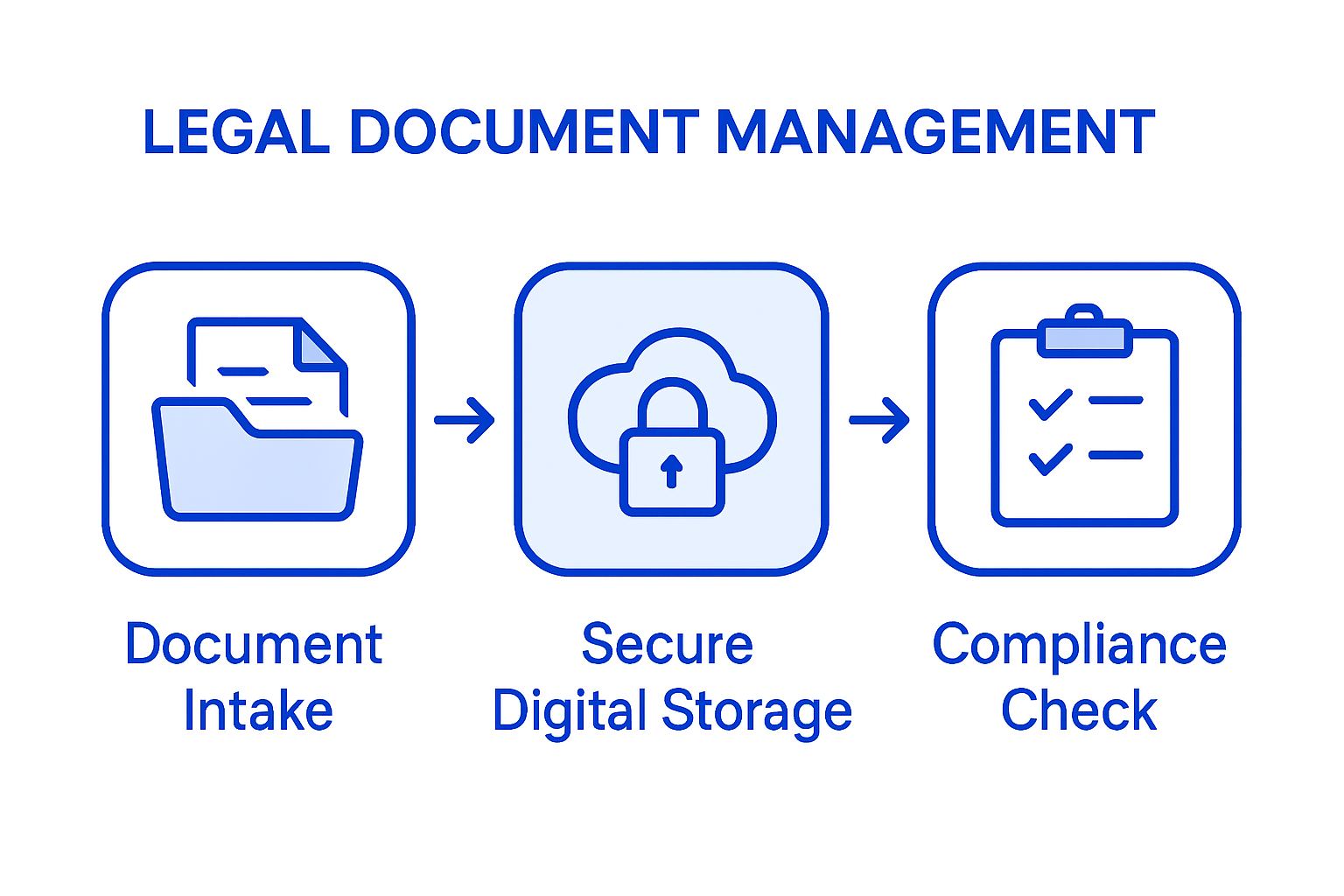
The core processes in legal document management typically encompass several critical stages. Document capture involves systematically collecting and digitizing physical and electronic documents, ensuring accurate metadata tagging and proper classification. Storage and retrieval processes focus on creating secure, organized digital repositories with advanced search capabilities that enable rapid access to critical information. Version control mechanisms track document modifications, maintaining comprehensive audit trails and preventing potential conflicts or unauthorized changes.

Key strategic processes in legal document management include:

  • Intake and classification: Systematically categorizing incoming documents
  • Digital preservation: Ensuring long-term document integrity and accessibility
  • Access management: Implementing granular user permissions and security protocols
  • Compliance tracking: Monitoring document lifecycles and regulatory requirements
  • Automated workflow routing: Streamlining document approvals and review processes

Law firm management essentials underscore the importance of integrating these processes into a cohesive system. Successful implementation requires technological solutions that adapt to evolving legal landscapes, providing robust security, seamless collaboration, and comprehensive document lifecycle management. Professionals who master these processes can significantly enhance their operational efficiency and strategic capabilities.

Infographic illustrating steps in legal document management

Legal compliance represents a complex framework of regulatory obligations that businesses and organizations must navigate carefully. Guidelines for staying legally compliant provide critical insights into the multifaceted requirements that govern business operations across various sectors. Understanding these requirements is essential for mitigating legal risks and maintaining ethical business practices.

The United States legal compliance landscape encompasses multiple layers of regulatory oversight. Federal regulations mandate specific requirements across different domains, including labor standards, financial reporting, data protection, and industry-specific guidelines. State-level compliance introduces additional complexity, with varying regulations that can differ significantly from federal mandates. Key areas of focus include employment practices, tax reporting, licensing requirements, and sector-specific regulatory frameworks.

Critical components of legal compliance in the United States include:

  • Federal and state registration requirements
  • Employment law adherence
  • Tax and financial reporting obligations
  • Industry-specific regulatory standards
  • Data privacy and protection protocols
  • Workplace safety regulations
  • Intellectual property protection

Labor law compliance standards underscore the importance of proactive regulatory management. Organizations must develop comprehensive compliance strategies that include regular audits, staff training, and robust documentation processes. Successful compliance requires a dynamic approach that anticipates regulatory changes, implements preventative measures, and maintains transparent reporting mechanisms.

Risk Mitigation and Security Best Practices

Document security represents a critical cornerstone of legal information management, demanding comprehensive strategies to protect sensitive information from potential threats. Legal technology essentials provide sophisticated frameworks for implementing robust security protocols that safeguard confidential data across digital and physical environments. Understanding and implementing these practices is fundamental to maintaining client trust and organizational integrity.

Risk mitigation in legal document management requires a multifaceted approach that addresses technological, procedural, and human factors. Technological safeguards include advanced encryption methods, secure cloud storage solutions, and multi-factor authentication systems. Procedural controls involve establishing strict access protocols, implementing comprehensive audit trails, and developing clear guidelines for document handling and information sharing. Human factor management focuses on training staff in cybersecurity awareness, creating a culture of security consciousness, and establishing clear accountability mechanisms.

Key risk mitigation and security strategies include:

  • Encryption for data at rest and in transit
  • Access control with granular user permissions
  • Regular security audits and vulnerability assessments
  • Comprehensive backup and disaster recovery planning
  • Continuous staff training and awareness programs
  • Secure document destruction protocols
  • Multi-factor authentication systems

Law firm management best practices emphasize the importance of creating a holistic security approach. Organizations must develop adaptive security frameworks that evolve with emerging technological threats, balancing robust protection with operational efficiency. Successful risk mitigation requires ongoing commitment, continuous education, and proactive technological investments.

Managing critical legal documents can be overwhelming with the need for secure storage, precise compliance, and timely processing. The article highlights challenges like ensuring legal compliance, maintaining document security, and reducing administrative bottlenecks. If you are seeking reliable support to meet these demands, YM Doc Services specializes in efficient process serving, document retrieval, and court filings that align with the essentials of legal document management discussed.

https://ymdocservices.com

Experience peace of mind by partnering with a professional service that values timeliness, reliability, and strict adherence to legal standards. Visit YM Doc Services today to simplify your workflow, reduce risks, and focus on what matters most. Learn more about how our comprehensive legal document solutions support law firm management essentials and legal technology essentials to elevate your practice. Take the next step toward hassle-free legal document handling now.

Frequently Asked Questions

Effective legal document management includes comprehensive digital storage systems, robust security mechanisms, version control protocols, and advanced search capabilities to ensure efficient organization and retrieval of documents.

Legal professionals can ensure compliance by implementing systems that accommodate various document types, maintain an auditable trail of interactions, and incorporate compliance tracking and monitoring systems.

Common types of legal documents include contracts, wills, deeds, and court filings, each requiring specific attention to detail and adherence to legal drafting principles.

Best practices for enhancing document security include using encryption for data, establishing strict access controls, conducting regular security audits, and providing ongoing staff training on cybersecurity awareness.

Posted in Uncategorized

Why Track Legal Documents – Safeguarding Compliance and Value

Most American law firms must handle tens of thousands of documents each year, yet over 60 percent report struggling with efficient tracking and management. The sheer volume and sensitivity of legal paperwork create a real risk of costly errors or missed deadlines. Understanding how legal document tracking works and adopting a systematic approach can help American professionals ensure every file is secure, traceable, and always within reach.

Table of Contents

Key Takeaways

Point Details
Importance of Legal Document Tracking Legal document tracking is essential for maintaining compliance, controlling document lifecycles, and managing deadlines effectively. It enhances operational efficiency and mitigates risks associated with legal processes.
Key Components of Tracking Systems Effective tracking systems incorporate digital archiving, version control, automated notifications, and secure access management to facilitate streamlined document management.
Risks of Inadequate Tracking Poor tracking can result in significant financial and reputational risks, including missed deadlines and legal penalties; implementing robust systems is crucial to mitigate these threats.
Proactive Compliance Strategies Establishing proactive tracking and compliance systems transforms legal responsibilities from reactive to systematic, minimizing risks and demonstrating organizational commitment to legal integrity.

Legal document tracking represents a systematic approach to monitoring, organizing, and managing critical legal documents throughout their lifecycle. At its core, this process involves comprehensive document management strategies designed to ensure accessibility, compliance, and strategic value for legal professionals and organizations. Computer-assisted legal research has significantly transformed how legal documents are tracked and managed in modern practice.

The fundamental purpose of legal document tracking extends beyond simple record-keeping. It encompasses a strategic framework that enables professionals to maintain precise control over documents, track their status, monitor critical deadlines, and ensure regulatory compliance. When implemented effectively, tracking systems provide real-time insights into document location, modification history, access permissions, and potential risks. Legal information retrieval technologies have made these advanced tracking capabilities more sophisticated and efficient than ever before.

Effective document tracking typically involves several key components. These include:

  • Digital archiving systems
  • Version control mechanisms
  • Automated notification protocols
  • Secure access management
  • Comprehensive audit trails

Professionals can leverage these tracking mechanisms to mitigate risks, streamline workflow processes, and maintain a structured approach to legal documentation. By integrating advanced legal document organization workflow techniques, organizations can transform document management from a mundane administrative task into a strategic operational advantage.

Types of Documents Requiring Tracking

Legal professionals encounter numerous document types that demand rigorous tracking and management. Court dockets and filings represent a critical category of legal documents that require meticulous monitoring. These documents, which include pleadings, motions, briefs, and case summaries, are essential for maintaining comprehensive legal records and understanding the progression of legal proceedings.

Paralegal reviewing legal files in records room

The spectrum of documents requiring systematic tracking is extensive and varies across different legal contexts. Contractual documents stand out as another pivotal category, encompassing employment agreements, service contracts, non-disclosure agreements, and corporate partnership documents. Legal department document management emphasizes the importance of tracking these documents to ensure compliance, manage obligations, and mitigate potential legal risks.

Key document types that necessitate robust tracking include:

  • Litigation documents
    • Court filings
    • Deposition transcripts
    • Legal correspondence
  • Contractual documents
    • Employment agreements
    • Service contracts
    • Intellectual property agreements
  • Regulatory compliance documents
    • Licensing paperwork
    • Certification records
    • Regulatory submissions

Professionals can streamline their legal document certification processes by implementing comprehensive tracking systems that provide real-time visibility, secure storage, and efficient retrieval mechanisms. These systems help organizations maintain accurate records, reduce administrative burdens, and ensure they meet critical legal and regulatory requirements.

How Document Tracking Systems Work

Document tracking systems represent sophisticated technological solutions designed to manage, monitor, and organize legal documents with precision and efficiency. Legal document management platforms operate through complex digital infrastructures that enable real-time document monitoring, status tracking, and comprehensive reporting capabilities.

The core functionality of these systems revolves around several critical technological components. Electronic document repositories serve as the central hub, providing secure storage and instant retrieval mechanisms. Document management modules integrate advanced features like version control, access permissions, and automated notification systems that alert legal professionals about critical updates, approaching deadlines, or required actions.

Key operational features of document tracking systems include:

  • Centralized digital storage
  • Automated version tracking
    • Timestamp recording
    • Change log maintenance
  • Permission-based access control
  • Real-time status monitoring
  • Comprehensive search capabilities
  • Advanced reporting tools

Professionals can leverage legal document retrieval process techniques to maximize the effectiveness of these tracking systems. By implementing robust digital infrastructure, organizations can transform document management from a complex administrative task into a streamlined, efficient workflow that reduces errors, enhances compliance, and provides unprecedented visibility into legal document lifecycles.

Legal compliance represents a critical dimension of organizational risk management, requiring meticulous attention to regulatory requirements and procedural timelines. Tracking and updating legal developments is fundamental to maintaining legal integrity and avoiding potential liabilities that could compromise an organization’s operational standing.

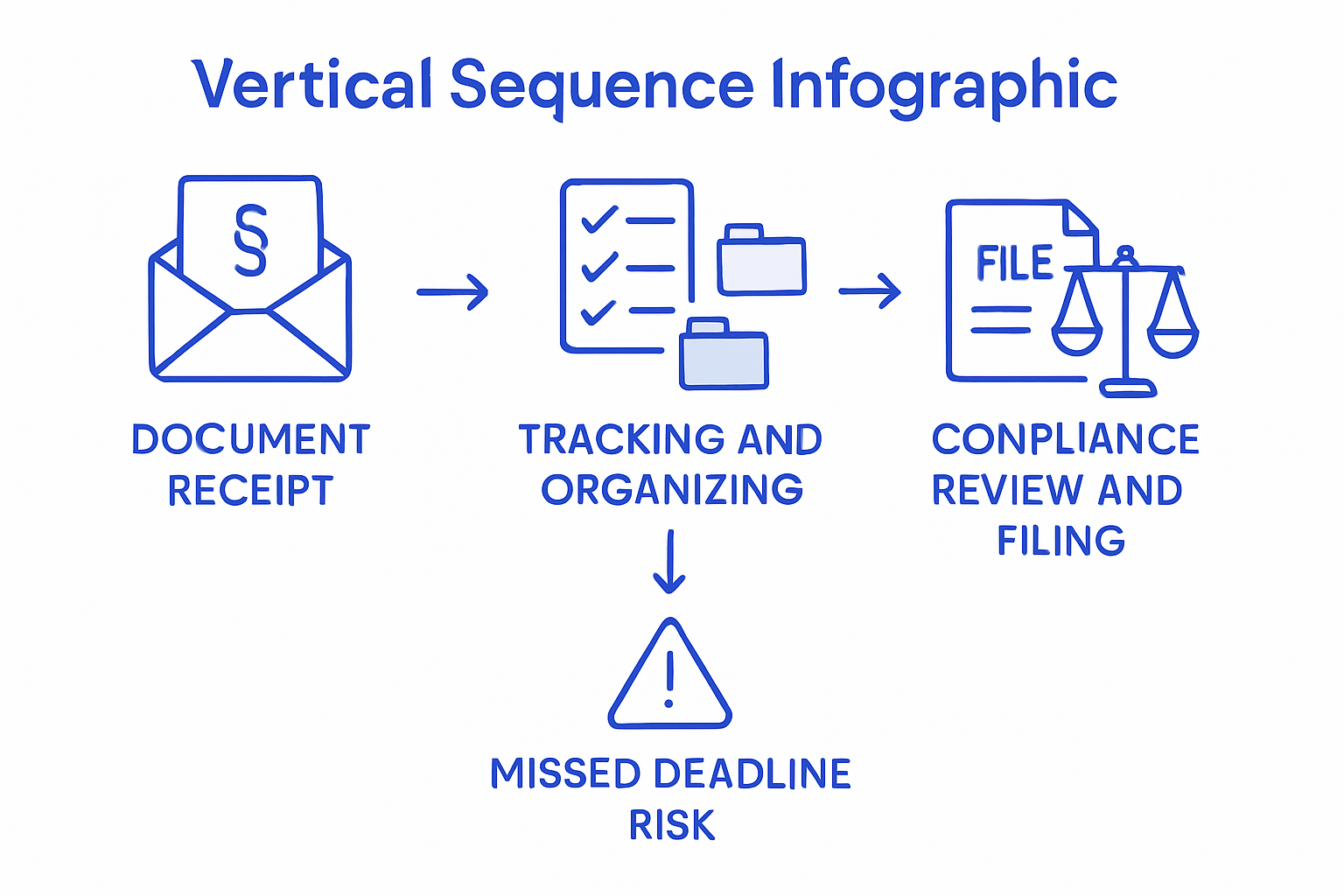
Infographic of legal document compliance steps

The legal responsibility framework demands comprehensive document management that goes beyond simple record-keeping. Organizations must establish robust systems that proactively monitor critical deadlines, ensure regulatory compliance, and maintain an auditable trail of all legal interactions. Missed deadlines can result in severe consequences, including legal penalties, contractual breaches, and potential litigation that could significantly impact an organization’s financial and reputational health.

Key compliance and deadline management strategies include:

  • Proactive deadline tracking
    • Automated reminder systems
    • Multi-stage alert protocols
  • Comprehensive documentation
    • Timestamped records
    • Detailed interaction logs
  • Regulatory monitoring
    • Ongoing legal landscape assessment
    • Continuous compliance updates
  • Risk mitigation protocols
    • Systematic review processes
    • Regular compliance audits

Professionals can leverage document filing protocols to create a comprehensive approach to legal responsibility. By implementing strategic tracking mechanisms, organizations can transform compliance from a reactive challenge into a proactive, structured approach that minimizes risks and demonstrates commitment to legal and ethical standards.

Risks of Poor Tracking and Best Practices

Network analytical frameworks reveal the profound risks associated with inadequate legal document tracking. Poor management can trigger cascading legal complications that extend far beyond simple administrative oversights, potentially exposing organizations to significant financial and reputational damage.

The document tracking landscape demands comprehensive strategies to mitigate potential risks. Advanced document retrieval techniques utilizing neural networks demonstrate how sophisticated tracking mechanisms can transform document management from a vulnerable process to a robust, proactive system. Critical risks of ineffective tracking include potential litigation, regulatory penalties, missed deadlines, and compromised legal standing.

Key risks and corresponding best practices include:

  • Documentation Integrity Risks
    • Incomplete record maintenance
    • Version control failures
    • Unauthorized document modifications
  • Compliance Vulnerability Risks
    • Missed regulatory updates
    • Inadequate deadline tracking
    • Inconsistent record preservation
  • Operational Exposure Risks
    • Information retrieval challenges
    • Increased legal vulnerability
    • Potential contract disputes

Professionals can leverage legal compliance process serving methodologies to develop comprehensive tracking protocols. By implementing systematic documentation strategies, organizations can transform potential risks into manageable, transparent legal workflows that protect their operational integrity and minimize potential legal exposures.

Tracking legal documents is essential to safeguard compliance and preserve the value of your legal operations. The article highlights challenges such as missed deadlines, regulatory risks, and the need for real-time monitoring to maintain document integrity and legal responsibility. These pain points can cause costly delays and threaten your organization’s reputation without reliable systems in place.

YM Doc Services understands these critical challenges and is here to streamline your legal document management. Our professional solutions in process serving, document retrieval, and court filings help you maintain compliance while reducing stress associated with tight legal deadlines. Trust us to provide timely and accurate service that supports your workflow with transparency and efficiency.

https://ymdocservices.com

Take control of your legal document processes today by partnering with YM Doc Services. Visit our website now to order services designed to protect your compliance and enhance operational confidence when managing vital legal documents.

Frequently Asked Questions

Legal document tracking is a systematic approach to monitoring, organizing, and managing legal documents throughout their lifecycle to ensure accessibility, compliance, and strategic value for legal professionals.

Tracking legal documents is crucial for maintaining precise control over document status, monitoring deadlines, and ensuring regulatory compliance, which helps mitigate risks and streamline workflow processes.

Key document types that require tracking include litigation documents (like court filings), contractual documents (such as employment agreements), and regulatory compliance documents (like licensing paperwork).

How do document tracking systems enhance compliance?

Document tracking systems enhance compliance by providing real-time monitoring of deadlines, maintaining comprehensive documentation with audit trails, and automating notification protocols to ensure adherence to regulatory requirements.

Posted in Uncategorized

Document Filing Protocols: Ensuring Legal Compliance

Most American law firms handle thousands of legal documents every year, yet even a single filing error can jeopardize an entire case. Staying organized is not just a formality for American legal professionals. With strict compliance rules and evolving technology, understanding document filing protocols directly impacts efficiency and risk management. This overview breaks down the essentials so you can avoid costly mistakes and keep your legal paperwork protected and accessible.

Table of Contents

Key Takeaways

Point Details
Document Filing Protocols Structured approaches ensure accurate organization and compliance of legal documents, protecting sensitive information.
Types of Legal Filings Understanding different categories of filings is essential to navigate legal requirements effectively.
Court Filing Process A step-by-step method is crucial for the accurate submission of legal documents to avoid common mistakes and ensure compliance.
Legal Compliance Standards Robust compliance measures protect organizational integrity and security, especially in the evolving digital landscape.

What Are Document Filing Protocols?

Document filing protocols represent a structured approach to organizing, storing, and managing legal paperwork with precision and compliance. These systematic procedures ensure that critical documents are processed, tracked, and maintained according to specific legal and administrative standards. At their core, document filing protocols establish a comprehensive framework for handling sensitive legal information across various organizational contexts.

Legal professionals rely on standardized document templates that provide consistent guidelines for drafting and filing critical paperwork. These protocols typically encompass several key elements:

  • Accurate document classification
  • Standardized naming conventions
  • Secure digital and physical storage systems
  • Compliance with regulatory requirements
  • Systematic record retention and management

The emergence of digital technologies has dramatically transformed document filing protocols. Federal regulations like the Government Paperwork Elimination Act now mandate electronic filing methods that prioritize efficiency and security. Modern protocols leverage advanced technologies to streamline document management, reducing human error and improving overall information accessibility.

Effective document filing protocols are not merely administrative tasks but critical legal safeguards. They protect organizational integrity, ensure regulatory compliance, and create transparent audit trails that can withstand legal scrutiny. By implementing robust filing systems, legal professionals can minimize risks, optimize workflow efficiency, and maintain the highest standards of professional documentation management.

Legal document filings represent a diverse landscape of critical paperwork essential for maintaining legal processes and organizational records. Different types of filings serve unique purposes, ranging from court submissions to administrative documentation. Understanding these variations helps legal professionals and individuals navigate complex regulatory requirements with precision and confidence.

Some primary categories of legal document filings include:

  • Court Filings: Legal documents submitted directly to judicial systems
  • Administrative Filings: Documents processed through government agencies
  • Corporate Filings: Regulatory submissions for business entities
  • Personal Legal Filings: Individual documentation for various legal purposes

Certain specialized filings require unique handling, such as documents filed under seal, which protect sensitive information from public disclosure. These specialized submissions allow courts and legal entities to manage confidential materials while maintaining procedural integrity. Record sealing represents another nuanced filing approach, enabling restricted access to specific documents to protect privacy and legal interests.

Paralegals placing legal documents in safe

Legal professionals often utilize comprehensive document templates to streamline various filing processes. These templates ensure consistency, reduce errors, and help maintain compliance across different types of legal submissions. By understanding the specific requirements and protocols for each document type, individuals and organizations can effectively manage their legal paperwork, mitigate potential risks, and ensure smooth administrative processes.

Step-By-Step Process For Court Filings

Navigating the court filing process requires meticulous attention to detail and a systematic approach to ensure legal documents are submitted correctly and efficiently. Court filings represent complex procedural requirements that demand precision and strict adherence to judicial guidelines. Understanding the step-by-step process is crucial for legal professionals and individuals seeking to submit documents through the court system.

The comprehensive process for court filings typically involves the following key steps:

  1. Document Preparation

    • Gather all necessary supporting documentation
    • Verify document accuracy and completeness
    • Ensure compliance with specific court formatting requirements
  2. Case Information Verification

    • Confirm correct case number
    • Validate appropriate court jurisdiction
    • Check filing deadlines
  3. Electronic or Physical Submission

    • Select appropriate filing method
    • Pay required filing fees
    • Obtain confirmation of submission

Legal professionals must be particularly cautious about common filing mistakes, which can significantly impact case proceedings. Critical errors such as incorrect case numbers, missing signatures, or filing in the wrong division can lead to document rejection and potential legal complications.

Court document preparation workflows have become increasingly sophisticated, incorporating digital technologies to streamline the submission process. By understanding each step and maintaining meticulous attention to detail, legal professionals can ensure their court filings are processed efficiently, minimizing potential delays and maintaining procedural integrity. Successful court filings require a combination of technical knowledge, procedural understanding, and careful execution.

Legal requirements and compliance standards represent a critical framework that governs document management, ensuring organizations maintain integrity, security, and regulatory adherence. Compliance standards are not merely bureaucratic checklists but essential protections that safeguard sensitive information, protect organizational interests, and maintain legal accountability across various industries and jurisdictions.

Key elements of legal compliance in document management include:

  • Maintaining document confidentiality
  • Implementing secure storage protocols
  • Establishing clear audit trails
  • Ensuring data privacy and protection
  • Adhering to industry-specific regulatory requirements

Digital documentation strategies have transformed how organizations approach legal compliance, introducing sophisticated technologies that enhance document security and regulatory adherence. Modern legal professionals must navigate increasingly complex digital landscapes while maintaining rigorous compliance standards.

Emergent technologies are revolutionizing compliance management, with innovative solutions like blockchain-based legal record systems offering unprecedented levels of security and transparency. Legal document preparation workflows now integrate advanced technologies that automatically validate compliance requirements, reducing human error and ensuring consistent adherence to regulatory standards. The future of legal compliance lies in seamlessly combining technological innovation with meticulous procedural standards, creating robust systems that protect organizational and individual interests.

Infographic illustrating legal compliance workflow

Common Pitfalls And How To Avoid Them

Document filing processes are fraught with potential errors that can derail legal proceedings and compromise organizational efficiency. Legal document management demands precision and careful attention to detail, with even minor mistakes potentially resulting in significant consequences. Understanding and anticipating these common pitfalls is crucial for legal professionals and individuals navigating complex documentation requirements.

The most frequent document filing challenges include:

  • Incorrect court or jurisdiction selection
  • Incomplete or inaccurate form submissions
  • Missing critical supporting documentation
  • Overlooking filing deadlines
  • Improper document formatting
  • Insufficient or incorrect case identification

Court filing mistakes can be particularly devastating, with potential consequences ranging from document rejection to potential legal complications. The Middle District of Florida highlights several critical areas where professionals frequently encounter challenges, emphasizing the need for meticulous preparation and verification.

Trial court documentation processes require systematic approaches to minimize errors. Legal document preparation workflows have evolved to incorporate comprehensive checklists and verification mechanisms that help professionals navigate these potential pitfalls. By implementing rigorous review processes, maintaining detailed documentation, and staying current with procedural requirements, legal professionals can significantly reduce the risk of filing errors and ensure smooth, compliant document submissions.

Navigating complex document filing protocols and maintaining strict legal compliance can feel overwhelming. Whether you are facing challenges such as court filing mistakes, regulatory demands, or tight deadlines, reliable support can make all the difference. YM Doc Services understands the critical need for accurate document classification, timely submissions, and secure handling to prevent costly errors and delays.

https://ymdocservices.com

Take control of your legal document workflow today by partnering with YM Doc Services. Our professional team offers efficient court filings, document retrieval, and comprehensive support tailored to your unique needs. Enjoy peace of mind knowing your filings meet rigorous compliance standards and are executed with precision. Visit https://ymdocservices.com to explore how we streamline your filing processes and reduce stress so you can focus on winning your cases.

Learn more about our structured Legal Document Preparation Workflows and comprehensive solutions designed to help you avoid common pitfalls and ensure success. Ready to elevate your document filing? Contact us now to experience trusted, timely, and professional service.

Frequently Asked Questions

What are document filing protocols?

Document filing protocols are structured procedures for organizing, storing, and managing legal paperwork, ensuring compliance with legal and administrative standards.

How has technology impacted document filing protocols?

Technology has transformed document filing protocols by enabling electronic filing methods and improving document management through enhanced security and efficiency.

Common types of legal document filings include court filings, administrative filings, corporate filings, and personal legal filings, each serving distinct purposes within legal processes.

What are common pitfalls in document filing?

Common pitfalls in document filing include incorrect court or jurisdiction selection, incomplete submissions, missing supporting documents, and overlooking filing deadlines. Avoiding these mistakes is crucial for successful legal processes.

Posted in Uncategorized

Document Filing Protocols: Ensuring Legal Compliance

Most American law firms handle thousands of legal documents every year, yet even a single filing error can jeopardize an entire case. Staying organized is not just a formality for American legal professionals. With strict compliance rules and evolving technology, understanding document filing protocols directly impacts efficiency and risk management. This overview breaks down the essentials so you can avoid costly mistakes and keep your legal paperwork protected and accessible.

Table of Contents

Key Takeaways

Point Details
Document Filing Protocols Structured approaches ensure accurate organization and compliance of legal documents, protecting sensitive information.
Types of Legal Filings Understanding different categories of filings is essential to navigate legal requirements effectively.
Court Filing Process A step-by-step method is crucial for the accurate submission of legal documents to avoid common mistakes and ensure compliance.
Legal Compliance Standards Robust compliance measures protect organizational integrity and security, especially in the evolving digital landscape.

What Are Document Filing Protocols?

Document filing protocols represent a structured approach to organizing, storing, and managing legal paperwork with precision and compliance. These systematic procedures ensure that critical documents are processed, tracked, and maintained according to specific legal and administrative standards. At their core, document filing protocols establish a comprehensive framework for handling sensitive legal information across various organizational contexts.

Legal professionals rely on standardized document templates that provide consistent guidelines for drafting and filing critical paperwork. These protocols typically encompass several key elements:

  • Accurate document classification
  • Standardized naming conventions
  • Secure digital and physical storage systems
  • Compliance with regulatory requirements
  • Systematic record retention and management

The emergence of digital technologies has dramatically transformed document filing protocols. Federal regulations like the Government Paperwork Elimination Act now mandate electronic filing methods that prioritize efficiency and security. Modern protocols leverage advanced technologies to streamline document management, reducing human error and improving overall information accessibility.

Effective document filing protocols are not merely administrative tasks but critical legal safeguards. They protect organizational integrity, ensure regulatory compliance, and create transparent audit trails that can withstand legal scrutiny. By implementing robust filing systems, legal professionals can minimize risks, optimize workflow efficiency, and maintain the highest standards of professional documentation management.

Legal document filings represent a diverse landscape of critical paperwork essential for maintaining legal processes and organizational records. Different types of filings serve unique purposes, ranging from court submissions to administrative documentation. Understanding these variations helps legal professionals and individuals navigate complex regulatory requirements with precision and confidence.

Some primary categories of legal document filings include:

  • Court Filings: Legal documents submitted directly to judicial systems
  • Administrative Filings: Documents processed through government agencies
  • Corporate Filings: Regulatory submissions for business entities
  • Personal Legal Filings: Individual documentation for various legal purposes

Certain specialized filings require unique handling, such as documents filed under seal, which protect sensitive information from public disclosure. These specialized submissions allow courts and legal entities to manage confidential materials while maintaining procedural integrity. Record sealing represents another nuanced filing approach, enabling restricted access to specific documents to protect privacy and legal interests.

Paralegals placing legal documents in safe

Legal professionals often utilize comprehensive document templates to streamline various filing processes. These templates ensure consistency, reduce errors, and help maintain compliance across different types of legal submissions. By understanding the specific requirements and protocols for each document type, individuals and organizations can effectively manage their legal paperwork, mitigate potential risks, and ensure smooth administrative processes.

Step-By-Step Process For Court Filings

Navigating the court filing process requires meticulous attention to detail and a systematic approach to ensure legal documents are submitted correctly and efficiently. Court filings represent complex procedural requirements that demand precision and strict adherence to judicial guidelines. Understanding the step-by-step process is crucial for legal professionals and individuals seeking to submit documents through the court system.

The comprehensive process for court filings typically involves the following key steps:

  1. Document Preparation

    • Gather all necessary supporting documentation
    • Verify document accuracy and completeness
    • Ensure compliance with specific court formatting requirements
  2. Case Information Verification

    • Confirm correct case number
    • Validate appropriate court jurisdiction
    • Check filing deadlines
  3. Electronic or Physical Submission

    • Select appropriate filing method
    • Pay required filing fees
    • Obtain confirmation of submission

Legal professionals must be particularly cautious about common filing mistakes, which can significantly impact case proceedings. Critical errors such as incorrect case numbers, missing signatures, or filing in the wrong division can lead to document rejection and potential legal complications.

Court document preparation workflows have become increasingly sophisticated, incorporating digital technologies to streamline the submission process. By understanding each step and maintaining meticulous attention to detail, legal professionals can ensure their court filings are processed efficiently, minimizing potential delays and maintaining procedural integrity. Successful court filings require a combination of technical knowledge, procedural understanding, and careful execution.

Legal requirements and compliance standards represent a critical framework that governs document management, ensuring organizations maintain integrity, security, and regulatory adherence. Compliance standards are not merely bureaucratic checklists but essential protections that safeguard sensitive information, protect organizational interests, and maintain legal accountability across various industries and jurisdictions.

Key elements of legal compliance in document management include:

  • Maintaining document confidentiality
  • Implementing secure storage protocols
  • Establishing clear audit trails
  • Ensuring data privacy and protection
  • Adhering to industry-specific regulatory requirements

Digital documentation strategies have transformed how organizations approach legal compliance, introducing sophisticated technologies that enhance document security and regulatory adherence. Modern legal professionals must navigate increasingly complex digital landscapes while maintaining rigorous compliance standards.

Emergent technologies are revolutionizing compliance management, with innovative solutions like blockchain-based legal record systems offering unprecedented levels of security and transparency. Legal document preparation workflows now integrate advanced technologies that automatically validate compliance requirements, reducing human error and ensuring consistent adherence to regulatory standards. The future of legal compliance lies in seamlessly combining technological innovation with meticulous procedural standards, creating robust systems that protect organizational and individual interests.

Infographic illustrating legal compliance workflow

Common Pitfalls And How To Avoid Them

Document filing processes are fraught with potential errors that can derail legal proceedings and compromise organizational efficiency. Legal document management demands precision and careful attention to detail, with even minor mistakes potentially resulting in significant consequences. Understanding and anticipating these common pitfalls is crucial for legal professionals and individuals navigating complex documentation requirements.

The most frequent document filing challenges include:

  • Incorrect court or jurisdiction selection
  • Incomplete or inaccurate form submissions
  • Missing critical supporting documentation
  • Overlooking filing deadlines
  • Improper document formatting
  • Insufficient or incorrect case identification

Court filing mistakes can be particularly devastating, with potential consequences ranging from document rejection to potential legal complications. The Middle District of Florida highlights several critical areas where professionals frequently encounter challenges, emphasizing the need for meticulous preparation and verification.

Trial court documentation processes require systematic approaches to minimize errors. Legal document preparation workflows have evolved to incorporate comprehensive checklists and verification mechanisms that help professionals navigate these potential pitfalls. By implementing rigorous review processes, maintaining detailed documentation, and staying current with procedural requirements, legal professionals can significantly reduce the risk of filing errors and ensure smooth, compliant document submissions.

Navigating complex document filing protocols and maintaining strict legal compliance can feel overwhelming. Whether you are facing challenges such as court filing mistakes, regulatory demands, or tight deadlines, reliable support can make all the difference. YM Doc Services understands the critical need for accurate document classification, timely submissions, and secure handling to prevent costly errors and delays.

https://ymdocservices.com

Take control of your legal document workflow today by partnering with YM Doc Services. Our professional team offers efficient court filings, document retrieval, and comprehensive support tailored to your unique needs. Enjoy peace of mind knowing your filings meet rigorous compliance standards and are executed with precision. Visit https://ymdocservices.com to explore how we streamline your filing processes and reduce stress so you can focus on winning your cases.

Learn more about our structured Legal Document Preparation Workflows and comprehensive solutions designed to help you avoid common pitfalls and ensure success. Ready to elevate your document filing? Contact us now to experience trusted, timely, and professional service.

Frequently Asked Questions

What are document filing protocols?

Document filing protocols are structured procedures for organizing, storing, and managing legal paperwork, ensuring compliance with legal and administrative standards.

How has technology impacted document filing protocols?

Technology has transformed document filing protocols by enabling electronic filing methods and improving document management through enhanced security and efficiency.

Common types of legal document filings include court filings, administrative filings, corporate filings, and personal legal filings, each serving distinct purposes within legal processes.

What are common pitfalls in document filing?

Common pitfalls in document filing include incorrect court or jurisdiction selection, incomplete submissions, missing supporting documents, and overlooking filing deadlines. Avoiding these mistakes is crucial for successful legal processes.

Posted in Uncategorized

7 Steps for a Complete Legal Process Serving Checklist

Every year, thousands of American legal proceedings are disrupted by incorrect or incomplete paperwork. Accuracy and transparency in the process serving workflow are not just formalities—they are legal necessities that protect both rights and outcomes. By mastering key steps in document verification, recipient identification, compliance with varying state laws, and professional conduct, you can minimize costly mistakes and ensure every American legal action moves forward efficiently and with full integrity.

Table of Contents

Quick Summary

Takeaway Explanation
1. Verify Legal Document Accuracy Ensure names, addresses, and dates are correct to maintain legal validity.
2. Confirm Recipient Details Thoroughly Validate recipient’s information through multiple sources to guarantee successful document delivery.
3. Understand Jurisdictional Rules Each jurisdiction has unique service requirements that must be meticulously followed.
4. Choose Appropriate Service Methods Select suitable methods based on the legal context and recipient accessibility to ensure valid service.
5. Document Proof of Service Carefully Prepare comprehensive proof of service to provide verifiable evidence of compliance with legal standards.

Ensuring the absolute precision of legal documents is your first critical step in the process serving workflow. Document verification forms the foundation of reliable legal communication, preventing potential errors that could derail entire legal proceedings.

When serving legal documents, accuracy is not just important—it is mandatory. One misplaced word or incorrect detail can invalidate service attempts and potentially cause significant legal complications. Professional process servers understand that verifying legal documents requires meticulous attention to multiple critical elements.

Start by conducting a comprehensive document review. Check every detail systematically: names must be spelled correctly, addresses must be current and precise, and all parties involved must be accurately identified. Verify that the documents match the specific court requirements and jurisdiction standards. This means cross referencing case numbers, checking document dates, and confirming that all required signatures and notary marks are present.

Key verification checkpoints include:

  • Matching full legal names exactly as they appear on official records
  • Confirming current mailing and physical addresses
  • Validating document timestamps and filing dates
  • Ensuring all required signatures are authentic
  • Cross checking case numbers with court records

Remember, a Notice of Correction and Proof of Service becomes crucial if any discrepancies are discovered during your initial review. This document allows legal teams to rectify errors and maintain the integrity of court records, preventing potential service rejections or legal challenges.

Professional tip: Create a standardized verification checklist unique to your specific legal jurisdiction. This systematic approach reduces human error and ensures consistent, reliable document processing every single time.

2. Confirm Recipient’s Details and Service Address

Verifying the precise location and personal details of the recipient is a critical component in successful legal document service. Accurate recipient identification ensures that legal notifications reach the intended party and meet all jurisdictional requirements for proper service.

The foundation of effective process serving lies in meticulously confirming every detail about the recipient. This means gathering comprehensive information that goes beyond a simple mailing address. You need to validate multiple contact points and potential service locations to guarantee successful document delivery.

Key verification steps include:

  • Obtaining the recipient’s full legal name
  • Confirming current residential address
  • Verifying employment address
  • Checking alternative contact locations
  • Cross referencing multiple information sources

When standard address verification becomes challenging, alternative service methods become crucial. Legal professionals understand that when a primary address is unavailable, jurisdictions allow serving documents at workplaces, alternative residences, or other known locations.

Professional process servers recommend creating a comprehensive research strategy. This might involve utilizing public records, online databases, utility billing information, vehicle registration data, and professional licensing records. Each source provides additional layers of verification that increase the likelihood of successful document service.

Practical approach: Always maintain a systematic documentation trail. Record every attempt and verification method used in your service process. This documentation becomes critical if legal challenges emerge regarding the validity of your service attempt.

Remember that precision matters. One incorrect digit in an address or a misspelled name can invalidate an entire service attempt. Thorough research and multiple verification points are not just recommended they are essential for maintaining the legal integrity of the document serving process.

3. Understand Jurisdictional Service Rules and Laws

Navigating the complex landscape of legal service requirements demands precision and deep understanding of jurisdiction specific regulations. Jurisdictional service rules are not universal they vary dramatically across different states and local legal systems.

Each jurisdiction maintains unique protocols for legal document service. What works in one state might completely invalidate your service attempt in another. Professional process servers recognize that legal compliance in process serving requires comprehensive knowledge of local statutes and procedural nuances.

Critical considerations for jurisdictional compliance include:

  • Identifying specific state service requirements
  • Understanding acceptable delivery methods
  • Recognizing authorized process serving personnel
  • Determining appropriate documentation standards
  • Tracking legal notification timelines

For example, state specific guidelines provide intricate details about personal delivery standards. The New York Department of State outlines precise documentation requirements that must be followed meticulously to ensure valid legal service.

Professional process servers recommend creating a comprehensive jurisdiction reference guide. This living document should catalog specific rules for each geographic area where you might conduct service. Regular updates become critical as legal regulations can change rapidly.

Understanding jurisdictional rules goes beyond mere compliance. It protects the legal integrity of the entire service process. One overlooked detail can render months of preparation invalid. Successful service requires a proactive approach that anticipates potential procedural challenges before they emerge.

Pro tip: Always consult local court resources and potentially engage legal counsel to confirm the most current service requirements for your specific jurisdiction. Regulations evolve constantly and staying informed prevents costly mistakes.

4. Choose the Appropriate Method of Service

Selecting the correct service method is a critical decision that can make or break your legal document delivery. Process serving methods are not one size fits all they require strategic selection based on specific circumstances and legal requirements.

Legal professionals must understand the nuanced landscape of service options. Types of process serving range from personal delivery to more complex alternative methods, each with unique legal implications and requirements.

Primary service method categories include:

  • Personal service
  • Substitute service
  • Service by mail
  • Electronic service
  • Service by publication
  • Certified mail with return receipt
  • Posting at residence or workplace

In challenging scenarios where the recipient cannot be directly located, courts may permit alternative service methods such as service by publication. This approach requires demonstrating diligent efforts to locate the individual through standard channels.

The selection process demands careful consideration of multiple factors. You must evaluate the recipients location, accessibility, legal jurisdiction requirements, and the specific type of legal document being served. Some methods work better for certain document types or defendant situations.

Pro tip: Always document your service attempts meticulously. Even if initial methods fail, a comprehensive record of your efforts can support alternative service requests in court. Each unsuccessful attempt provides valuable information for refining your service strategy.

Remember that inappropriate service methods can invalidate legal proceedings. Consulting with a legal professional who understands local jurisdictional nuances can help you navigate complex service scenarios and ensure your documents are delivered effectively and legally.

5. Complete Proper Proof of Service Documentation

The cornerstone of any successful legal document service is a meticulously prepared proof of service. Documentation integrity serves as your legal shield, providing verifiable evidence that all required notifications have been executed precisely and professionally.

A comprehensive process server’s affidavit represents more than paperwork it is a critical legal record that validates the entire service process. Proper proof of service documentation ensures transparency and demonstrates strict adherence to legal standards.

Critical documentation elements include:

  • Complete server identification details
  • Exact date and time of service
  • Precise location of document delivery
  • Method of service used
  • Physical description of recipient
  • Witnessed signature confirmation
  • Sworn statement of service accuracy

Professional process servers understand that each detail matters. A single omission can potentially invalidate an entire service attempt. Your documentation must tell a clear, comprehensive story that leaves no room for legal challenges or procedural doubts.

Your proof of service should answer every potential question a court might ask. Who served the documents? When? Where? How? Each answer must be documented with precision and clarity. Think of it as creating a legal narrative that stands up to the most rigorous scrutiny.

Pro tip: Create a standardized documentation template that ensures you capture every required detail systematically. Consistency is key in building a reputation for reliable and thorough legal document service. Regular training and documentation reviews can help prevent potential errors that might compromise your service attempts.

6. Track Deadlines and Service Timelines Effectively

In the intricate world of legal document service, time is not just money it is a critical legal requirement. Deadline tracking represents the backbone of successful process serving, where a single missed timeline can unravel entire legal proceedings.

Legal document workflow management demands precision and systematic approach. Effective tracking of service timelines ensures compliance with legal requirements and prevents potentially costly delays.

Critical timeline tracking strategies include:

  • Implement digital tracking systems
  • Create automated deadline reminders
  • Establish multiple backup notification methods
  • Maintain detailed service logs
  • Set internal deadlines ahead of official cutoffs
  • Regularly audit and update tracking processes
  • Use cloud based management tools

Professional process servers recognize that timeline management goes beyond simple calendar marking. It requires a proactive methodology that anticipates potential delays, builds in buffer periods, and creates multiple fail safes to ensure absolute compliance.

Your tracking system should function like a comprehensive early warning network. Each document service attempt needs multiple checkpoint mechanisms that alert you well in advance of approaching deadlines. This means creating redundant notification systems electronic alerts, physical calendars, team communication protocols that ensure no critical date slips through unnoticed.

Pro tip: Develop a color coded tracking system that provides instant visual understanding of your service timeline status. Green for on track, yellow for approaching deadline, red for urgent action required. This intuitive approach allows quick decision making and prevents last minute scrambles.

7. Maintain Confidentiality and Professional Conduct

The final cornerstone of exceptional process serving is maintaining unwavering professional integrity through strict confidentiality and ethical conduct. Professional process servers are entrusted with sensitive legal communications that demand the highest standards of discretion and respect.

Legitimate process servers understand that their role extends far beyond simple document delivery. They are guardians of legal communication, responsible for executing service with precision, sensitivity, and absolute professionalism.

Critical confidentiality and conduct principles include:

  • Protect all personal information
  • Maintain strict professional boundaries
  • Avoid unnecessary communication about cases
  • Follow ethical guidelines consistently
  • Document all interactions professionally
  • Respect recipient privacy
  • Never disclose case details to unauthorized parties

Confidentiality in process serving is not just a recommendation it is a fundamental professional requirement. Your conduct reflects directly on the legal system and the integrity of the judicial process. This means maintaining a neutral demeanor, avoiding personal interactions, and focusing solely on the professional task of document service.

Ethical process servers understand the delicate nature of legal notifications. You are often delivering potentially life changing information. Your approach must balance legal precision with human dignity. This means being direct yet respectful, firm yet compassionate.

Pro tip: Develop a standardized professional protocol that guides every interaction. Create scripts that are clear, concise, and legally compliant. Practice maintaining emotional neutrality while ensuring the recipient understands the significance of the documents being served.

Below is a comprehensive table summarizing the key processes and strategies discussed in the article related to legal document serving.

Main Step Key Points & Actions Benefits/Outcomes
Verify Legal Documents Conduct comprehensive reviews; ensure names, addresses, and details are accurate; match court requirements. Prevents legal errors; ensures document validity.
Confirm Recipient’s Details Verify full legal name, residential and employment address; use multiple verification sources. Ensures correct and legal document delivery.
Understand Jurisdictional Rules Identify state-specific requirements; understand legal delivery methods. Protects legal integrity; prevents invalid service attempts.
Choose Service Method Select method based on context; consider personal, mail, electronic, or publication service. Ensures effective and compliant delivery.
Complete Proof of Service Document server details; log service time and method; use sworn statements. Provides legal evidence and transparency.
Track Deadlines Use digital systems; set automated reminders and backup notifications. Ensures timely compliance and prevents legal delays.
Maintain Confidentiality Protect personal data; follow ethical guidelines; respect privacy. Upholds professional integrity and legal standards.

The article “7 Steps for a Complete Legal Process Serving Checklist” highlights the critical challenges of ensuring accuracy, jurisdictional compliance, and timely documentation when serving legal documents. You need to verify every detail meticulously, choose the right service methods, and maintain detailed proof of service to protect your case from costly delays or invalidation. Failing to meet these complex requirements can cause frustration and jeopardize legal outcomes.

YM Doc Services understands these pain points and offers a streamlined solution designed to reduce your stress and guarantee professional reliability. With our expertise in process serving, court filings, and document retrieval, you gain a trusted partner committed to precision, confidentiality, and adherence to every legal detail outlined in the checklist. We help you stay ahead of deadlines and ensure your legal documents reach the right recipients with complete proof of service.

https://ymdocservices.com

Take control of your legal document delivery today and avoid common service pitfalls. Visit YM Doc Services to access our comprehensive legal document services. Learn how to safeguard your cases with our process server affidavit guide and ensure full legal compliance in process serving. Act now to experience dependable service that keeps your legal processes moving forward smoothly.

Frequently Asked Questions

To ensure a complete legal process serving checklist, follow these seven steps: verify legal documents, confirm recipient details and service address, understand jurisdictional service rules, choose the appropriate method of service, complete proper proof of service documentation, track deadlines and service timelines, and maintain confidentiality and professional conduct. Start by creating a checklist that outlines each step to streamline your process.

To verify legal documents accurately, conduct a comprehensive document review, checking names, addresses, case numbers, and signatures. Use a standardized verification checklist tailored to your legal jurisdiction to minimize errors and ensure consistency.

What should I do if I can’t locate the recipient at their primary address?

If you cannot locate the recipient at their primary address, consider alternative service methods, such as service at their workplace or another known location. Document every attempted service to support your case if further actions are needed.

How do I ensure compliance with local service rules?

Ensure compliance by researching and understanding the specific service rules for your jurisdiction, including acceptable delivery methods and documentation standards. Create a jurisdiction reference guide and update it regularly to stay informed of any changes.

What elements are essential for proof of service documentation?

Essential elements for proof of service documentation include server identification details, date and time of service, location of delivery, method of service, and a sworn statement. Make sure to document each aspect accurately to provide a clear record of the service process.

What strategies can help me track deadlines effectively in the service process?

Implement digital tracking systems and create automated deadline reminders to manage your service timelines. Set internal deadlines that precede official cutoffs to build in buffer periods and avoid missing essential legal deadlines.

Posted in Uncategorized

State Versus Federal Process Serving – Key Differences for Legal Success

Over 90 percent of American legal actions depend on proper process serving for fair judicial outcomes. For anyone involved in the legal system, understanding both state and federal process serving rules is crucial to avoid costly mistakes. With requirements varying widely across the United States, this guide helps American professionals and individuals confidently navigate the detailed procedures and legal standards that protect everyone’s rights during legal disputes.

Table of Contents

Key Takeaways

Point Details
Federal Process Serving Governed by the Federal Rules of Civil Procedure, ensuring uniformity and strict timelines for serving documents.
State Process Serving Each state has unique and varied regulations, necessitating knowledge of specific local protocols.
Service Methods Personal delivery is preferred, but alternatives like certified mail and electronic service are also accepted based on jurisdiction.
Legal Risks Errors in serving can lead to case dismissals and increased costs, highlighting the need for meticulous record-keeping and compliance with procedural requirements.

Defining State and Federal Process Serving

Process serving is a critical legal procedure that ensures defendants receive official notification about legal proceedings against them. At its core, the process involves formally delivering court documents to individuals or entities involved in a lawsuit. However, the mechanisms for serving these documents differ significantly between state and federal jurisdictions.

In federal cases, service of process is governed by specific rules outlined in the Federal Rules of Civil Procedure. These rules provide a standardized framework for how legal documents must be delivered, ensuring uniformity across different federal court systems. Key requirements include precise documentation, verification of receipt, and adherence to strict timelines that protect defendants’ rights to be informed about legal actions.

State level process serving, by contrast, involves more varied approaches. Each state maintains its own set of regulations and protocols for serving legal documents, which can range from personal delivery to alternative methods like posting notices or using certified mail. Professional process servers play a crucial role in navigating these complex state-specific requirements, ensuring that legal notifications are completed accurately and in compliance with local jurisdictional standards.

The fundamental purpose remains consistent across both state and federal levels: providing legal notice. Whether through federal or state mechanisms, process serving guarantees that all parties have a fair opportunity to respond to legal proceedings. This systematic approach protects due process and maintains the integrity of the judicial system by ensuring transparent, verifiable communication of legal actions.

The complexity of legal proceedings becomes particularly pronounced when navigating the intricate landscape of jurisdictional conflicts in the United States legal system. These differences fundamentally impact how legal actions are processed, served, and ultimately resolved across different court systems.

Jurisdictional variations create significant challenges for legal professionals. Federal courts operate under a uniform set of procedural rules that apply nationwide, while state courts maintain unique protocols that can vary dramatically from one jurisdiction to another. This means that the same legal document might require entirely different service methods depending on whether the case is being heard in a federal or state court.

Infographic comparing state and federal process serving

The legal impacts of these jurisdictional differences extend far beyond mere procedural technicalities. Each jurisdiction may interpret laws differently, apply distinct standards of evidence, and have unique requirements for document service. Professional legal teams must carefully navigate these nuanced differences to ensure that service of process meets all legal standards, preventing potential case dismissals or procedural challenges.

Ultimately, understanding these jurisdictional complexities is not just a technical requirement but a critical strategic consideration. The wrong approach to serving legal documents can compromise an entire legal action, making precise knowledge of federal and state-specific requirements an essential skill for attorneys, process servers, and legal professionals seeking successful litigation outcomes.

Procedural Requirements and Compliance Rules

Navigating the complex landscape of process serving requires a deep understanding of legal compliance standards that govern document delivery. The procedural requirements for serving legal documents vary significantly between federal and state jurisdictions, creating a challenging environment for legal professionals and process servers.

Federal procedural rules are meticulously defined by the U.S. Department of Justice, with specific guidelines that must be followed precisely. These regulations outline exact methods for serving legal documents, including personal delivery, certified mail, and electronic service options. Professional process servers must understand these nuanced requirements to ensure that legal notifications are executed correctly and legally admissible in court.

Legal assistant sorting federal compliance papers

State level compliance introduces additional layers of complexity. Each state maintains its own set of procedural rules, which can differ dramatically from federal standards and from other state jurisdictions. These variations might include specific time frames for service, acceptable delivery methods, and documentation requirements. Professional process servers must be adaptable and knowledgeable about the specific compliance rules in each jurisdiction they operate within.

Ultimately, successful process serving hinges on meticulous attention to procedural details. A single misstep in following compliance rules can invalidate an entire legal action, potentially causing case dismissals or significant legal complications. This underscores the critical importance of working with experienced process servers who understand the intricate landscape of jurisdictional requirements and can navigate these complex legal requirements with precision and expertise.

Service Methods and Allowed Agents

Process serving encompasses a complex array of service methods that vary across different legal jurisdictions. The fundamental goal remains consistent: ensuring legal documents are delivered effectively and in compliance with established legal standards.

Federal and state courts recognize multiple service methods, each with specific requirements and legal implications. Personal delivery remains the gold standard, where documents are directly handed to the intended recipient. However, alternative methods exist for situations where direct personal service proves challenging. These alternatives include certified mail, electronic service, substituted service (delivering documents to a resident at the recipient’s address), and sometimes public notice through newspaper publications.

The selection of allowed agents is equally nuanced. Professional process servers, law enforcement officers, and sometimes licensed private investigators can serve legal documents, depending on jurisdictional rules. Each jurisdiction maintains strict criteria about who can legally deliver court documents, with qualifications ranging from professional certifications to background checks and specific training requirements. Some jurisdictions even permit special circumstances where family members or neutral third parties can serve documents under specific conditions.

Critical to understanding service methods is recognizing that improper document delivery can completely invalidate legal proceedings. This means that process servers must possess intricate knowledge of local and federal regulations, demonstrating precision and expertise in navigating the complex landscape of legal document delivery. The stakes are high – a single procedural misstep can potentially derail an entire legal action, making professional competence paramount in this critical legal function.

Navigating the complex terrain of process serving requires an understanding of critical legal risks that can emerge during document delivery. The landscape of legal document service is fraught with potential pitfalls that can compromise entire legal proceedings.

Jurisdictional complexity represents a significant challenge for process servers. Different federal and state regulations create a minefield of potential errors, where a seemingly minor procedural mistake can invalidate months of legal preparation. Common risks include improper document delivery, failure to follow specific jurisdictional requirements, incorrect timing of service, and inadequate documentation of service attempts.

The financial and legal consequences of process serving errors can be devastating. Incorrect service can result in case dismissals, extended legal timelines, additional court costs, and potential professional liability for the process server or the law firm. Professional process servers must maintain meticulous records, understand nuanced jurisdictional requirements, and demonstrate extraordinary attention to detail to mitigate these substantial risks.

Ultimately, successful process serving demands more than technical skill – it requires a comprehensive understanding of legal protocols, precise documentation, and the ability to adapt to rapidly changing jurisdictional requirements. The margin for error is razor-thin, making professional expertise not just valuable, but absolutely essential in navigating the complex legal landscape of document service.

Master the Complexities of State and Federal Process Serving with Expert Support

The differences between state and federal process serving can create major challenges that risk delaying or jeopardizing your case. Whether you face intricate jurisdictional rules, strict compliance demands, or varied service methods, navigating these complexities requires precision and expertise. When proper procedural requirements are overlooked, it can lead to case dismissals and costly setbacks. At YM Doc Services, we understand these critical legal pain points and specialize in delivering reliable, timely, and fully compliant process serving that helps you maintain control and confidence throughout your legal proceedings.

https://ymdocservices.com

Take the uncertainty out of legal document handling by partnering with a trusted provider who knows the nuances of both state and federal regulations. Visit YM Doc Services today to order your service or learn how our comprehensive solutions can support your needs. Get started now and protect your case with professionals who put your legal success first. For more details on legal compliance and process serving procedures, explore our resources on Service of Process Laws Guide and Legal Compliance Process Serving.

Frequently Asked Questions

What is the main difference between state and federal process serving?

The primary difference lies in the regulations governing service of process. Federal cases follow strict guidelines outlined in the Federal Rules of Civil Procedure, while each state has its own set of rules and methods for serving legal documents.

What are the common methods used for process serving?

Common methods include personal delivery, certified mail, electronic service, substituted service (delivering documents to a resident at the intended recipient’s address), and public notice through newspaper publications.

Improper process serving can lead to case dismissals, extended legal timelines, additional court costs, and potential liability for the process server or the law firm. Documentation and adherence to local regulations are crucial to mitigate these risks.

Why is it important to hire a professional process server?

Hiring a professional is essential as they have the expertise required to navigate complex jurisdictional requirements, ensuring that documents are served accurately and legally admissible in court. This helps prevent costly errors and legal complications.

Posted in Uncategorized
Verified by MonsterInsights