
Every American law firm faces the high-stakes challenge of sifting through mountains of paperwork to uncover crucial truths. With more than 60 percent of legal budgets devoted to document review, this meticulous process can shape the outcome of any case. Whether handling compliance checks or preparing for litigation, understanding each phase of legal document review sets the foundation for sound decision making and lowers the risk of costly mistakes.
Table of Contents
- Defining Document Review for Legal Needs
- Types of Legal Document Reviews Explained
- Document Review Workflow and Key Steps
- Compliance, Privacy, and Legal Responsibilities
- Risks, Pitfalls, and Cost Considerations
Key Takeaways
| Point | Details |
|---|---|
| Importance of Document Review | Document review is essential in the eDiscovery process, requiring meticulous examination of legal documents to extract critical information. |
| Types of Document Reviews | Various methodologies like Litigation Review and Contract Review address specific legal needs and objectives efficiently. |
| Systematic Workflow | A structured document review workflow with clear protocols ensures thorough examination and compliance with legal standards. |
| Risk Management | Identifying and mitigating financial, legal, and operational risks is crucial to avoid costly repercussions during document review. |
Defining Document Review for Legal Needs
Document review is a critical legal process where professionals methodically examine and analyze documents to determine their significance, relevance, and potential impact within a specific legal context. Document review is a critical phase in the eDiscovery process where legal experts carefully assess materials to extract crucial information and evaluate potential evidence.
At its core, document review involves a systematic examination of various types of legal materials, including contracts, correspondence, electronic communications, financial records, and other relevant documentation. Legal professionals scrutinize these documents to identify key details, assess potential risks, verify compliance, and prepare for potential litigation or legal proceedings. The process requires meticulous attention to detail, a comprehensive understanding of legal standards, and the ability to quickly recognize patterns, anomalies, or critical information.
The scope of document review extends beyond simple page scanning. Attorneys and legal professionals must consider multiple dimensions when evaluating documents, such as:
- Relevance to the specific legal matter
- Potential privileged or confidential information
- Authenticity and reliability of the documents
- Potential legal implications or strategic insights
- Compliance with regulatory requirements
Pro Tip for Document Review: Always develop a structured workflow and use standardized protocols to ensure consistent, thorough, and defensible document review processes that can withstand potential legal scrutiny.
Types of Legal Document Reviews Explained
Legal document reviews encompass a diverse range of methodological approaches, each designed to address specific legal requirements and objectives. Document review encompasses various methods such as archival research, legal research, literature and periodicals review, enabling legal professionals to extract critical insights from complex documentary evidence.
One prominent type of document review is contract analysis, which involves a comprehensive evaluation of legal agreements. Contract analysis involves evaluating legal agreements to understand their terms, conditions, and potential legal implications, ensuring organizational compliance and identifying potential risks before they escalate. This meticulous process requires attorneys to scrutinize every clause, assess potential liabilities, and determine the precise legal ramifications of contractual language.
The primary types of legal document reviews include:
- Litigation Document Review: Analyzing documents relevant to pending legal cases
- Regulatory Compliance Review: Verifying documents against current legal and industry standards
- Due Diligence Review: Examining documents during mergers, acquisitions, or significant business transactions
- Contract Review: Detailed assessment of legal agreements and their potential implications
- Electronic Discovery (eDiscovery) Review: Analyzing digital documents and communications
Pro Tip for Document Reviews: Develop a systematic checklist for each document review type to ensure consistent, thorough, and standardized examination that captures all critical legal nuances.
Here’s a concise comparison of major legal document review types and their primary applications:
| Review Type | Main Purpose | Typical Use Case |
|---|---|---|
| Litigation Review | Identify evidence for legal cases | Lawsuit preparation |
| Compliance Review | Ensure adherence to regulations | Industry audits |
| Due Diligence Review | Analyze risks in business transactions | Mergers and acquisitions |
| Contract Review | Assess agreement terms and obligations | Contract negotiation |
| eDiscovery Review | Examine digital data for relevance | Electronic communication cases |
Document Review Workflow and Key Steps
Document review is a systematic process that requires precision, strategic planning, and comprehensive legal expertise. The document review workflow includes stages such as identifying relevant documents, assessing their responsiveness, determining privilege, and preparing them for production, which demands meticulous attention to detail and a structured approach.

The typical document review workflow consists of several critical stages that ensure thorough and legally defensible examination. Legal professionals must first collect and organize all potentially relevant documents, creating a comprehensive initial dataset. This initial stage involves gathering electronic files, physical documents, emails, communications, and other potential evidence. Teams then employ advanced filtering techniques to narrow down the document set, removing duplicates, irrelevant materials, and establishing initial categorization parameters.
Key steps in an effective document review process include:
- Initial Document Collection
- Identifying all potential document sources
- Preserving document integrity
- Creating a centralized document repository
- Preliminary Screening
- Removing duplicate and irrelevant documents
- Applying initial relevance filters
- Establishing review protocols
- Detailed Document Analysis
- Examining document contents
- Assessing legal relevance
- Identifying privileged information
- Quality Control
- Implementing multiple reviewer checks
- Conducting random sample reviews
- Ensuring consistent categorization
- Final Preparation
- Organizing documents for potential production
- Creating comprehensive review logs
- Preparing summary reports
Pro Tip for Workflow Management: Develop a standardized document review protocol that includes clear guidelines, technological support, and consistent quality control measures to streamline the entire review process and minimize potential errors.
Compliance, Privacy, and Legal Responsibilities
Legal document review demands rigorous adherence to complex compliance standards that protect both organizational interests and individual privacy rights. During document review, legal professionals must adhere to compliance standards, protect privacy by identifying privileged information, and fulfill legal responsibilities by ensuring all relevant documents are disclosed appropriately, which requires an intricate understanding of legal and ethical boundaries.
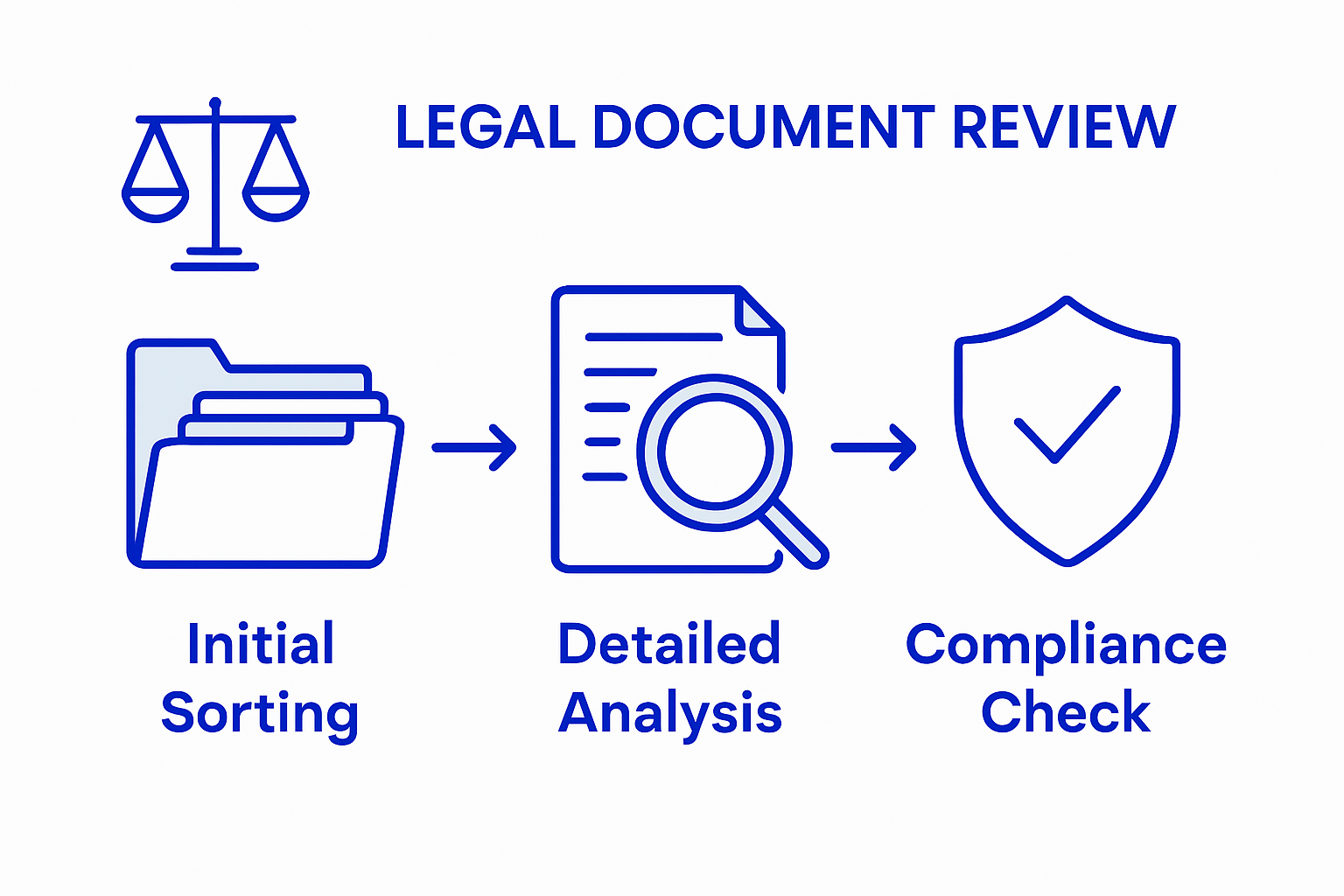
The landscape of legal compliance involves multiple interconnected responsibilities that extend far beyond simple document examination. Legal professionals must navigate intricate regulatory frameworks, ensuring that every document is handled with utmost confidentiality and in strict accordance with applicable laws. This process involves implementing robust privacy protection mechanisms, carefully screening for sensitive information, and maintaining comprehensive audit trails that demonstrate transparency and ethical handling of potentially confidential materials.
Key compliance and legal responsibilities in document review include:
- Confidentiality Protection
- Safeguarding privileged information
- Preventing unauthorized disclosure
- Maintaining strict information barriers
- Regulatory Adherence
- Following industry-specific legal standards
- Ensuring complete and accurate document disclosure
- Maintaining comprehensive documentation
- Ethical Information Management
- Respecting individual privacy rights
- Implementing secure document handling protocols
- Avoiding potential conflicts of interest
- Data Security
- Protecting sensitive document information
- Using encrypted storage and transmission systems
- Implementing strict access control measures
- Audit and Accountability
- Creating detailed review logs
- Maintaining transparent review processes
- Ensuring defensible document management strategies
Pro Tip for Compliance Management: Develop a comprehensive internal compliance checklist that addresses legal, ethical, and procedural requirements, and regularly update it to reflect changing regulatory landscapes.
Risks, Pitfalls, and Cost Considerations
Document review represents a complex legal process fraught with potential financial and strategic risks that can significantly impact organizational outcomes. Document review can be resource-intensive, posing risks such as overlooking relevant documents or misidentifying privileged information, leading to potential legal repercussions and increased costs, making comprehensive risk management an essential component of any legal document examination strategy.
The financial implications of document review extend far beyond immediate processing expenses. Organizations must consider both direct and indirect costs associated with comprehensive document examination, including personnel time, technological infrastructure, potential legal penalties, and the opportunity costs of prolonged review processes. Inefficient document review can result in substantial monetary losses, ranging from unnecessary legal expenses to potential sanctions for incomplete or improper document disclosure.
Key risks and cost considerations in legal document review include:
- Direct Financial Risks
- Excessive review time and personnel expenses
- Technology and software investment costs
- Potential overtime and extended project durations
- Legal and Compliance Risks
- Penalties for incomplete document disclosure
- Potential legal sanctions
- Reputational damage from procedural errors
- Operational Efficiency Risks
- Productivity disruptions
- Resource allocation challenges
- Potential project timeline extensions
- Technological Risks
- Software compatibility issues
- Data security vulnerabilities
- Potential system integration challenges
- Human Error Risks
- Misinterpretation of document contents
- Inconsistent review standards
- Potential bias in document assessment
Pro Tip for Risk Mitigation: Implement a robust quality control framework with multiple review stages, advanced technological tools, and standardized assessment protocols to minimize potential risks and control overall document review expenses.
The following table highlights key risks in document review and the impacts of effective mitigation:
| Risk Category | Common Issue | Impact of Mitigation |
|---|---|---|
| Financial | High labor costs | Lowered expenses |
| Legal Sanctions | Incomplete disclosures | Reduced liability |
| Operational | Delayed review processes | Faster project completion |
| Technological | Software or data breaches | Improved data security |
| Human Error | Inconsistent review decisions | Greater accuracy and consistency |
Simplify Your Legal Document Review with Trusted Support
Navigating the complexities of document review requires precision and reliability. The challenges of managing vast amounts of legal documents while ensuring compliance and confidentiality can be overwhelming. YM Doc Services specializes in easing this burden by offering expert process serving, document retrieval, and court filing solutions tailored for lawyers, businesses, and individuals. With our commitment to timeliness and strict adherence to legal standards, we help you maintain control over your legal document workflow without unnecessary stress.
Take the first step toward streamlining your document review process today. Visit YM Doc Services to discover how our professional legal document services can reduce risks and improve efficiency. Don’t let deadlines or complicated procedures slow you down. Get reliable assistance now and ensure your legal matters are handled with the utmost care.
Explore more about our services and place your order easily through our legal document service platform, where managing deliveries has never been more straightforward.
Frequently Asked Questions
What is the main purpose of document review in legal services?
Document review serves to meticulously examine and analyze legal documents to determine their relevance, significance, and potential implications within a legal context, ensuring all pertinent information is identified and evaluated for litigation or compliance.
What types of documents are commonly reviewed during the document review process?
Legal professionals review various types of documents including contracts, correspondence, electronic communications, financial records, and other materials relevant to the specific legal matters at hand.
How does document review influence litigation preparation?
Document review plays a crucial role in litigation preparation by identifying key evidence, assessing risks, and ensuring compliance with legal standards, which can ultimately shape legal strategies and case outcomes.
What are the key stages of a document review workflow?
The typical document review workflow includes stages such as initial document collection, preliminary screening, detailed document analysis, quality control, and final preparation for production.
Recommended
- Legal Paperwork Basics: Everything You Need to Know – YM Doc Services
- Legal Document Organization Workflow: Streamline Your Process – YM Doc Services
- Legal Process Explained: Essential Steps and Services – YM Doc Services
- Essentials of Legal Document Management: Streamlining Compliance – YM Doc Services
We provide GPS-stamped, court-compliant service of process throughout Orange County, Seminole County, and West Volusia County. Licensed Florida process server — FAPPS Member · NAPPS Member · Florida Statutes Chapter 48 Compliant.