

Most American legal disputes hinge on proper notification, yet over half of new legal professionals report confusion about service of process basics. Mistakes in this critical step can delay justice or even dismiss a case. Understanding what actually counts as legal service—and debunking stubborn myths—matters more than ever, as courts and regulations across the United States evolve at a rapid pace. This guide offers clarity on what every American should know to avoid costly missteps.
Table of Contents
- Service of Process Defined and Common Myths
- Types of Service: Personal, Substituted, Electronic
- Key Legal Requirements and Governing Laws
- Technological Advances Shaping Process Serving
- Risks, Liabilities, and Common Pitfalls to Avoid
Key Takeaways
| Point | Details |
|---|---|
| Service of Process is Crucial | It ensures that parties are formally notified of legal actions, protecting their rights and responsibilities. |
| Evolving Methods of Service | Traditional methods like personal service are being complemented by electronic options, necessitating legal adaptation. |
| Risks of Non-Compliance | Legal teams face significant challenges with jurisdictional variations, making adherence to local laws essential. |
| Technological Innovations | Advanced digital tools and AI are streamlining document delivery, enhancing efficiency and accountability in process serving. |
Service of Process Defined and Common Myths
Service of Process represents the legal procedure by which a defendant or party is formally notified about a pending court action or lawsuit. At its core, this critical legal mechanism ensures individuals and organizations receive official documentation regarding legal proceedings that directly impact their rights and responsibilities.
In 2025, the landscape of service of process is experiencing significant transformations. Service of process volume is surging across the United States, creating mounting operational pressures for legal teams and amplifying compliance risks. This increasing complexity requires legal professionals and businesses to stay vigilant and adaptive.
Several persistent myths continue to cloud understanding of service of process. Contrary to popular belief, service is not a simple mail delivery but a structured legal protocol with precise requirements. Common misconceptions include:
-
Myth: Anyone can serve legal documents
- Reality: Process servers must follow strict legal guidelines and often require specific certifications
-
Myth: Digital communication can replace traditional service methods
- Reality: Most jurisdictions still require physical document delivery with verifiable proof
-
Myth: Service of process is a standardized national procedure
Understanding these nuances is crucial for legal professionals, businesses, and individuals navigating complex legal landscapes. Accurate service ensures due process, protects individual rights, and maintains the integrity of legal proceedings. By recognizing the evolving nature of service of process and dispelling common myths, stakeholders can better prepare for potential legal challenges and maintain compliance with emerging regulatory standards.
Types of Service: Personal, Substituted, Electronic
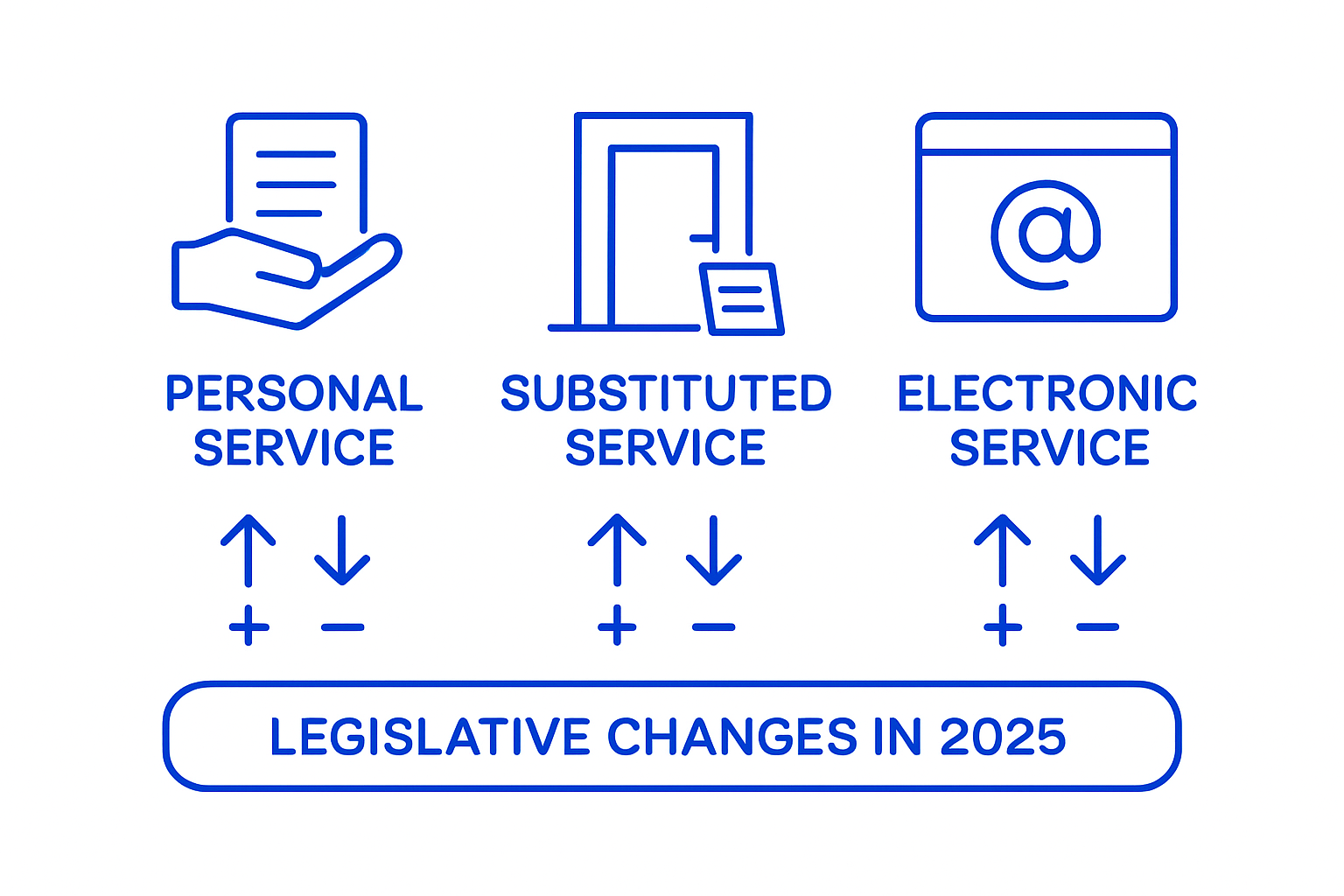
Service of process encompasses several distinct methods, each designed to ensure legal notifications reach intended recipients effectively. The primary types include personal, substituted, and increasingly, electronic service methods that adapt to modern communication technologies and legal requirements.
Personal Service remains the gold standard in legal notifications. This method involves directly handing legal documents to the recipient, providing immediate and verifiable proof of delivery. Process servers must locate and physically interact with the defendant, ensuring they personally receive court documents. Digital tracking systems now enable real-time updates during these service attempts, enhancing accountability and efficiency.
Substituted Service becomes critical when personal delivery proves challenging. This approach allows documents to be left with a designated adult at the recipient’s residence or workplace, typically a family member or authorized representative. Legal requirements vary by jurisdiction, often mandating specific protocols such as follow-up mailed notifications or additional verification steps.
Electronic Service represents the emerging frontier of process serving. Courts are increasingly accepting electronic service, particularly in civil cases and scenarios involving hard-to-locate defendants. This method might include email delivery, digital platform notifications, or approved online communication channels. Key considerations for electronic service include:
- Verifiable delivery confirmation
- Recipient’s explicit consent or court-approved communication method
- Comprehensive digital audit trail
- Compliance with specific jurisdictional requirements
Understanding these service types is crucial for legal professionals navigating the complex landscape of legal notifications. Each method offers unique advantages and challenges, requiring careful selection based on specific case circumstances, jurisdictional rules, and practical considerations of document delivery.
Key Legal Requirements and Governing Laws
Service of process operates within a complex legal framework governed by federal, state, and local regulations that define precise procedural requirements for legal notifications. These laws establish critical standards for document delivery, ensuring due process and protecting the rights of all parties involved in legal proceedings.
The legal landscape for service of process continues to evolve, with significant regulatory innovations emerging across different jurisdictions. Washington state is pioneering a groundbreaking pilot initiative that relaxes traditional legal service regulations, potentially setting a precedent for broader national reforms. This initiative allows non-traditional businesses to provide legal services, signaling a transformative approach to legal practice delivery.
Key legal requirements for service of process typically encompass several fundamental elements:
- Proof of Service: Documented evidence demonstrating the exact method, date, and time of document delivery
- Jurisdictional Compliance: Adherence to specific state and local regulations governing legal notifications
- Recipient Verification: Confirming the identity of the individual receiving legal documents
- Timely Delivery: Meeting prescribed deadlines for document service
Jurisdictional Variations represent a critical consideration in service of process. Each state maintains unique requirements regarding acceptable service methods, authorized process servers, and documentation standards. The Washington Supreme Court’s approval of a pilot program demonstrates the potential for regulatory flexibility, suggesting a trend towards more adaptive legal service frameworks that incorporate technological advancements and alternative service models.
Professional process servers and legal professionals must remain vigilant about these evolving regulations, continually updating their knowledge to ensure full compliance. The intersection of technological innovation and legal practice is reshaping traditional service of process requirements, demanding a dynamic and adaptive approach to legal notifications.
Technological Advances Shaping Process Serving
Process serving is experiencing a technological revolution, transforming traditional methods of legal document delivery through innovative digital solutions. The integration of advanced technologies is fundamentally redesigning how legal notifications are tracked, delivered, and verified across the legal ecosystem.

Digital tools and online platforms are significantly improving the speed and efficiency of process serving, introducing unprecedented levels of transparency and accountability. Modern process servers now utilize sophisticated digital tracking systems that provide real-time updates on case statuses, enabling legal professionals to monitor document delivery with unprecedented precision.
Artificial Intelligence (AI) is playing a transformative role in process serving technologies. Advanced AI systems are automating routine tasks such as document routing, address verification, and service attempt tracking, dramatically increasing operational efficiency and reducing human error. Key technological advancements include:
- Geolocation Tracking: Precise location verification for service attempts
- Automated Document Management: Intelligent routing and classification of legal documents
- Biometric Verification: Enhanced recipient identification techniques
- Blockchain Documentation: Immutable records of service attempts
These technological innovations are not merely incremental improvements but represent a fundamental reimagining of process serving. By integrating advanced digital tools, the legal service industry is creating more reliable, transparent, and efficient mechanisms for delivering critical legal notifications. Process servers who embrace these technological advances will be better positioned to meet the increasingly complex demands of modern legal communication.
Risks, Liabilities, and Common Pitfalls to Avoid
Service of process demands meticulous attention to detail, with significant legal and financial consequences for procedural errors. Legal professionals and process servers must navigate a complex landscape of potential risks that can compromise the validity of legal document delivery.
The rising complexity of service of process across multiple states is increasing compliance exposure for legal teams, with 59% of in-house counsel reporting significant challenges in managing diverse state requirements. This complexity creates substantial risks that can invalidate legal proceedings or result in costly legal challenges.
Common risks and potential pitfalls in service of process include:
- Jurisdictional Non-Compliance: Failing to meet specific state-level service requirements
- Improper Document Handling: Incorrect delivery methods or insufficient documentation
- Missed Service Deadlines: Failing to serve documents within prescribed time frames
- Inadequate Proof of Service: Insufficient documentation of delivery attempts
Recent legislative changes, such as Florida’s House Bill 157, illustrate the nuanced challenges in process serving. The bill allows service on any employee present at a registered office, which might streamline processes but also introduces risks of improper document handling by untrained staff. This highlights the critical need for comprehensive training and rigorous verification protocols.
Mitigating these risks requires a proactive approach that combines technological solutions, continuous training, and meticulous attention to jurisdictional variations. Process servers must develop robust systems that document every step of the service attempt, maintain comprehensive records, and stay current with evolving legal requirements across different jurisdictions.
Stay Ahead of Service of Process Challenges with Expert Support
As service of process procedures grow increasingly complex with evolving state laws and technological demands, legal teams often face mounting risks of noncompliance and missed deadlines. Whether you need reliable personal service, substituted delivery, or help navigating emerging electronic service options, it is critical to partner with a provider you can trust. YM Doc Services is dedicated to helping lawyers, businesses, and individuals overcome these challenges by offering efficient, legally compliant document handling and process serving solutions.
Don’t let jurisdictional variations or new legislative changes derail your legal process. Visit YM Doc Services today to streamline your service of process with professional support. Explore how our comprehensive process serving and legal document services, including document retrieval and court filings, can reduce your stress and increase your confidence in meeting deadlines. Act now to ensure your legal notifications are handled accurately, timely, and with proven expertise.
Frequently Asked Questions
What is service of process?
Service of process is the legal procedure by which a defendant is formally notified about a pending court action or lawsuit, ensuring they receive official documentation regarding legal proceedings that impact their rights and responsibilities.
What are the common myths about service of process?
Common myths include the belief that anyone can serve legal documents, that digital communication can fully replace traditional methods, and that service of process is a standardized procedure across the country when in fact it varies significantly by state.
What are the types of service of process?
The primary types of service of process include personal service, where documents are directly handed to the recipient; substituted service, where documents are left with a designated adult; and electronic service, which is increasingly being accepted in courts, particularly for hard-to-locate defendants.
What legal requirements govern service of process?
Service of process must meet several key requirements, including proof of service, jurisdictional compliance, recipient verification, and timely delivery, ensuring all legal notifications adhere to specific state and local regulations.

