
Most American law firms must handle tens of thousands of documents each year, yet over 60 percent report struggling with efficient tracking and management. The sheer volume and sensitivity of legal paperwork create a real risk of costly errors or missed deadlines. Understanding how legal document tracking works and adopting a systematic approach can help American professionals ensure every file is secure, traceable, and always within reach.
Table of Contents
- Legal Document Tracking Defined And Explained
- Types Of Documents Requiring Tracking
- How Document Tracking Systems Work
- Compliance, Deadlines, And Legal Responsibility
- Risks Of Poor Tracking And Best Practices
Key Takeaways
| Point | Details |
|---|---|
| Importance of Legal Document Tracking | Legal document tracking is essential for maintaining compliance, controlling document lifecycles, and managing deadlines effectively. It enhances operational efficiency and mitigates risks associated with legal processes. |
| Key Components of Tracking Systems | Effective tracking systems incorporate digital archiving, version control, automated notifications, and secure access management to facilitate streamlined document management. |
| Risks of Inadequate Tracking | Poor tracking can result in significant financial and reputational risks, including missed deadlines and legal penalties; implementing robust systems is crucial to mitigate these threats. |
| Proactive Compliance Strategies | Establishing proactive tracking and compliance systems transforms legal responsibilities from reactive to systematic, minimizing risks and demonstrating organizational commitment to legal integrity. |
Legal Document Tracking Defined and Explained
Legal document tracking represents a systematic approach to monitoring, organizing, and managing critical legal documents throughout their lifecycle. At its core, this process involves comprehensive document management strategies designed to ensure accessibility, compliance, and strategic value for legal professionals and organizations. Computer-assisted legal research has significantly transformed how legal documents are tracked and managed in modern practice.
The fundamental purpose of legal document tracking extends beyond simple record-keeping. It encompasses a strategic framework that enables professionals to maintain precise control over documents, track their status, monitor critical deadlines, and ensure regulatory compliance. When implemented effectively, tracking systems provide real-time insights into document location, modification history, access permissions, and potential risks. Legal information retrieval technologies have made these advanced tracking capabilities more sophisticated and efficient than ever before.
Effective document tracking typically involves several key components. These include:
- Digital archiving systems
- Version control mechanisms
- Automated notification protocols
- Secure access management
- Comprehensive audit trails
Professionals can leverage these tracking mechanisms to mitigate risks, streamline workflow processes, and maintain a structured approach to legal documentation. By integrating advanced legal document organization workflow techniques, organizations can transform document management from a mundane administrative task into a strategic operational advantage.
Types of Documents Requiring Tracking
Legal professionals encounter numerous document types that demand rigorous tracking and management. Court dockets and filings represent a critical category of legal documents that require meticulous monitoring. These documents, which include pleadings, motions, briefs, and case summaries, are essential for maintaining comprehensive legal records and understanding the progression of legal proceedings.

The spectrum of documents requiring systematic tracking is extensive and varies across different legal contexts. Contractual documents stand out as another pivotal category, encompassing employment agreements, service contracts, non-disclosure agreements, and corporate partnership documents. Legal department document management emphasizes the importance of tracking these documents to ensure compliance, manage obligations, and mitigate potential legal risks.
Key document types that necessitate robust tracking include:
- Litigation documents
- Court filings
- Deposition transcripts
- Legal correspondence
- Contractual documents
- Employment agreements
- Service contracts
- Intellectual property agreements
- Regulatory compliance documents
- Licensing paperwork
- Certification records
- Regulatory submissions
Professionals can streamline their legal document certification processes by implementing comprehensive tracking systems that provide real-time visibility, secure storage, and efficient retrieval mechanisms. These systems help organizations maintain accurate records, reduce administrative burdens, and ensure they meet critical legal and regulatory requirements.
How Document Tracking Systems Work
Document tracking systems represent sophisticated technological solutions designed to manage, monitor, and organize legal documents with precision and efficiency. Legal document management platforms operate through complex digital infrastructures that enable real-time document monitoring, status tracking, and comprehensive reporting capabilities.
The core functionality of these systems revolves around several critical technological components. Electronic document repositories serve as the central hub, providing secure storage and instant retrieval mechanisms. Document management modules integrate advanced features like version control, access permissions, and automated notification systems that alert legal professionals about critical updates, approaching deadlines, or required actions.
Key operational features of document tracking systems include:
- Centralized digital storage
- Automated version tracking
- Timestamp recording
- Change log maintenance
- Permission-based access control
- Real-time status monitoring
- Comprehensive search capabilities
- Advanced reporting tools
Professionals can leverage legal document retrieval process techniques to maximize the effectiveness of these tracking systems. By implementing robust digital infrastructure, organizations can transform document management from a complex administrative task into a streamlined, efficient workflow that reduces errors, enhances compliance, and provides unprecedented visibility into legal document lifecycles.
Compliance, Deadlines, and Legal Responsibility
Legal compliance represents a critical dimension of organizational risk management, requiring meticulous attention to regulatory requirements and procedural timelines. Tracking and updating legal developments is fundamental to maintaining legal integrity and avoiding potential liabilities that could compromise an organization’s operational standing.
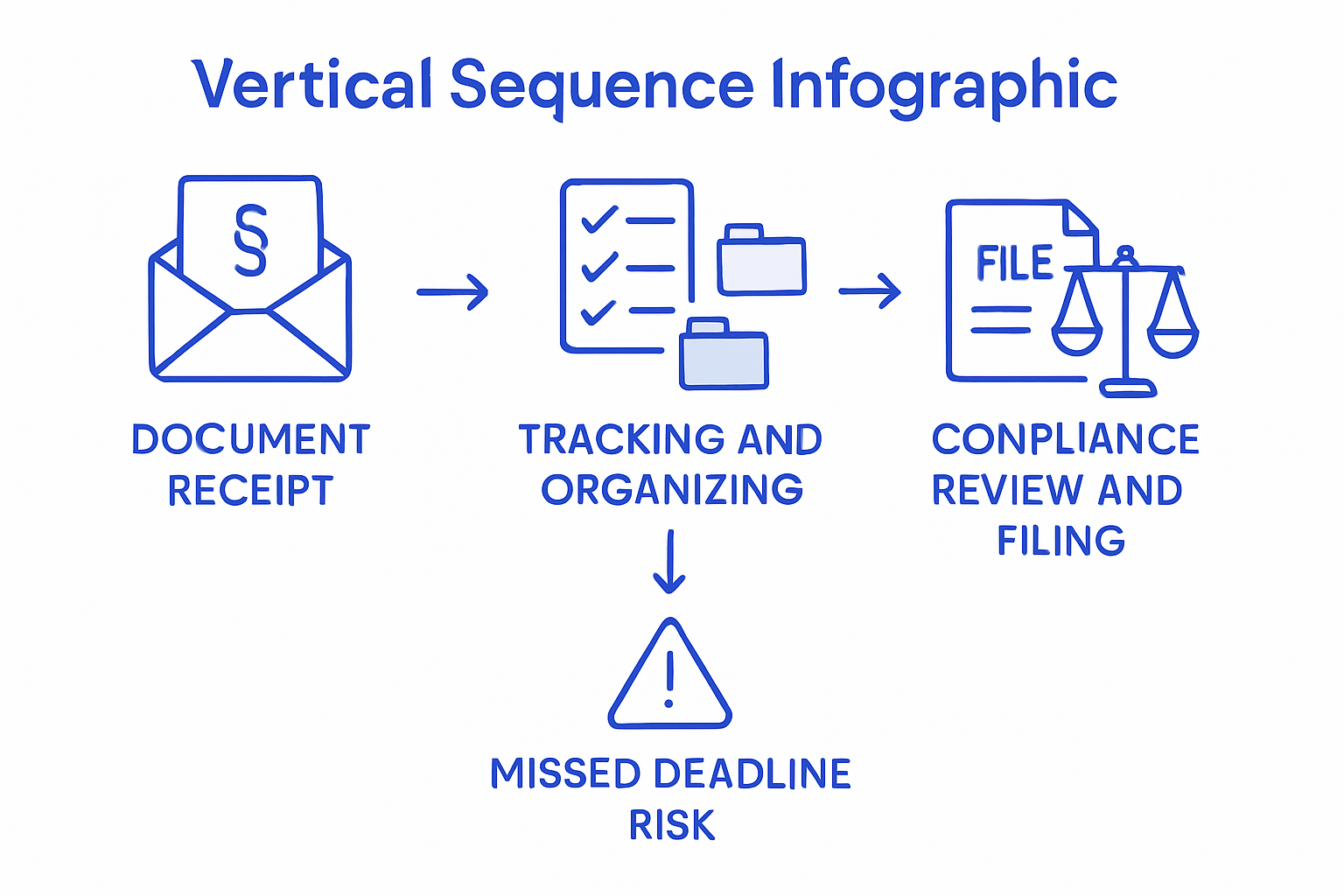
The legal responsibility framework demands comprehensive document management that goes beyond simple record-keeping. Organizations must establish robust systems that proactively monitor critical deadlines, ensure regulatory compliance, and maintain an auditable trail of all legal interactions. Missed deadlines can result in severe consequences, including legal penalties, contractual breaches, and potential litigation that could significantly impact an organization’s financial and reputational health.
Key compliance and deadline management strategies include:
- Proactive deadline tracking
- Automated reminder systems
- Multi-stage alert protocols
- Comprehensive documentation
- Timestamped records
- Detailed interaction logs
- Regulatory monitoring
- Ongoing legal landscape assessment
- Continuous compliance updates
- Risk mitigation protocols
- Systematic review processes
- Regular compliance audits
Professionals can leverage document filing protocols to create a comprehensive approach to legal responsibility. By implementing strategic tracking mechanisms, organizations can transform compliance from a reactive challenge into a proactive, structured approach that minimizes risks and demonstrates commitment to legal and ethical standards.
Risks of Poor Tracking and Best Practices
Network analytical frameworks reveal the profound risks associated with inadequate legal document tracking. Poor management can trigger cascading legal complications that extend far beyond simple administrative oversights, potentially exposing organizations to significant financial and reputational damage.
The document tracking landscape demands comprehensive strategies to mitigate potential risks. Advanced document retrieval techniques utilizing neural networks demonstrate how sophisticated tracking mechanisms can transform document management from a vulnerable process to a robust, proactive system. Critical risks of ineffective tracking include potential litigation, regulatory penalties, missed deadlines, and compromised legal standing.
Key risks and corresponding best practices include:
- Documentation Integrity Risks
- Incomplete record maintenance
- Version control failures
- Unauthorized document modifications
- Compliance Vulnerability Risks
- Missed regulatory updates
- Inadequate deadline tracking
- Inconsistent record preservation
- Operational Exposure Risks
- Information retrieval challenges
- Increased legal vulnerability
- Potential contract disputes
Professionals can leverage legal compliance process serving methodologies to develop comprehensive tracking protocols. By implementing systematic documentation strategies, organizations can transform potential risks into manageable, transparent legal workflows that protect their operational integrity and minimize potential legal exposures.
Secure Your Legal Document Workflow with Expert Support
Tracking legal documents is essential to safeguard compliance and preserve the value of your legal operations. The article highlights challenges such as missed deadlines, regulatory risks, and the need for real-time monitoring to maintain document integrity and legal responsibility. These pain points can cause costly delays and threaten your organization’s reputation without reliable systems in place.
YM Doc Services understands these critical challenges and is here to streamline your legal document management. Our professional solutions in process serving, document retrieval, and court filings help you maintain compliance while reducing stress associated with tight legal deadlines. Trust us to provide timely and accurate service that supports your workflow with transparency and efficiency.
Take control of your legal document processes today by partnering with YM Doc Services. Visit our website now to order services designed to protect your compliance and enhance operational confidence when managing vital legal documents.
Frequently Asked Questions
What is legal document tracking?
Legal document tracking is a systematic approach to monitoring, organizing, and managing legal documents throughout their lifecycle to ensure accessibility, compliance, and strategic value for legal professionals.
Why is it important to track legal documents?
Tracking legal documents is crucial for maintaining precise control over document status, monitoring deadlines, and ensuring regulatory compliance, which helps mitigate risks and streamline workflow processes.
What types of documents require tracking in legal contexts?
Key document types that require tracking include litigation documents (like court filings), contractual documents (such as employment agreements), and regulatory compliance documents (like licensing paperwork).
How do document tracking systems enhance compliance?
Document tracking systems enhance compliance by providing real-time monitoring of deadlines, maintaining comprehensive documentation with audit trails, and automating notification protocols to ensure adherence to regulatory requirements.
Recommended
- Legal Document Organization Workflow: Streamline Your Process – YM Doc Services
- Legal Paperwork Basics: Everything You Need to Know – YM Doc Services
- Master Legal Document Workflow 2025 for Fast, Compliant Delivery – YM Doc Services
- 7 Essential Legal Paperwork Tips for Smooth Processing – YM Doc Services
- Understanding the Importance of Technical Documentation – My WordPress
We provide GPS-stamped, court-compliant service of process throughout Orange County, Seminole County, and West Volusia County. Licensed Florida process server — FAPPS Member · NAPPS Member · Florida Statutes Chapter 48 Compliant.