
Nearly one billion documents are notarized in the United States every year, reflecting how central these professionals are to legal and business transactions. When a single mistake can void a contract or trigger a costly dispute, understanding the work of a notary takes on real urgency. Reliable notarial services protect everyone involved, adding security and legal standing to some of life’s most important agreements.
Key Takeaways
| Point | Details |
|---|---|
| Notary Public Role | Notaries act as impartial witnesses, ensuring document authenticity and preventing fraud. They verify identities and oversee the signing of legal documents. |
| Types of Notarizations | Various notarization types include acknowledgments, jurats, certified copies, specialized acts, and remote online notarizations, each serving unique legal purposes. |
| Credentialing Requirements | Becoming a notary requires meeting state-specific qualifications, such as age, residency, a criminal background check, and obtaining a surety bond. |
| Risks and Common Mistakes | Notaries face significant liabilities for errors; common mistakes include improper identification and failing to complete notarial certificates, which may invalidate documents. |
Table of Contents
- Defining A Notary And Core Responsibilities
- Primary Types Of Notarizations In The U.S.
- Legal Requirements And Credentialing Process
- Notary’s Role In Legal Document Validity
- Risks, Liabilities, And Common Mistakes
Defining a Notary and Core Responsibilities
A Notary Public serves as a critical legal professional appointed by state governments to act as an impartial witness during crucial document transactions. According to the Witnessing Legal Documents: Complete U.S. Guide, these officials play a fundamental role in preventing fraud and ensuring document authenticity by verifying the identities of individuals signing important legal paperwork.
The core responsibilities of a notary extend far beyond simple signature witnessing. As outlined by the Notary Association, their primary functions include:
- Verifying the identity of document signers
- Administering oaths and affirmations
- Taking official affidavits and declarations
- Authenticating document executions
- Certifying document copies
- Maintaining precise official records of notarial acts
Notaries operate under strict state guidelines, ensuring they provide an objective, professional service that maintains legal integrity. Their official seal and signature transform standard documents into legally recognized instruments, giving them enhanced credibility and legal standing. By serving as neutral third-party witnesses, notaries help protect all parties involved in critical legal and business transactions.
Primary Types of Notarizations in the U.S.
Notarizations in the United States encompass several distinct legal procedures designed to authenticate and validate important documents. According to the Notary Public Association, these specialized services ensure the integrity and legitimacy of critical legal transactions through various formal processes. In our Notary Services in Orlando, we recognize the nuanced approaches required for different document verification needs.
The primary types of notarizations include:
- Acknowledgments: Confirming a signer’s voluntary signature and identity
- Jurats: Administering oaths or affirmations for sworn statements
- Certified Copies: Verifying exact reproductions of original documents
- Specialized Acts: Including depositions and protest documentations
- Remote Online Notarizations (RON): Digital transaction verification
Each notarization type serves a unique legal purpose, providing different levels of authentication and protection. While acknowledgments verify signature ownership, jurats ensure the truthfulness of sworn statements. Certified copies offer official reproductions, and specialized acts cover complex legal scenarios. With the rise of digital transactions, Remote Online Notarizations have emerged as a flexible, technology-driven approach to document verification, expanding notarial services beyond traditional in-person interactions.

Here’s a summary of the primary types of notarizations in the U.S.:
| Notarization Type | Key Purpose | Typical Use Cases |
|---|---|---|
| Acknowledgment | Verify identity, confirm voluntary signature | Real estate, contracts |
| Jurat | Witness sworn statements, administer oath | Affidavits, depositions |
| Certified Copy | Attest to authenticity of document copy | Academic records, legal filings |
| Specialized Acts | Address unique legal needs | Protests, depositions |
| Remote Online Notarization (RON) | Digital identity and signature verification | Online closings, remote agreements |
Legal Requirements and Credentialing Process
Becoming a Notary Public involves navigating a complex set of state-specific legal requirements designed to ensure professional competence and integrity. According to Wikipedia, the appointment process is typically managed by state officials like governors or secretaries of state, with each jurisdiction establishing its own unique set of qualifications. When exploring Notary Services in Orlando, professionals must meet rigorous standards that go beyond basic eligibility.
The core credentialing requirements typically include:
- Minimum age requirement (usually 18 years)
- State residency verification
- Clean criminal background
- Passing a state-approved certification exam
- Obtaining a surety bond (ranging $5,000–$15,000)
- Completing mandatory training programs
- Purchasing an official notarial seal
- Maintaining a professional notary journal
State variations in credentialing are significant. Some states like California and New York mandate comprehensive training and examinations, while others have more streamlined processes. Notaries must also typically maintain Errors & Omissions insurance to protect against potential professional mistakes. This multi-layered approach ensures that notaries are not just authorized, but truly prepared to handle critical legal documentation with the highest standards of professionalism and accuracy.
Notary’s Role in Legal Document Validity
Notaries play a critical role in establishing the legal credibility and authenticity of important documents through a meticulous verification process. According to the Online Notary Center, these professionals do not assess the substantive content of documents but instead focus on ensuring proper execution and witnessing procedures. When navigating complex legal documentation, understanding the essential legal document process tips becomes crucial for maintaining document integrity.
The notary’s authentication process typically involves several key verification steps:
- Confirming the identity of document signers
- Verifying the signer’s willingness and mental competence
- Witnessing the actual signing of the document
- Applying an official notarial seal and signature
- Creating a formal record of the notarization
- Ensuring the document meets legal requirements for execution
While notaries do not guarantee the legal content of a document, their official acknowledgment significantly enhances its credibility and admissibility in legal proceedings. By meticulously following standardized procedures, notaries provide an essential layer of protection against fraud and misrepresentation, transforming ordinary documents into legally recognized instruments that can withstand scrutiny in courts and official contexts.
Risks, Liabilities, and Common Mistakes
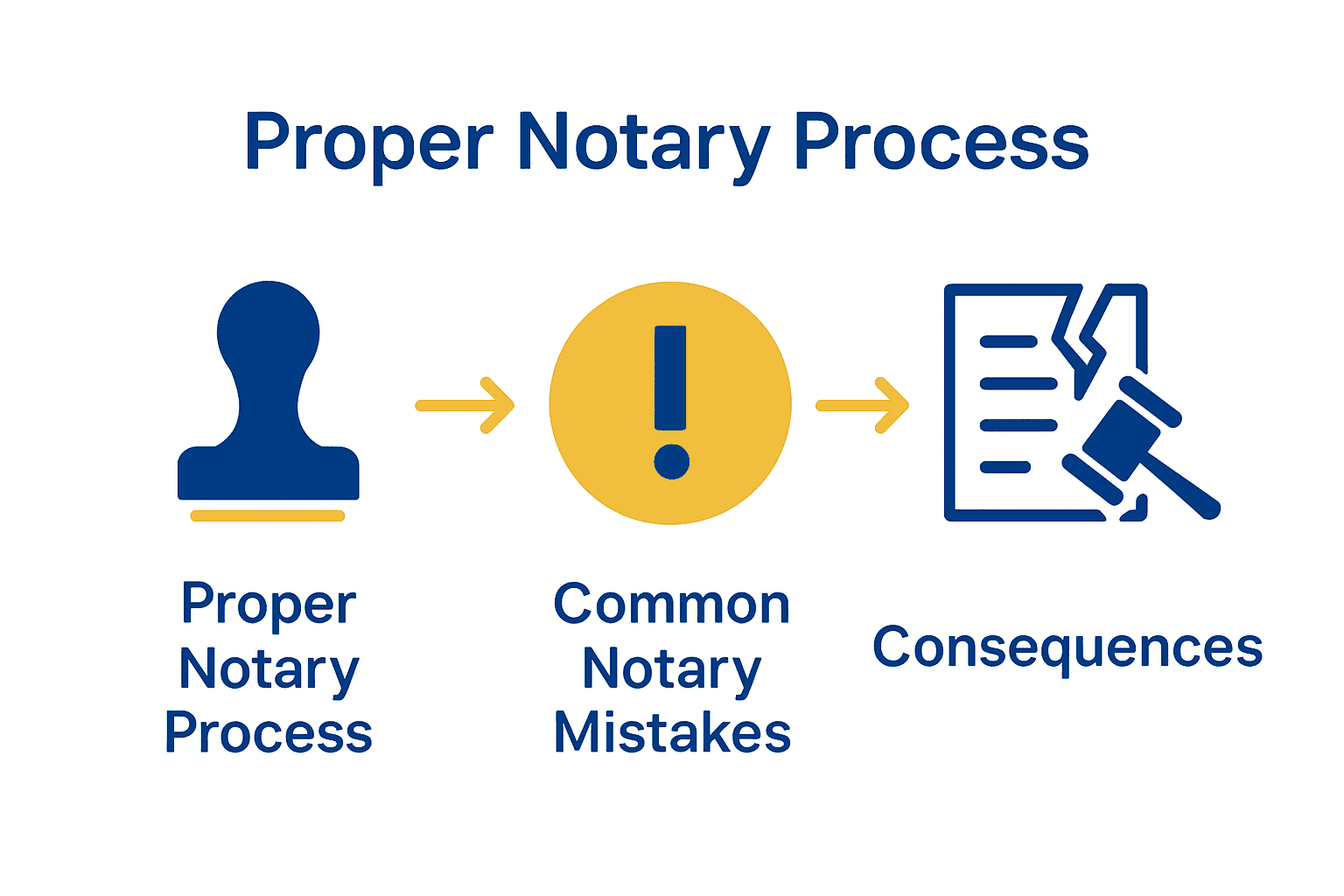
Notaries operate in a high-stakes environment where professional precision is paramount. According to US Legal sources, these professionals can face significant civil and criminal liability for errors or misconduct during document authentication. When exploring potential risks, reviewing our legal document delivery guide can provide crucial insights into maintaining professional standards.
The most frequent notarial mistakes include:
- Improper identification verification
- Using expired official seals
- Notarizing incomplete documents
- Failing to properly complete notarial certificates
- Poor record-keeping practices
- Performing unauthorized legal interpretations
- Neglecting to secure notarial materials and stamps
The consequences of these mistakes can be severe. A notary might face personal liability, potential commission revocation, and financial penalties that could be covered by their professional bond or surety. Beyond immediate professional repercussions, such errors can invalidate critical legal documents, potentially causing substantial legal and financial complications for the parties involved. Maintaining rigorous professional standards, continuous training, and meticulous attention to detail are essential for notaries to mitigate these substantial professional risks.
Ensure Every Legal Document Holds Up with Professional Notary Services
Worried about the risk of invalidated contracts or missed legal deadlines due to notary mistakes? The recent article “Role of Notary in Legal Documents Explained” highlights how small errors, like improper identity checks or incomplete notarizations, can cause financial loss, legal delays, and stress for individuals and businesses. At YM Doc Services, we understand the pressure you face to keep your legal documentation accurate and fully compliant. Our team is trained in all types of notarizations from acknowledgments to remote online notarizations so you get peace of mind with every transaction. We also maintain up-to-date credentials and protect against costly mistakes with professional diligence.

Ready to avoid costly errors and streamline your next legal transaction? Trust your notarization to experts who keep your paperwork safe and your deadlines on track. Explore our Notary Services in Orlando for in-person or online needs, discover how to protect your files with our legal document delivery guide, or start your secure order directly on our homepage. Visit https://ymdocservices.com today—the right notary keeps your business moving forward.
Frequently Asked Questions
What is the role of a Notary Public in legal documents?
A Notary Public acts as an impartial witness during the signing of important documents, verifying the identities of signers and ensuring proper execution to prevent fraud and ensure authenticity.
What are the different types of notarizations performed by Notaries?
The primary types of notarizations include acknowledgments, jurats, certified copies, specialized acts, and remote online notarizations, each serving a unique legal purpose.
What are the legal requirements to become a Notary Public?
To become a Notary Public, individuals typically must meet age and residency requirements, pass a state-approved exam, obtain a surety bond, complete training, and purchase an official notarial seal.
What common mistakes do Notaries make that could lead to legal issues?
Common mistakes include improper identification verification, notarizing incomplete documents, using expired seals, and failing to complete notarial certificates, which can lead to personal liability and document invalidation.