

Did you know that a single error in delivering legal documents can lead to an entire lawsuit being thrown out? Legal document delivery, also called service of process, is the backbone of fairness in court cases. It gives everyone a fair chance to respond and protect their rights. Understanding this process is vital because even a small mistake can have serious legal and financial consequences for individuals and businesses alike.
Key Takeaways
| Point | Details |
|---|---|
| Importance of Service of Process | Legal document delivery protects constitutional rights by ensuring parties receive proper notification of legal actions, establishing court jurisdiction. |
| Role of Professional Process Servers | Accurate and meticulous service is crucial; errors in document delivery can invalidate legal proceedings, emphasizing the need for trained professionals. |
| Types of Legal Documents | Different legal documents, such as summons and subpoenas, each serve specific purposes and require proper handling to maintain their legal validity. |
| Compliance with Legal Standards | Adhering to state and federal regulations, including timely service and qualified delivery methods, is mandatory to avoid case dismissals. |
Table of Contents
- Legal Document Delivery Explained Clearly
- Types of Legal Documents Served
- Step-By-Step Process Serving Methods
- Legal Standards and Compliance Requirements
- Roles, Responsibilities, and Client Obligations
- Common Mistakes and How to Avoid Them
Legal Document Delivery Explained Clearly
Legal document delivery, technically known as service of process, is far more than just handing someone paperwork. It’s a critical legal mechanism that ensures fairness and protects fundamental constitutional rights. According to Wikipedia’s research on service of process, this formal procedure allows a party in a lawsuit to provide official notice of legal action to another party, effectively establishing court jurisdiction.
The process involves several key components:
- Initiating Documents: Typically includes court-issued documents like summons and complaints
- Qualified Delivery: Must be performed by an authorized server (process server, sheriff, or designated adult)
- Proof of Service: Mandatory documentation filed with the court confirming legal notification
Why does this matter? Read more about our legal courier services to understand the nuances. Legal document delivery fundamentally protects an individual’s constitutional right to due process. It ensures that no one can be legally proceeded against without proper notification, giving them an opportunity to respond, defend themselves, or take appropriate legal action.
The complexity of legal document delivery requires precision. A single mistake in serving documents can potentially invalidate an entire legal proceeding, making professional and meticulous service crucial for maintaining the integrity of the judicial system.
Types of Legal Documents Served
Legal document delivery encompasses a diverse range of legal documents, each serving a unique purpose in the judicial system. According to Wikipedia’s research on legal process, common forms include summons, subpoenas, mandates, and warrants—formal notices or writs designed to establish court jurisdiction over individuals or property.
Key Types of Legal Documents
- Summons: Official court notice requiring a defendant to respond to a legal action
- Subpoenas: Legally binding orders compelling witness testimony or document production
- Mandates: Court orders directing specific actions or behaviors
- Warrants: Legal documents authorizing law enforcement to take specific actions
Specialized Document Types
The importance of professional process serving cannot be overstated when dealing with complex legal documents. Take subpoena duces tecum, for instance. As defined by Wikipedia, this specialized document orders a recipient to appear in court and produce specific documents or tangible evidence. Similarly, a subpoena ad testificandum summons a witness to provide verbal testimony.
Each document type requires precise handling and delivery to ensure legal validity. Incorrect service can potentially invalidate legal proceedings, underscoring the critical nature of professional, accurate document delivery in maintaining the integrity of the judicial process.
Here’s a comparison of the main types of legal documents served:
| Document Type | Purpose | Typical Recipient |
|---|---|---|
| Summons | Notify party of legal action Request response | Defendant |
| Subpoena | Compel witness testimony Order document production | Witness Third party |
| Mandate | Direct specific action Enforce court order | Individual Organization |
| Warrant | Authorize law enforcement action | Suspect Property owner |
| Subpoena duces tecum | Require documents/evidence in court | Custodian of records |
| Subpoena ad testificandum | Require verbal court testimony | Witness |
Step-by-Step Process Serving Methods
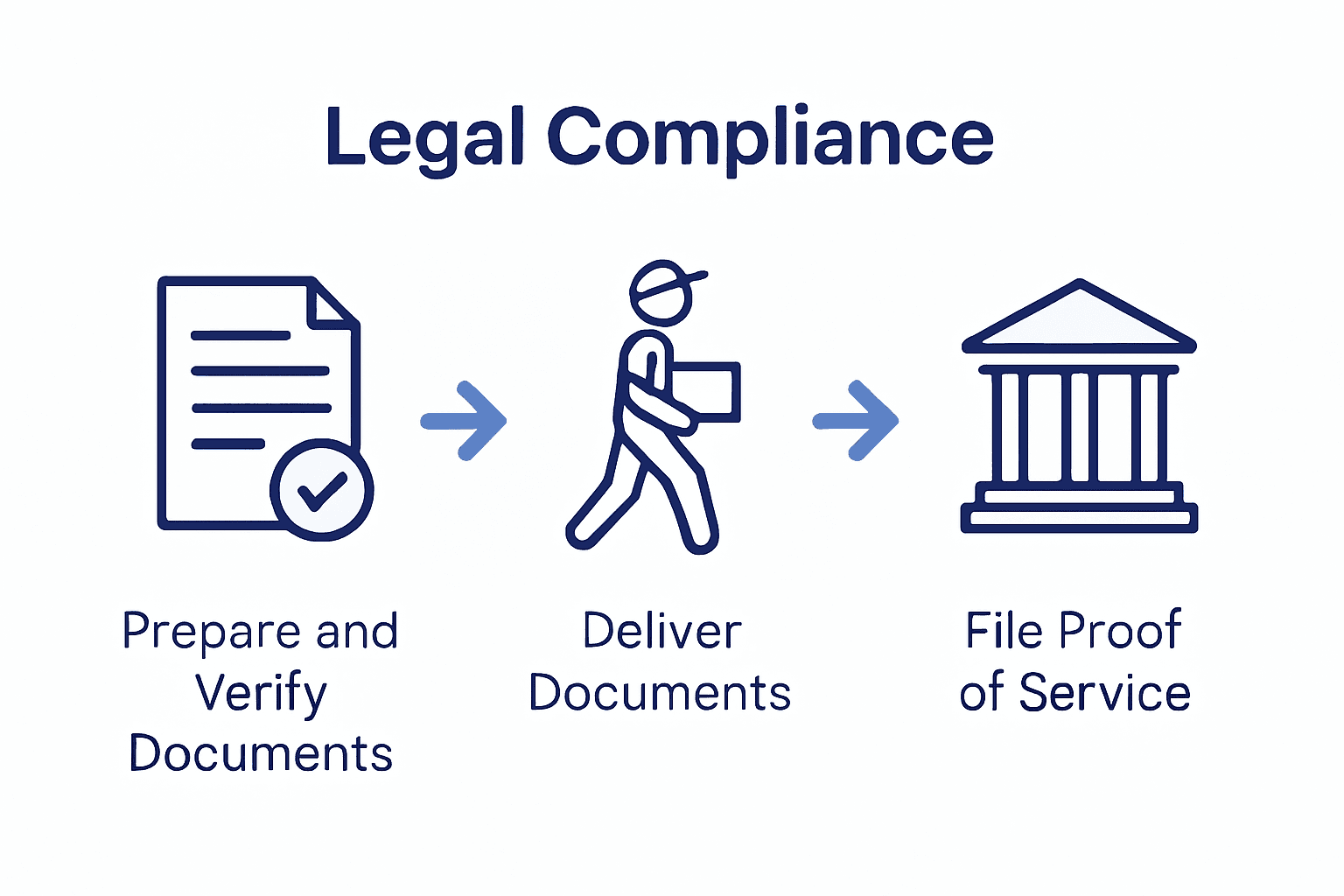
Process serving is a meticulous legal procedure that requires precision and adherence to strict protocols. According to research from ABC Legal, the core workflow involves three critical stages that ensure legal documents are delivered effectively and legally.
The Comprehensive Process Serving Workflow
- Document Preparation
- Court issues official legal documents (summons, subpoena)
- Verify all document details for accuracy
- Prepare comprehensive cover sheet
- Delivery Strategies
- Identify and locate the intended recipient
- Multiple delivery attempts at different times
- Personal service preferred when possible
- Alternative service methods if direct contact impossible
- Documentation and Verification
- Complete detailed proof of service
- File signed service documentation with the court
- Document any challenges or non-service scenarios
Our comprehensive service of process guide offers deeper insights into these intricate procedures. According to ABC Legal’s process serving guidelines, professional servers must make multiple strategic attempts to deliver documents, ensuring the recipient has a genuine opportunity to receive legal notifications.
The critical aspect of process serving is legal compliance. A single misstep can invalidate an entire legal proceeding, which is why professional process servers undergo rigorous training to execute these steps with absolute precision and professionalism.
Legal Standards and Compliance Requirements
Legal document delivery is a complex process governed by intricate federal and state regulations. According to Wikipedia’s research on service of process, federal civil process serving in the U.S. primarily adheres to Federal Rules of Civil Procedure Rule 4, with courts maintaining jurisdiction only when service strictly complies with established legal standards.
Key Compliance Parameters
- Time Limitations: Typically 90 days from complaint filing
- Service Methods:
- Personal service
- Substituted service
- Alternate approved delivery methods
- Geographical Restrictions: State-specific jurisdictional limits
- Server Qualifications: Licensed and authorized process servers
Critical Compliance Considerations
Compliance isn’t just a recommendation—it’s a legal requirement. Learn more about our professional service of process standards to understand the nuanced landscape. As outlined by ABC Legal’s comprehensive guide, proper service involves:
- Precise adherence to state-specific service rules
- Documenting and filing comprehensive proof of service
- Ensuring valid notification of all involved parties
- Meeting strict procedural timelines
Failing to meet these rigorous standards can result in case dismissal, making professional, meticulous process serving not just a service, but a critical legal safeguard.
Roles, Responsibilities, and Client Obligations
Legal document delivery involves a complex ecosystem of responsibilities shared between process servers, clients, and legal entities. According to Wikipedia’s research on registered agents, businesses have specific legal obligations in managing legal communications and document reception.
Client Responsibilities
- Document Accuracy: Provide complete and correct legal documents
- Recipient Information: Supply accurate contact and location details
- Timely Communication: Respond promptly to service requests
- Legal Compliance: Understand and respect service protocols
Key Roles in Document Delivery
Client/Requester
- Initiate legal document service
- Provide comprehensive case information
- Ensure document authenticity
Process Server
- Execute professional document delivery
- Verify recipient identity
- Maintain detailed service records
Registered Agent (for businesses)
- Officially receive legal documents
- Maintain registered business contact information
- Facilitate legal communication channels
Learn more about our comprehensive process serving requirements to understand the intricate dynamics of legal document management. The registered agent’s role is particularly crucial—they serve as the official point of legal contact, ensuring businesses remain accessible and responsive to legal proceedings.
Successful legal document delivery requires collaborative effort, mutual understanding, and strict adherence to professional and legal standards. Each party plays a pivotal role in maintaining the integrity of the legal communication process.
Common Mistakes and How to Avoid Them
Legal document delivery is a minefield of potential errors that can derail entire legal proceedings. According to research from Bryan Fagan Legal, there are several critical mistakes that can compromise the entire service of process.
Typical Service of Process Pitfalls
Critical Mistakes to Avoid:
- Serving documents incorrectly
- Misunderstanding who can legally serve
- Missing critical service deadlines
- Failing to serve the correct legal representative
- Neglecting proper documentation
Strategic Mistake Prevention
Who Can Serve
- Only use authorized process servers
- Verify server’s legal credentials
- Never attempt personal service if untrained
Precise Service Methods
- Confirm correct service method for jurisdiction
- Document every delivery attempt
- Understand alternative service options
Learn more about avoiding critical process serving mistakes to protect your legal interests. The consequences of improper service can be devastating—a single procedural error could result in case dismissal, wasted legal resources, and potential financial penalties.
Professional process servers undergo extensive training to navigate these complex requirements. Their expertise ensures that legal documents are served accurately, legally, and with the utmost precision, minimizing the risk of costly mistakes that could compromise your entire legal action.
Trust YM Doc Services for Flawless Legal Document Delivery
Struggling with the fear of mistakes in legal document delivery? After reading about the risks—improper service, missed deadlines, and costly compliance errors—in our Complete Guide to Legal Document Delivery (US), you know how easily a single oversight can threaten your entire legal case. These problems can cause lost time, court delays, and unnecessary stress.
Get professional support for your service of process today
Imagine handing off every detail to a reliable team that delivers your documents swiftly and in full compliance with legal standards. YM Doc Services brings you peace of mind by focusing on timeliness and accuracy. We help you avoid critical missteps and provide full transparency at every stage. Ready for stress-free legal document management? Visit YM Doc Services right now to start your order or discover all our legal courier services. Protect your case and get support you can count on—act before another deadline passes.
Frequently Asked Questions
What is legal document delivery?
Legal document delivery, also known as service of process, is the formal procedure used to provide official notice of legal action to another party, ensuring court jurisdiction and the right to due process.
What types of documents are typically served in the legal process?
Common types of legal documents served include summons, subpoenas, mandates, and warrants. Each document serves a unique purpose in the legal system, such as notifying a party of legal action or compelling a witness to testify.
What happens if legal documents are served incorrectly?
If legal documents are served incorrectly, it can potentially invalidate the legal proceeding. This may lead to case dismissal, requiring reservice and additional legal complications.
What are the key compliance requirements for legal document delivery?
Key compliance requirements include adhering to specific time limitations for service, following approved delivery methods, ensuring the server is qualified, and completing detailed proof of service documentation.