

Nearly 60 percent of process service errors happen because of missing or incomplete documents. Reliable legal document delivery begins with careful preparation, and one mistake can throw an entire case off track. From filing court papers to confirming proper delivery, understanding the correct steps saves time, avoids costly missteps, and ensures your case proceeds smoothly.
Quick Summary
| Key Point | Explanation |
|---|---|
| 1. Gather all necessary legal documents | Collect original court documents, affidavits, and communication records for accurate service preparation. |
| 2. Choose the right delivery method | Select a service method based on jurisdiction and recipient availability to ensure a valid delivery process. |
| 3. Prepare detailed delivery documentation | Create a comprehensive package with recipient details and service instructions to avoid procedural issues. |
| 4. Execute delivery with precision | Confirm the recipient’s identity and document each interaction during service to validate the process legally. |
| 5. Confirm receipt and prepare affidavit | Compile a thorough affidavit of service to document delivery details and ensure it meets legal standards. |
Table of Contents
- Step 1: Gather Required Legal Documents And Information
- Step 2: Select The Appropriate Delivery Method
- Step 3: Prepare Delivery Documentation And Instructions
- Step 4: Execute Legal Document Service Accurately
- Step 5: Confirm Receipt And Compliance With Legal Standards
Step 1: Gather Required Legal Documents and Information
Before diving into legal document delivery, you’ll need to assemble all necessary paperwork and information strategically. Think of this stage as preparing your legal service toolkit.
Start by collecting every single document related to your legal matter. This means hunting down original court filings, summons, complaints, or any official legal notices. According to legal service guidelines, the accuracy of your document collection determines the success of subsequent service methods.
Verify each document’s completeness and current status. Check for recent amendments, updated contact information, and ensure all pages are present. Missing a single page could invalidate your entire service process.
Key Documents to Compile
- Original court summons
- Complete complaint or petition
- Defendant’s current address information
- Any previous communication records
- Notarized affidavits (if applicable)
As UpCounsel research indicates, your affidavit of service will eventually require precise details. So while gathering documents, simultaneously collect comprehensive information about the individual being served.
Pro Tip: Create a dedicated folder or digital file where you can systematically organize all documents. This prevents last minute scrambling and potential errors.
Once your documents are assembled, you’re ready to move forward with selecting the appropriate service method. Each document set might require a different approach based on jurisdiction and recipient circumstances.
Here’s a comparison of the primary legal document delivery methods discussed:

| Service Method | Proof Provided | When to Use |
|---|---|---|
| Personal Delivery | Immediate receipt confirmation | Direct handoff feasible |
| Substituted Service | Delivery to another responsible | Recipient difficult to reach |
| Mail Service | Return receipt or tracking | Jurisdiction allows mail delivery |
| Legal Courier | Professional tracking & reports | Complex or evasive cases |
Ready to proceed? Your next step involves understanding the specific legal service requirements for your unique situation.
Step 2: Select the Appropriate Delivery Method
Choosing the right document delivery method can make or break your legal service process. Your goal is to ensure legal papers reach the intended recipient through a method that meets court requirements and guarantees valid service.
According to legal service guidelines, you have several primary service methods to consider. Personal delivery remains the gold standard where a professional process server directly hands documents to the recipient. This method provides immediate proof of service and minimizes potential challenges.
If direct personal service proves challenging, substituted service offers an alternative. This involves leaving documents with a responsible adult at the recipient’s residence or workplace. Some jurisdictions allow service through an authorized representative or family member who is over a specific age threshold.
Mail service represents another common approach. You can send documents via certified or registered mail with return receipt requested. This method creates a paper trail and provides documented proof of attempted delivery.
Warning: Not all jurisdictions accept every service method. Always verify local court rules before proceeding.
According to Wikipedia research, jurisdictional deadlines vary significantly. For instance, New York allows 120 days for completing service while Hawaii provides up to six months. Additionally, many states restrict serving documents on Sundays or legal holidays.
Carefully document every service attempt. Courts require precise records detailing when, where, and how documents were delivered. Incomplete or incorrect documentation could invalidate your entire service process.
Ready to move forward? Your next step involves preparing the specific documentation needed to prove your service method was legally compliant.
Step 3: Prepare Delivery Documentation and Instructions
Preparing precise documentation transforms your legal document service from a simple task into a legally bulletproof process. Your goal is creating a comprehensive package that leaves no room for procedural challenges.
Process serving experts emphasize the critical nature of meticulous preparation across every U.S. jurisdiction. Start by creating a detailed service instruction packet that includes all necessary information about the recipient. This means compiling complete contact details, potential alternate addresses, work location, and any known communication preferences.
Your documentation package should include multiple key elements. First draft a comprehensive cover sheet that outlines exactly what documents are being served. Include the court case number, names of parties involved, and specific instructions for the process server. Attach copies of all relevant legal documents in a clear sequential order.
Photographic identification verification becomes crucial. Include clear instructions about verifying the recipient’s identity before service. This might involve requesting specific government issued identification or cross referencing with provided information.
Pro Tip: Create a standardized checklist for your documentation to ensure nothing gets overlooked.
Make multiple copies of everything. One set for court records, one for your files, and one to accompany the actual service attempt. Digital backups provide an additional layer of protection against potential document loss.
Carefully review every single page for accuracy. Typos or incomplete information can derail an entire legal process. Double check names spellings court references and contact information.
Ready to proceed? Your next step involves executing the actual document delivery with precision and legal compliance.
Step 4: Execute Legal Document Service Accurately
Confident document service requires precision navigation through legal protocols. Your mission shifts from preparation to executing a legally sound delivery that stands up to judicial scrutiny.
Legal service experts emphasize the importance of robust compliance strategies during service execution. This means treating each document delivery as a strategic operation where every detail matters. Professional process servers understand that successful service goes beyond mere document handoff.
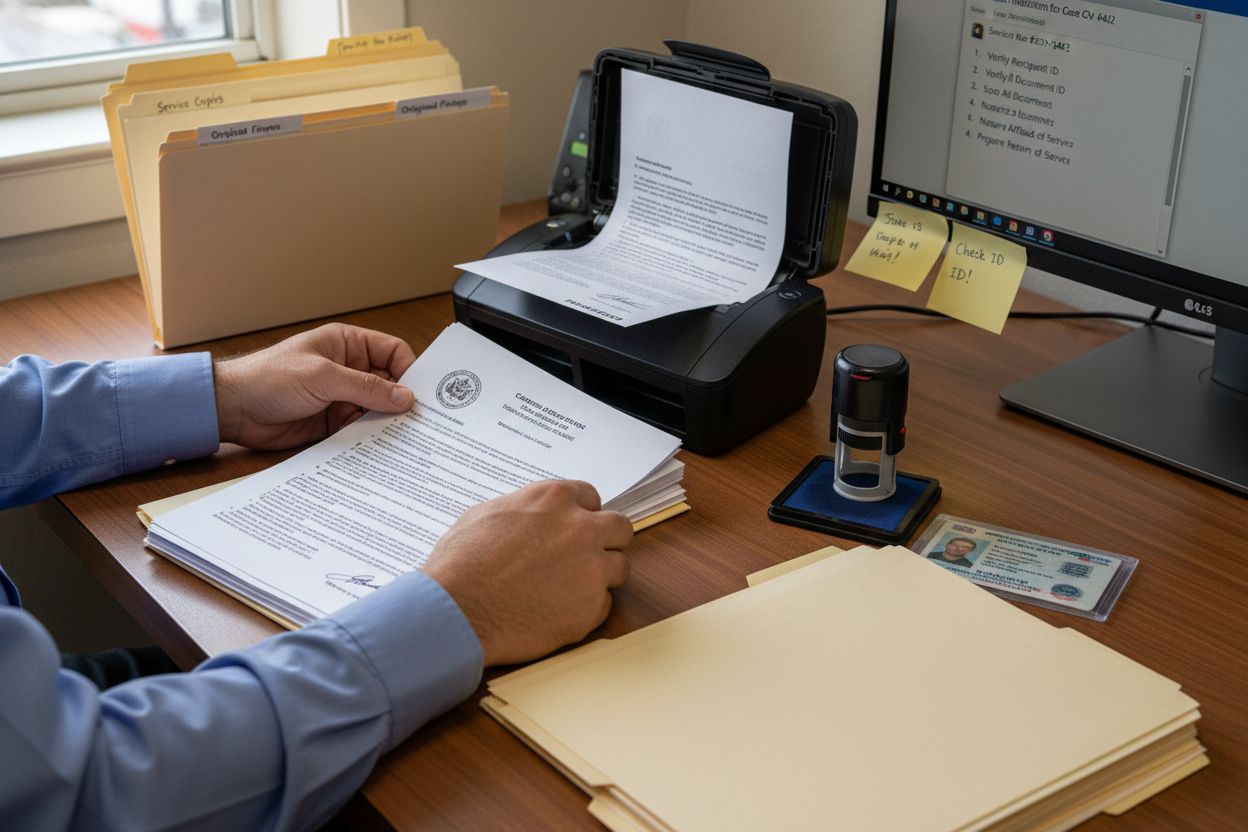
Begin by confirming the recipient’s identity with ironclad verification. Request government issued photo identification and meticulously cross reference details. Document every interaction thoroughly documenting the exact time place and manner of service. Take clear photographs if permissible and maintain a comprehensive log of your service attempt.
Your service approach must adapt to the specific circumstances. Some recipients might be cooperative while others could be evasive. Remain professional calm and persistent. Follow all jurisdictional rules precisely tracking each interaction with forensic attention to detail.
Pro Tip: Always maintain a neutral demeanor and strictly follow legal protocols regardless of recipient cooperation.
Consider utilizing legal courier services for complex or challenging service scenarios. Professional services can navigate difficult serving situations while maintaining legal compliance.
After completing service prepare an affidavit documenting every aspect of your delivery attempt. Include precise timestamps location details and any interactions during the process. This documentation becomes your legal shield protecting the validity of your service.
Ready to wrap up? Your final step involves confirming service completion and preparing court documentation.
Step 5: Confirm Receipt and Compliance with Legal Standards
The final stage of legal document delivery transforms all your previous efforts into official court recognition. Your goal now is creating an airtight record that validates every step of your service process.
UpCounsel research highlights the critical importance of preparing a comprehensive affidavit of service. This document is your legal proof that documents were delivered correctly. An incomplete or improperly filed affidavit could potentially result in service dismissal or even legal consequences for the server.
Prepare your affidavit with meticulous precision. Include every minute detail of the service attempt. Document the exact date time and location of delivery. Record the method of service whether personal delivery substituted service or mail. Capture the recipient’s identification method and any interactions during service.
Notarization transforms your affidavit from a simple record to an official legal document. Schedule a notary to validate your statement adding an extra layer of credibility. Ensure all information is accurate consistent and matches your original service documentation.
Pro Tip: Create digital and physical copies of your affidavit. Store them securely and maintain multiple backups.
According to legal service platforms, many modern services offer client portals where you can access court ready proof of service instantly. These digital platforms provide additional verification and tracking mechanisms.
Review your documentation one final time.
Check for any potential errors or omissions. A single mistake could compromise the entire legal service process. Verify that your affidavit meets all jurisdictional requirements and follows precise legal standards.
Your legal document delivery journey is now complete. You have successfully navigated a complex process with precision and professionalism.
Take the Stress Out of Legal Document Delivery — Get Peace of Mind Now
Following complex guidelines for legal document delivery can feel overwhelming. Missing deadlines, collecting incomplete paperwork, or using the wrong delivery method may risk your case and add unnecessary anxiety. The article highlighted how easily a single error in preparation or compliance can invalidate your service attempt. When time is short and accuracy is critical, you need a partner dedicated to timeliness, legal compliance, and secure handling of every document.
Choose YM Doc Services for trusted legal document delivery. We help lawyers, businesses, and individuals eliminate mistakes by offering expert process serving, swift document retrieval, official notarization, and reliable court filings. Experience a seamless process with clear status updates, secure service, and dedicated support in English or Spanish. Visit our main site today and take the first step to hassle-free legal compliance before your next deadline passes.
Frequently Asked Questions
What key documents do I need for legal document delivery?
You need to gather original court summons, complete complaints or petitions, and the defendant’s current address, among other relevant records. Assemble all necessary paperwork to ensure compliant service, aiming to have everything organized before proceeding.
How do I choose the right delivery method for legal documents?
Select a delivery method based on the recipient’s accessibility and jurisdictional rules. Consider options like personal delivery for immediate proof or mail service when direct contact is difficult, ensuring you meet local legal requirements.
What should be included in the affidavit of service for legal documents?
An affidavit of service must detail the date, time, location of delivery, and the method used. Document everything meticulously; this affidavit serves as your formal proof of compliance and needs to be accurate to uphold legal standards.
How can I ensure the recipient’s identity before serving legal documents?
Confirm the recipient’s identity by requesting a government-issued photo ID and cross-referencing it with existing information. This step is crucial to avoid challenges later, as verifying identity ensures the delivery process adheres to legal protocols.
What do I need to do after completing the legal document delivery?
Once you complete the delivery, prepare a comprehensive affidavit documenting all aspects of the service attempt. Ensure this affidavit is notarized and stored securely, as it serves as essential proof of service in potential legal proceedings.
How can I maintain compliance throughout the legal document delivery process?
Adhere strictly to jurisdictional rules regarding service methods and documentation preparation. Keep thorough records of every interaction and double-check all documents for accuracy to mitigate risks of invalid service or legal disputes.