

Missing a single detail during legal notification can mean a case never reaches court. Service of process forms the backbone of fair and transparent legal proceedings for individuals. Courts dismiss thousands of cases each year due to improper service or incomplete documentation. Understanding how official notice is delivered in legal matters is not just a technicality, it is critical for protecting your rights and ensuring your side of the story is heard.
Table of Contents
- Defining Service of Process For Individuals
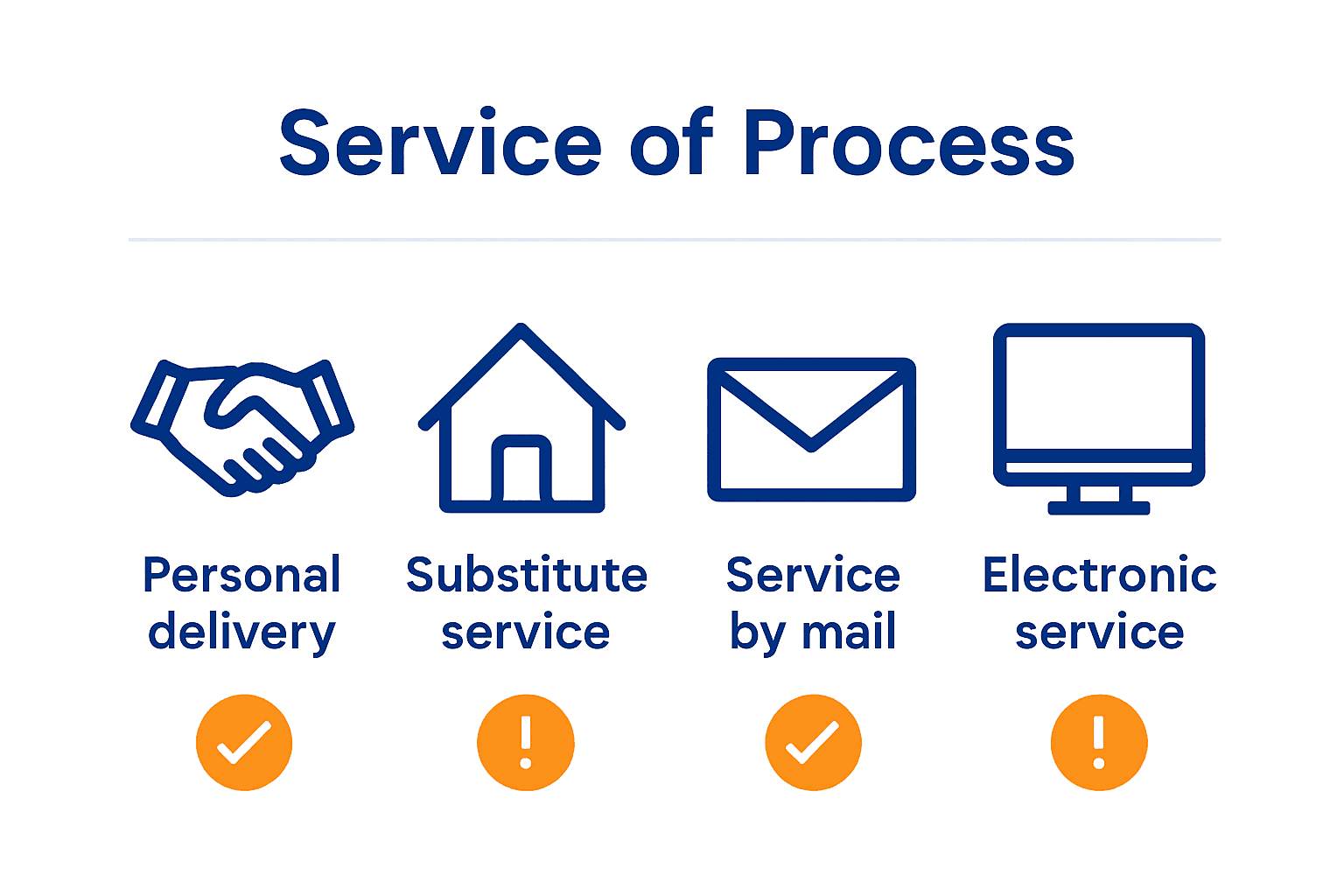
- Methods of Serving Legal Documents
- Legal Requirements And Compliance Standards
- Proof Of Service And Documentation
- Common Pitfalls And Mistakes To Avoid
Key Takeaways
| Point | Details |
|---|---|
| Importance of Service of Process | Service of process ensures individuals are legally notified of lawsuits, providing critical protection of their rights. |
| Various Serving Methods | Methods include personal delivery, substitute service, and electronic service, each with specific legal requirements. |
| Compliance and Documentation | Adhering to legal regulations and maintaining thorough documentation is essential for valid service of process. |
| Common Pitfalls | Avoiding service mistakes, such as incorrect identification and timing errors, is crucial to uphold the integrity of legal proceedings. |
Defining Service of Process for Individuals
Service of process represents the legal mechanism through which an individual receives official notice about a lawsuit or court proceeding. Formal legal notification is crucial because it ensures that all parties have an opportunity to respond and protect their legal rights. According to Cornell Law School, service of process is a fundamental aspect of due process in the legal system, guaranteeing that defendants are properly informed about legal actions against them.
The primary purpose of service of process is to provide legal notice to a defendant or interested party that a legal action has been initiated. This notification typically includes critical documents such as:
- Summons
- Complaint
- Court orders
- Subpoenas
Process serving involves delivering these documents through legally recognized methods to ensure the recipient understands the legal proceedings. Our comprehensive guide on process serving can provide more detailed insights into the intricacies of this legal procedure.
For individuals, service of process can occur through various methods, including personal delivery, substitute service, or sometimes even publication. Each method has specific legal requirements designed to ensure the defendant receives proper notification. The goal is always to provide a fair opportunity for the individual to respond to legal actions, protecting their rights while maintaining the integrity of the judicial process.
Understanding service of process is essential for anyone potentially involved in legal proceedings. Whether you are the person being served or seeking to serve legal documents, knowing the proper procedures can help you navigate complex legal situations more effectively and ensure your rights are protected.
Methods of Serving Legal Documents
Serving legal documents involves multiple strategic approaches designed to ensure defendants receive proper legal notification. Personal service remains the most direct and preferred method, where a licensed process server hand-delivers documents directly to the intended recipient. This method provides immediate confirmation that the individual has been officially notified about legal proceedings.
Legal professionals recognize several primary methods of serving documents:
- Personal Delivery
- Direct hand-to-hand document transfer
- Most legally reliable method
- Provides immediate proof of notification
- Substitute Service
- Documents left with a competent adult at recipient’s residence or workplace
- Used when direct personal service proves challenging
- Requires specific legal guidelines
- Service by Mail
- Certified or registered mail with return receipt
- Provides documented proof of attempted delivery
- Often used for less time-sensitive communications
- Electronic Service
- Increasingly accepted in modern legal environments
- Requires explicit court approval
- Must meet strict authentication requirements
Our comprehensive guide on legal document delivery offers deeper insights into navigating these complex service protocols. Understanding these methods helps ensure legal notifications meet jurisdictional requirements and maintain procedural integrity.
Each serving method carries specific legal implications and documentation requirements.
 Process servers must meticulously follow local and state regulations to guarantee valid service. Factors like recipient location, document type, and jurisdictional rules significantly influence which method can be employed, making professional expertise crucial in executing proper legal document service.
Successful document service goes beyond mere delivery.
It represents a critical step in maintaining fairness within the legal system, ensuring all parties have proper opportunity to understand and respond to legal actions initiated against them. Precise, legally compliant service protects both the plaintiff’s right to proceed and the defendant’s right to due process.
Legal Requirements and Compliance Standards
Legal compliance in service of process represents a complex landscape of strict regulations designed to protect individual rights and ensure fair legal proceedings. Process servers must navigate a intricate web of federal, state, and local requirements that govern how legal documents can be delivered and authenticated. These standards are not merely bureaucratic checkboxes but fundamental safeguards that maintain the integrity of the judicial system.
Key compliance standards typically encompass several critical areas:
Jurisdictional Authorization
Proper licensing and certification
Understanding local court rules
Maintaining professional credentials
Documentation Requirements
Detailed service verification
Accurate proof of service forms
Time-stamped delivery records
Ethical Conduct
Respect for individual privacy
Non-invasive serving techniques
Adherence to legal boundaries
Our comprehensive process server compliance guide offers deeper insights into the nuanced world of legal document service regulations. Professional process servers must demonstrate an intricate understanding of these standards to ensure legal documents are served correctly and legally.
Each jurisdiction maintains unique requirements that can dramatically impact service validity. Some regions mandate specific timeframes for document delivery, while others have strict rules about who can accept service on behalf of the intended recipient. These variations underscore the importance of local expertise and continuous professional education. Failure to comply with these standards can result in service being deemed invalid, potentially derailing entire legal proceedings.
Ultimately, compliance in service of process is about balancing legal precision with respect for individual rights. Process servers act as critical intermediaries in the judicial system, ensuring that legal notifications are delivered professionally, accurately, and in full accordance with established legal standards. Their role requires a delicate blend of legal knowledge, interpersonal skills, and unwavering commitment to procedural integrity.
Proof of Service and Documentation
Proof of service represents the critical legal documentation that verifies a defendant has been officially notified about pending legal proceedings. This formal record serves as an essential validation mechanism, ensuring transparency and accountability in the legal notification process. Every successful service requires meticulous documentation that can withstand potential legal scrutiny and court examination.
The standard proof of service typically includes several key components:
- Server Identification
- Full name of process server
- Professional licensing information
- Contact details
- Service Details
- Date and exact time of service
- Location of document delivery
- Method of service used
- Recipient Information
- Name of person served
- Relationship to primary recipient
- Verification of personal identification
Our comprehensive legal document delivery guide provides in-depth insights into creating thorough and legally defensible service documentation. Professional process servers understand that these documents are more than administrative paperwork they are legal instruments that can determine the validity of entire legal proceedings.
Courts have strict requirements for what constitutes acceptable proof of service. Incomplete or improperly completed documentation can render an entire legal action invalid, potentially causing significant delays or dismissal of cases. This makes precision absolutely critical. Process servers must capture every relevant detail, from the exact moment of delivery to the specific circumstances surrounding the service.
Beyond the immediate legal requirements, comprehensive documentation protects all parties involved. For defendants, it provides clear evidence of when and how they were notified. For plaintiffs, it ensures their legal actions proceed according to established protocols. Ultimately, meticulous proof of service documentation represents a fundamental safeguard in maintaining the integrity and fairness of the judicial process.
Common Pitfalls and Mistakes to Avoid
Legal document service presents numerous potential challenges that can derail entire legal proceedings if not handled with precision and care. Process servers and individuals involved in serving legal documents must navigate a complex landscape of potential mistakes that could compromise the entire legal notification process. Understanding these common pitfalls is crucial for maintaining the integrity of legal communications.
Most frequent mistakes in service of process include:
- Improper Personal Identification
- Serving documents to wrong individual
- Failing to verify recipient’s identity
- Assuming relationship or residence status
- Timing and Location Errors
- Serving outside permitted hours
- Attempting service at inappropriate locations
- Ignoring jurisdictional time restrictions
- Documentation Deficiencies
- Incomplete service records
- Inaccurate time and date stamps
- Missing critical verification details
Our essential legal document process tips guide provides comprehensive strategies for avoiding these potentially costly errors. Professional process servers understand that a single misstep can invalidate months of legal preparation and potentially derail critical legal proceedings.
Many individuals underestimate the complexity of proper legal document service. Common misconceptions can lead to significant legal complications, such as believing that any method of notification is acceptable or assuming family members can always accept service on someone’s behalf. Each jurisdiction maintains specific rules about acceptable service methods, recipient verification, and documentation requirements. These nuanced regulations demand meticulous attention to detail and a deep understanding of local legal protocols.
Ultimately, avoiding service of process mistakes requires a combination of professional training, careful documentation, and an unwavering commitment to procedural accuracy. Process servers must remain vigilant, continuously updating their knowledge of changing legal requirements and maintaining the highest standards of professional conduct. The consequences of errors can be severe, potentially resulting in case dismissals, legal challenges, and significant financial and professional repercussions.
Ensure Your Legal Notices Are Delivered Right the First Time
Navigating the complexities of service of process can feel overwhelming when you consider the strict legal requirements and the risk of costly mistakes discussed in the article. Whether you are concerned about verifying proper identification, meeting jurisdictional rules, or securing airtight proof of service, these challenges demand a reliable partner who understands every step of the process.
YM Doc Services offers expert solutions designed to take the stress away from legal document delivery. With a steadfast focus on timeliness, compliance, and accuracy, our professional process servers guarantee your documents are served correctly according to local rules. We also assist with document retrieval and court filings so you can trust your entire legal notification process is handled professionally.
Don’t leave your legal documents to chance. Visit YM Doc Services now to discover how our comprehensive service of process support can protect your rights and keep your case moving forward without delay. Learn more about our expert process serving and explore our tailored legal document delivery solutions that align perfectly with the needs detailed in the article.
Take control today and secure your peace of mind with trusted legal document services.
Frequently Asked Questions
What is the purpose of service of process?
Service of process provides formal legal notification to individuals about a lawsuit or court proceeding, ensuring they have the opportunity to respond and protect their legal rights.
What methods are available for serving legal documents?
Common methods include personal delivery, substitute service, service by mail, and electronic service. Each method has specific legal requirements and varying levels of reliability.
What constitutes proof of service?
Proof of service includes documentation that verifies a defendant has been notified of legal proceedings, specifying details like the server’s identity, service date and time, recipient information, and method of service.
What are common mistakes to avoid in the service of process?
Common pitfalls include improper personal identification, timing and location errors, and deficiencies in documentation. These mistakes can invalidate legal actions and complicate proceedings.
Recommended
- 7 Essential Types of Process Serving Explained for Legal Use – YM Doc Services
- 7 Key Examples of Process Serving Every Client Should Know – YM Doc Services
- Complete Guide to the Role of Process Server – YM Doc Services
- Process Servers Explained: Ensuring Legal Compliance – YM Doc Services
- Filing Claims Against Public Entity | Serendib Law Firm
We provide GPS-stamped, court-compliant service of process throughout Orange County, Seminole County, and West Volusia County. Licensed Florida process server — FAPPS Member · NAPPS Member · Florida Statutes Chapter 48 Compliant.