

Did you know that a single mistake in process server compliance can render an entire legal case invalid? This reality highlights how precise legal document delivery is more than just procedure—it is the backbone of fair court processes. For anyone involved in legal document service, understanding these strict standards, the varying requirements across states, and the risks involved can help safeguard reputations and ensure every action holds up in court.
Table of Contents
- Defining Process Server Compliance Standards
- Types Of Process Service Requirements In The US
- Key Laws Governing Process Server Conduct
- Essential Steps For Maintaining Compliance
- Risks, Liabilities, And Avoiding Mistakes
Key Takeaways
| Point | Details |
|---|---|
| Importance of Compliance | Process server compliance is essential to uphold the integrity of legal communications, preventing invalidation of legal proceedings. |
| Detailed Documentation | Meticulous documentation and adherence to jurisdictional requirements are critical in achieving and maintaining compliance. |
| Continuous Education | Ongoing professional development and awareness of evolving regulations are necessary for effective compliance and risk mitigation. |
| Risks of Non-Compliance | Failure to follow established protocols can lead to severe legal consequences and damage to professional reputations. |
Defining Process Server Compliance Standards
Process server compliance represents a critical framework of legal and ethical standards governing how legal documents are delivered and served to intended recipients. Legal compliance in this context means strictly following established protocols that ensure the validity and legality of document service. According to lawshun, process servers must adhere to specific legal protocols, explicitly avoiding unlawful actions such as trespassing or impersonation to maintain the integrity of legal document service.
The core standards of process server compliance typically encompass several key requirements:
- Accurate identification of the recipient
- Proper documentation of service attempts
- Adherence to jurisdictional service regulations
- Maintaining professional and ethical conduct
- Submitting precise and truthful affidavits of service
In specific jurisdictions like New York, the compliance standards become even more stringent. subpoenadelivery highlights that process servers are required to meticulously comply with all legal requirements, which include comprehensive preparation and accurate filing of service affidavits. This means every interaction, documentation, and service attempt must be conducted with utmost precision and legal awareness.
Here’s a summary of key compliance standards in major jurisdictions:
| Compliance Standard | General US Protocols | New York Requirements |
|---|---|---|
| Recipient Identification | Accurate identification required | Stringent identity verification |
| Service Documentation | Record all service attempts | Precise, detailed records mandatory |
| Affidavit of Service | Submit truthful affidavit | Comprehensive, accurate filings needed |
| Professional Conduct | Maintain ethical behavior | Enhanced professionalism expected |
| Jurisdictional Regulations | Adhere to local/state laws | Strict adherence to NY state/city laws |
Ultimately, process server compliance is not just about delivering documents—it’s about maintaining the fundamental integrity of legal communication. A single misstep can potentially invalidate an entire legal proceeding, making rigorous adherence to established standards absolutely crucial. Process servers must continuously educate themselves on changing regulations, maintain detailed records, and approach each service with professional diligence. For those seeking deeper insights into professional process serving, our complete guide to the role of process servers offers comprehensive information on best practices and legal requirements.
Types Of Process Service Requirements In The US
Process service requirements in the United States are complex and highly variable, reflecting the diverse legal landscapes across different states and jurisdictions. sprintprocess reveals that licensing requirements for process servers differ significantly between states, with some mandating strict licensing protocols while others maintain more flexible regulations.
Key types of process service requirements typically include:
- State Licensing: Mandatory in some states, optional in others
- Personal Service: Direct hand delivery to the recipient
- Substitute Service: Delivery to an authorized person at recipient’s residence
- Service by Mail: Certified or registered mail with proof of receipt
- Electronic Service: Digital delivery methods in specific legal scenarios
ranworks highlights that certain states like New York have particularly stringent requirements, including mandatory licensing and even GPS tracking of service attempts. These advanced tracking mechanisms ensure accountability and provide verifiable documentation of service attempts.
Navigating these requirements demands significant professional expertise.
 Process servers must understand not just the general principles, but the specific nuances of local jurisdictions. Variations can include age restrictions for servers, documentation standards, permissible service times, and acceptable delivery methods. For professionals seeking comprehensive guidance through this complex landscape, our legal document delivery guide offers an in-depth exploration of national service protocols and best practices.
Key Laws Governing Process Server Conduct
Process server conduct is tightly regulated by a complex web of federal, state, and local laws designed to protect both legal proceedings and individual rights. processanywhere highlights that federal law provides critical protections, explicitly prohibiting interference with process servers and establishing significant penalties including potential fines and imprisonment for those who obstruct legal document service.
The key legal frameworks governing process server conduct typically encompass:
- Strict documentation requirements
- Prohibition of harassment or deceptive practices
- Mandatory adherence to jurisdictional service regulations
- Protection from physical interference
- Maintaining professional boundaries during service attempts
nyc specifically points out that local regulations, such as those in New York City, mandate meticulous record-keeping and compliance with precise service procedures. These requirements ensure transparency and accountability in the legal document delivery process.
Navigating these legal requirements demands extensive knowledge and continuous professional development.
Process servers must stay updated on evolving regulations, understand nuanced legal distinctions between jurisdictions, and maintain the highest standards of ethical conduct. For professionals seeking deeper insights into maintaining legal compliance, our guide on professional process servers provides comprehensive strategies for navigating these complex legal landscapes.
Essential Steps For Maintaining Compliance
Process server compliance requires a systematic and meticulous approach to legal document service. lawshun emphasizes that process servers must categorically avoid illegal actions like trespassing and prioritize proper documentation to maintain professional standards and legal integrity.
Key steps for maintaining compliance include:
- Thorough verification of recipient identity
- Comprehensive documentation of all service attempts
- Strict adherence to jurisdictional service regulations
- Maintaining detailed and accurate service logs
- Continuous professional education and training
subpoenadelivery underscores the critical importance of state-specific compliance, highlighting that accurate preparation and precise filing of service affidavits are fundamental to maintaining legal standards. This means process servers must develop an intricate understanding of local regulations and meticulously follow every procedural requirement.
Successful compliance is not a one-time achievement but an ongoing commitment to professional excellence. Process servers must remain vigilant, continuously update their knowledge, and implement robust systems that prevent potential legal missteps. For professionals seeking comprehensive guidance on navigating these complex requirements, our legal documentation tips guide offers essential insights into maintaining the highest standards of legal document service.
Risks, Liabilities, And Avoiding Mistakes
Legal risks in process serving can be catastrophic, potentially derailing entire legal proceedings and destroying professional careers. processserver reveals that improper service can trigger severe consequences, including substantial fines, potential imprisonment, and complete revocation of professional certification.
The most common risks process servers face include:
- Unintentional violation of service protocols
- Incorrect recipient identification
- Failure to properly document service attempts
- Unauthorized entry or trespassing
- Breach of privacy regulations
- Misrepresentation during service attempts
lawshun emphasizes that engaging in unlawful practices can expose process servers to significant legal action, including potential lawsuits for serious infractions like trespassing or impersonation. These risks underscore the critical importance of maintaining absolute professional integrity and strict adherence to legal standards.
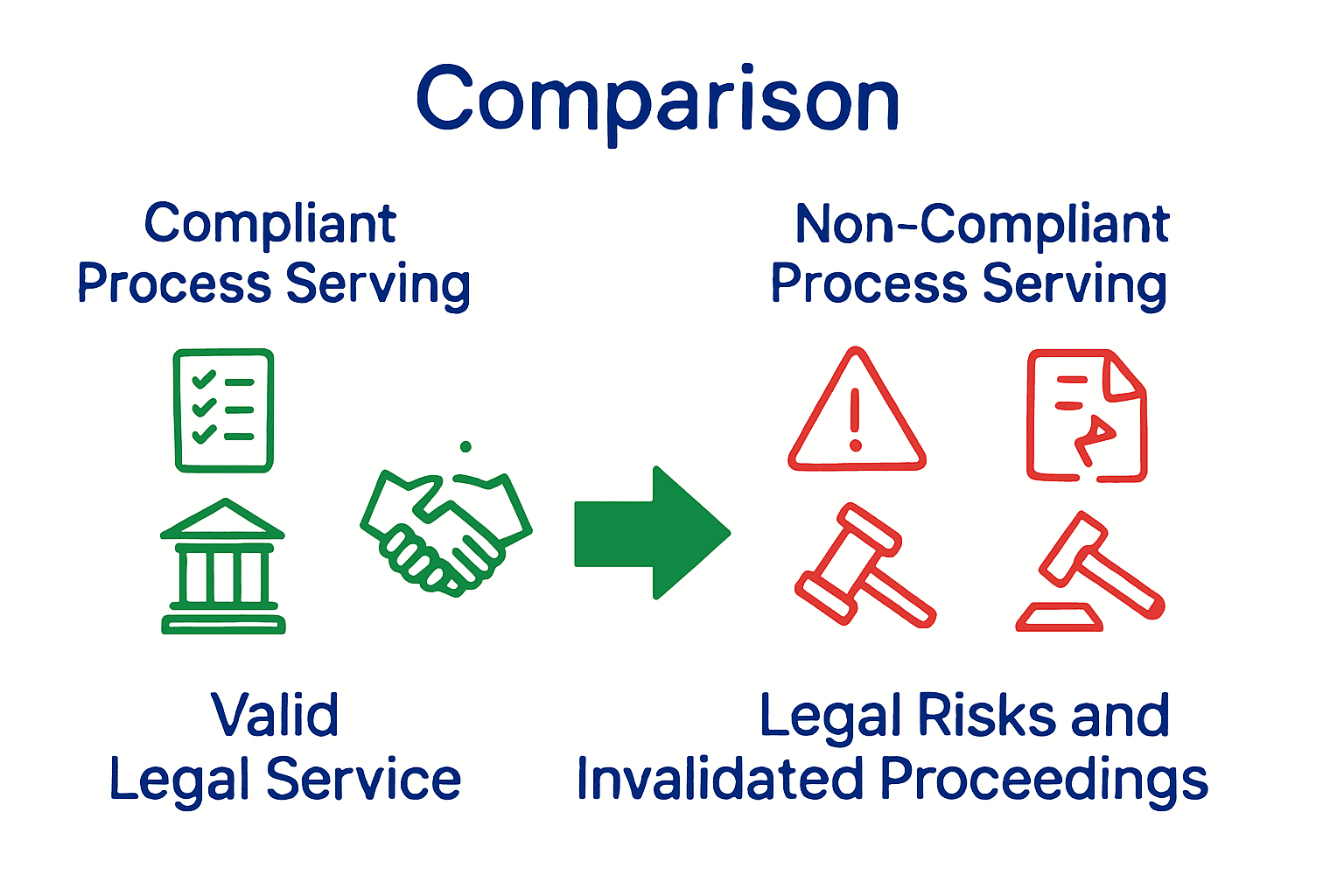
Mitigating these risks requires a proactive, systematic approach to professional practice. Process servers must invest in continuous training, maintain meticulous documentation, and develop a comprehensive understanding of jurisdictional requirements. For professionals seeking comprehensive strategies to navigate these complex legal landscapes, our legal documentation tips guide provides essential insights into protecting your professional reputation and avoiding potential legal pitfalls.
Ensure Flawless Process Server Compliance with Expert Support
Understanding and meeting the strict standards of process server compliance can be overwhelming. The article highlights key challenges such as precise recipient identification, detailed service documentation, and strict adherence to jurisdictional regulations. These factors carry significant risks like invalidated legal proceedings or legal penalties if not handled properly. If you are seeking to avoid costly mistakes and uphold the integrity of your legal communications, having a trustworthy and compliant partner is essential.
At YM Doc Services, we specialize in professional process serving backed by thorough knowledge of compliance requirements and a commitment to legal excellence. Our legal document delivery guide helps you navigate complex service protocols while our complete guide to the role of process servers adds deep insight into best practices. Take control today and protect your case from legal complications by choosing a process server who prioritizes accuracy, ethics, and timeliness. Visit YM Doc Services now to streamline your legal document management and ensure every service meets exact legal standards.
Frequently Asked Questions
What is process server compliance?
Process server compliance refers to the legal and ethical standards that process servers must adhere to when delivering legal documents, ensuring the validity and legality of the service performed.
What are the core standards of process server compliance?
Core standards include accurate identification of the recipient, proper documentation of service attempts, adherence to jurisdictional regulations, maintaining professional conduct, and submitting truthful affidavits of service.
What are the risks associated with non-compliance in process serving?
Risks of non-compliance can include unintentional violations of service protocols, incorrect identification of recipients, failure to document service attempts properly, trespassing, breach of privacy regulations, and potential lawsuits for serious infractions.
How can process servers ensure compliance with legal standards?
Process servers can ensure compliance by thoroughly verifying recipient identity, documenting all service attempts comprehensively, adhering to local service regulations, maintaining detailed service logs, and engaging in continuous professional education and training.
Recommended
- Complete Guide to the Role of Process Server – YM Doc Services
- Process Servers Explained: Ensuring Legal Compliance – YM Doc Services
We provide GPS-stamped, court-compliant service of process throughout Orange County, Seminole County, and West Volusia County. Licensed Florida process server — FAPPS Member · NAPPS Member · Florida Statutes Chapter 48 Compliant.