

Did you know that missing a single court document can cause an entire legal case to collapse? Process servers hold a vital role in the justice system by ensuring no one is left in the dark about legal actions against them. Their work impacts everything from business compliance to personal rights. With so much riding on proper notification and strict legal standards, understanding the duties and challenges faced by process servers can shed light on an often overlooked but essential part of legal proceedings.
Key Takeaways
| Point | Details |
|---|---|
| Role of Process Servers | Process servers are vital legal professionals responsible for delivering court documents and ensuring legal due process. |
| Types of Process Servers | Various types include corporate, judicial, private investigation, and eviction process servers, each serving unique client needs. |
| Legal Requirements | Process servers must comply with strict eligibility criteria, including background checks and licensing, which vary by jurisdiction. |
| Best Practices | Effective risk management strategies, such as using technology and collaborating with law enforcement, are essential for a safe and compliant serving process. |
Table of Contents
- Defining The Role Of A Process Server
- Types Of Process Servers And Their Duties
- Legal Requirements And Compliance Standards
- Steps In The Process Serving Procedure
- Risks, Challenges, And Professional Best Practices
Defining the Role of a Process Server
A process server is a critical legal professional who acts as a neutral third-party messenger in the judicial system. According to Cornell Law, these professionals are responsible for delivering crucial court documents like summons, complaints, and subpoenas that initiate legal proceedings.
The primary function of a process server goes beyond simple document delivery. They ensure legal due process by officially notifying individuals about pending legal actions against them. This notification is fundamental because it prevents default judgments and provides recipients an opportunity to respond to legal challenges. As research from Firefly Legal highlights, process servers play a pivotal role in maintaining fairness within the judicial system.
Process servers often face unique challenges in their profession. Some specialize in locating and serving documents to individuals who actively attempt to avoid legal notifications. Their work requires:
- Exceptional tracking and investigative skills
- Strong understanding of legal protocols
- Ability to maintain professional composure
- Detailed record-keeping for legal verification

Many jurisdictions have specific licensing and regulatory requirements for process servers, underscoring the critical nature of their professional responsibilities. Read more about legal document processes to understand the intricate world of legal document management.
Types of Process Servers and Their Duties
Process servers operate across various legal and business contexts, serving different types of clients with specialized document delivery needs. According to Firefly Legal, these professionals serve a diverse range of clients including law firms, landlords, businesses, and individual parties, each requiring unique approach and documentation.
One critical category is the registered agent, a specialized type of process server in business law. As Wikipedia explains, registered agents are designated to receive official state filings and legal documents on behalf of business entities during normal business hours. They provide a consistent, official legal address that ensures businesses remain compliant with legal notification requirements.
Process servers can be categorized based on their specific service types and client needs:
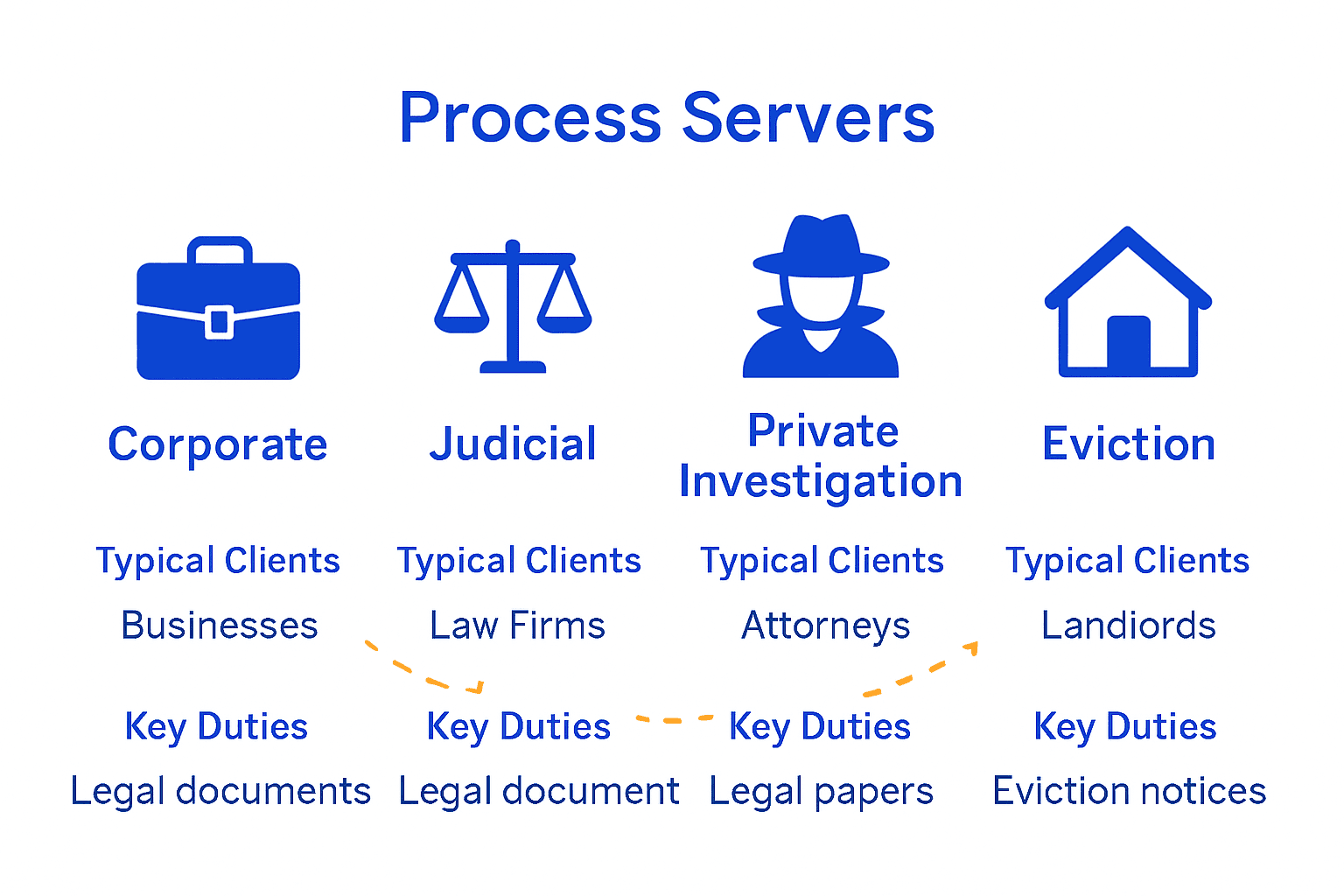
Here’s a comparison of major types of process servers and their core duties:
| Type of Process Server | Typical Clients | Key Duties |
|---|---|---|
| Corporate | Businesses Corporations | Deliver business legal docs Maintain compliance |
| Judicial | Law firms Court systems | Serve court orders File affidavits |
| Private Investigation | Attorneys Individuals | Track evasive parties Locate recipients |
| Eviction | Landlords Property managers | Serve eviction notices Verify resident identity |
- Corporate Process Servers: Handle document delivery for businesses and corporate entities
- Judicial Process Servers: Specialize in court-related document serving
- Private Investigation Process Servers: Focus on locating hard-to-find individuals
- Eviction Process Servers: Work specifically with landlords and property management
Learn more about professional process serving requirements to understand the intricate landscape of legal document management. Their primary duties consistently involve ensuring legal notifications are delivered accurately, professionally, and in compliance with jurisdictional regulations.
Legal Requirements and Compliance Standards
Process serving is a profession with stringent legal requirements that vary significantly across different jurisdictions. According to Firefly Legal, most states impose specific eligibility criteria, including minimum age restrictions, background checks, and professional certifications to ensure the integrity of legal document delivery.
Licensing standards are particularly complex. Many states require process servers to meet multiple professional qualifications. For instance, in states like California, Texas, and Florida, individuals must be at least 18 years old, have no felony convictions, and successfully complete rigorous licensing procedures. As detailed research from Legal Clarity reveals, some jurisdictions like Florida mandate additional requirements such as:
- Permanent state residency
- Passing comprehensive background checks
- Completing written examinations
- Specific county-level training programs
The consequences of non-compliance can be severe. Improper service of legal documents can result in case dismissals, potential legal penalties, and professional disqualification. Understand more about professional process serving standards to appreciate the critical nature of adhering to these stringent regulatory frameworks. Process servers must meticulously document each service through formal affidavits, ensuring transparency and legal accountability in every interaction.
Steps in the Process Serving Procedure
Service of process is a structured legal procedure that requires meticulous attention to detail and strict adherence to jurisdictional protocols. According to Wikipedia, this formal notification process involves multiple strategic steps to ensure legal documents are effectively delivered and legally recognized.
The process serving procedure typically follows a systematic approach that includes several critical stages. First, the process server must locate and verify the identity of the intended recipient. This initial step often requires investigative skills, especially when individuals intentionally attempt to avoid legal notifications. Once located, servers must choose an appropriate service method, which can include:
- Personal service: Direct hand delivery of documents
- Substituted service: Delivering to a suitable alternative person
- Mail service: Sending documents via certified or registered mail
- Publication service: Legal notification through public media when direct service is impossible
After successfully serving the documents, process servers must complete a crucial final step: filing an affidavit of service. This legal document provides proof that notification was completed according to specific jurisdictional rules. Some jurisdictions impose additional restrictions, such as prohibiting service on certain days or requiring specific timeframes for document delivery. Learn more about our comprehensive service of process procedures to understand the intricate details of this critical legal communication method.
Risks, Challenges, and Professional Best Practices
Process servers operate in an inherently unpredictable professional environment fraught with potential risks and complex challenges. According to Process Server Insights, these professionals frequently encounter dangerous situations, particularly when serving documents involving domestic violence cases or legal actions against potentially aggressive criminal defendants.
The professional landscape demands sophisticated risk mitigation strategies. Best practices have evolved to protect both the process server and maintain the legal integrity of document service. Research indicates multiple critical approaches to managing professional risks, including:
- Utilizing GPS tracking technology
- Wearing body cameras during serves
- Maintaining comprehensive documentation
- Collaborating with law enforcement for high-risk serves
- Developing situational awareness and de-escalation skills
States like New York and Arizona have implemented stringent regulatory frameworks to enhance professional standards. As detailed by Ranworks, these jurisdictions mandate extensive requirements such as licensing, substantial surety bonds, continuous professional education, and meticulous record retention. Learn more about professional process serving standards to understand the complex ecosystem of legal document delivery.
Let Our Professionals Handle Your Process Serving Challenges
Are you tired of the stress and uncertainty that comes with ensuring your legal documents are served quickly and in strict compliance with legal standards? This article has highlighted the many challenges process servers face, such as strict licensing requirements, finding evasive recipients, and the importance of detailed, legally valid documentation. Missing deadlines or failing to meet jurisdictional guidelines can put your entire case at risk. You need a reliable partner who truly understands the complex procedures of process serving and legal document management.
YM Doc Services is here to make a difference. Our experienced team specializes in serving legal documents the right way, so you do not have to worry about costly mistakes or missed details. Visit YM Doc Services today to order service of process and explore our full range of legal document support solutions. Act now to protect your legal rights and ensure every document is delivered on time and in full compliance. Our professional support will help you stay one step ahead in any legal process.
Frequently Asked Questions
What is the primary role of a process server?
The primary role of a process server is to deliver legal documents such as summons, complaints, and subpoenas to individuals involved in legal proceedings, ensuring they are officially notified of pending legal actions against them.
What types of clients do process servers typically serve?
Process servers typically serve a diverse range of clients, including law firms, landlords, businesses, and individual parties, each with specific needs for legal document delivery.
What are the legal requirements for being a process server?
Legal requirements for process servers vary by jurisdiction but often include being at least 18 years old, completing background checks, obtaining professional certifications, and adhering to specific licensing standards.
What steps are involved in the process serving procedure?
The process serving procedure involves several critical steps: locating and verifying the recipient’s identity, choosing an appropriate service method (personal, substituted, mail, or publication service), and filing an affidavit of service to prove that notification was completed according to legal requirements.
Recommended
- Understanding the Role of Process Servers in Divorce – YM Doc Services
- 7 Essential Legal Document Process Tips for Smooth Results – YM Doc Services
- Complete Guide to Legal Document Delivery (US) – YM Doc Services
- Legal Document Delivery Guide for Timely, Compliant Service – YM Doc Services
- A Guide to Notary Publics in Ontario – Notary Near Me – My Mobile Notary
- Understanding California Probate: Legal Process & Estate Distribution