

Nearly 75 percent of court cases risk costly delays because defendants never receive their legal documents on time. Missing even a single hand-delivered notice can derail justice and put entire lawsuits at risk. Process servers stand at the heart of every fair legal process, combining detective work, legal know-how, and unwavering attention to detail to ensure that courts and clients can trust every case starts on solid ground.
Key Takeaways
| Point | Details |
|---|---|
| Role of Process Servers | Process servers are essential legal professionals who ensure fair legal proceedings by delivering legal documents directly to parties involved. |
| Service Methods | They employ various methods like personal service, substituted service, and service by publication, adapting based on jurisdictional requirements and circumstances. |
| Legal Compliance | Process serving is highly regulated, requiring servers to adhere to strict laws regarding licensing, service hours, and documentation standards. |
| Advantages Over Alternatives | Professional process servers offer higher success rates, better recipient verification, and advanced tracking, making them preferable to methods like certified mail or sheriff’s deliveries. |
Table of Contents
- What Professional Process Servers Do
- Different Types Of Service Methods
- Legal Requirements And Compliance Standards
- Benefits Over Alternative Delivery Methods
- Common Mistakes When Serving Legal Documents
What Professional Process Servers Do
Process servers are legal professionals who play a critical role in ensuring fair legal proceedings by delivering important legal documents directly to defendants or involved parties. According to research from legal service providers, they officially notify individuals about legal actions by hand-delivering crucial documents like summonses, subpoenas, and complaints.
Their responsibilities extend far beyond simple document delivery. As legal service professionals explain, process servers must:
- Verify the recipient’s true identity
- Make multiple delivery attempts if initial contact fails
- Document each interaction meticulously
- Prepare formal proof of service affidavits
Perhaps most challenging is their ability to locate and serve documents to individuals who are intentionally difficult to find. This might involve sophisticated skip tracing techniques, surveillance, and strategic planning to ensure legal notifications reach their intended recipients. Professional process servers understand that proper service prevents default judgments and guarantees all parties have a fair opportunity to respond to legal proceedings. Read more about the importance of professional process serving to understand how these professionals maintain the integrity of legal systems.
Successful process servers combine investigative skills, legal knowledge, and professional persistence to navigate complex serving scenarios.
 Whether dealing with cooperative or uncooperative recipients, they ensure that legal documents are delivered accurately, legally, and ethically.
Different Types Of Service Methods
Legal document delivery isn’t a one-size-fits-all process. According to Wikipedia’s comprehensive overview, there are several service methods that process servers can utilize depending on specific legal requirements and individual circumstances.
Personal service remains the gold standard, where documents are handed directly to the intended recipient. However, when direct delivery proves challenging, process servers have alternative approaches:
- Substituted service: Delivering documents to a responsible adult at the recipient’s residence or workplace
- Service by mail: Sending documents through postal channels when permitted
- Voluntary acceptance: When recipients willingly accept and acknowledge service documents
- Service by publication: Court-authorized method for serving hard-to-locate individuals
As process server experts explain, substituted service offers significant flexibility. This method allows servers to leave documents with a responsible person and follow up with mailed documentation if required. Strategic approaches like surveillance and skip tracing help locate evasive individuals, ensuring legal notifications reach their intended targets. Learn more about professional process serving techniques to understand the nuanced strategies employed.
The chosen service method depends on jurisdictional rules, case specifics, and the recipient’s accessibility. Professional process servers must navigate these complex requirements with precision, always prioritizing legal compliance and effective communication.
Legal Requirements And Compliance Standards
Process serving is a highly regulated profession with stringent legal frameworks designed to protect individual rights and ensure fair legal proceedings. According to research on legal process serving regulations, these professionals must navigate complex requirements outlined by the Federal Rules of Civil Procedure and an intricate web of state-specific laws.
The legal compliance landscape for process servers is multifaceted, involving critical restrictions and standards:
- Licensing requirements for professional process servers
- Specific service hours limitations
- Strict trespass restrictions
- Prohibitions against impersonation
- Detailed affidavit documentation standards
Wikipedia’s overview of service of process highlights that proper service is fundamental to establishing personal jurisdiction. Jurisdictions impose precise rules about who can serve documents, including:
- Age restrictions (typically servers must be over 18)
- Specific deadlines for completing service after initial filing
- Limitations on service times (such as no service on Sundays or holidays)
Explore more about professional process serving standards, where legal compliance isn’t just a requirement—it’s the cornerstone of maintaining the integrity of legal notifications. Professional process servers must constantly adapt to evolving legal standards, ensuring each document is served with absolute precision and respect for legal protocols.
Benefits Over Alternative Delivery Methods
Professional process servers offer significant advantages over traditional document delivery methods like certified mail or local sheriff’s offices. According to research from legal service experts, these specialized professionals provide more comprehensive and reliable document delivery solutions.
The key benefits of professional process servers include:
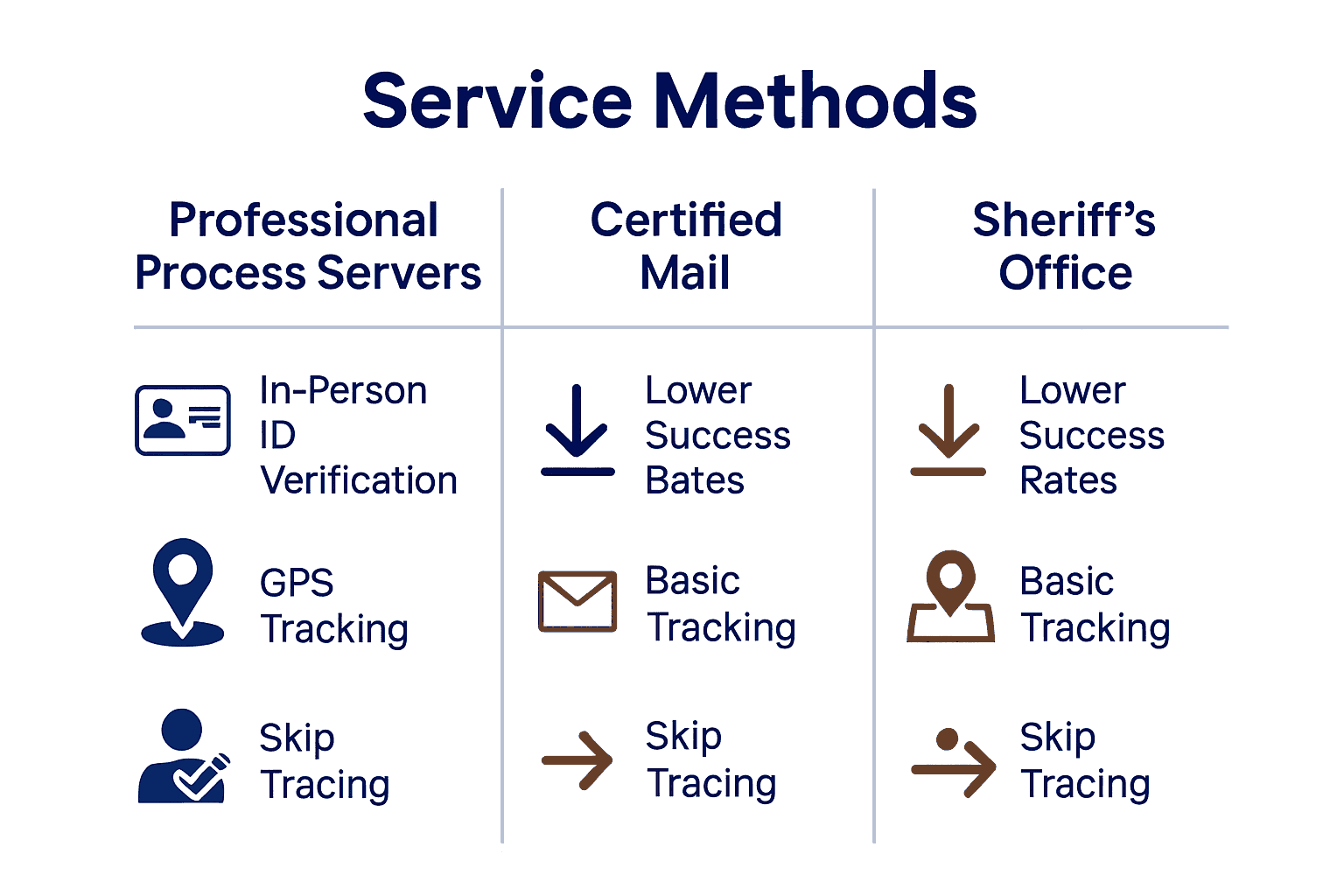
Here’s a comparison of professional process servers versus alternative delivery methods:
| Feature | Professional Process Servers | Certified Mail | Sheriff’s Office |
|---|---|---|---|
| Success Rate | High Multiple attempts | Moderate Depends on acceptance | Variable Limited attempts |
| Recipient Verification | In-person ID check | Signature only | In-person, less flexible |
| Advanced Tracking | GPS, detailed logs | Postal tracking | Basic reporting |
| Service Flexibility | Any time Any location Nationwide | Postal hours Mail only | Office hours Local only |
| Handling Evasive Parties | Skip tracing Surveillance options | Not available | Not available |
| Legal Compliance | Affidavit, strict protocols | Basic proof of mailing | Officer affidavit |
- Advanced tracking capabilities, including GPS monitoring
- National coverage across multiple jurisdictions
- Higher success rates in document delivery
- Ability to verify recipient identity through personal interaction
- Expertise in managing evasive or uncooperative recipients
Unlike certified mail, which can fail if a recipient refuses delivery, or sheriff’s offices operating on limited schedules, professional process servers are dedicated to ensuring documents reach their intended recipients. Learn more about our online legal document delivery services to see how technology and expertise can streamline your legal notifications.
Moreover, professional process servers bring a level of precision and legal compliance that alternative methods cannot match. They understand local regulations, can navigate complex serving scenarios, and provide detailed documentation of their service attempts. This comprehensive approach ensures that legal documents are not just delivered, but delivered in a manner that meets strict judicial standards and protects the legal rights of all parties involved.
Common Mistakes When Serving Legal Documents
Legal document service is a precision-driven process where even minor errors can have significant consequences. Research from process serving experts reveals that seemingly small mistakes can completely derail legal proceedings.
The most critical errors in serving legal documents include:
- Serving the wrong person
- Failing to properly identify the defendant
- Leaving documents with unauthorized individuals
- Trespassing during document delivery
- Missing critical legal deadlines
- Falsifying service affidavits
Additional research highlights other nuanced mistakes that can invalidate legal service:
- Not following state-specific service rules
- Serving documents at incorrect addresses
- Using unauthorized servers
- Failing to file proper proof of service
- Incorrect timing or service locations
- Improper substitute service techniques
Learn more about navigating legal document processes to understand how professional precision can prevent these costly errors. Each mistake represents more than a procedural misstep—it can potentially compromise an entire legal case, waste significant time and resources, and create unnecessary legal complications for all parties involved.
Let YM Doc Services Take the Risk Out of Process Serving
Are you worried a small mistake in process serving could derail your case or cost you valuable time? The article highlights how improper service, missed deadlines, or failing to verify identities can ruin legal proceedings and create unnecessary complications. Legal compliance, proven documentation, and accurate delivery are not just best practices—they are essential safeguards for your reputation and outcomes. At YM Doc Services, we specialize in taking this stress off your shoulders by offering precise and comprehensive legal document management. Learn more about how our legal document process tips can help you avoid costly errors and stay ahead of tight deadlines.
Experience confidence in every delivery. Visit YM Doc Services now to streamline your service of process, access time-saving administrative support, and receive expert guidance in skip tracing, notarization, and court filings. Our professional team is ready to help you eliminate uncertainty and ensure legal compliance today. Don’t let process errors jeopardize your next case—take action now.
Frequently Asked Questions
What is the role of a process server?
Process servers are responsible for delivering legal documents, such as summonses and subpoenas, directly to involved parties. They ensure that individuals are officially notified about legal actions, which is crucial for fair legal proceedings.
What are the different methods of serving legal documents?
There are several methods for serving legal documents, including personal service, substituted service, service by mail, voluntary acceptance, and service by publication. The appropriate method depends on legal requirements and the recipient’s accessibility.
Why should I hire a professional process server instead of using certified mail?
Professional process servers offer a high success rate for delivery, can verify the recipient’s identity in person, and use advanced tracking methods. They also have the expertise to handle evasive parties, ensuring legal documents are served effectively and in compliance with legal standards.
What are common mistakes in the process serving that should be avoided?
Common mistakes include serving the wrong person, failing to follow state-specific rules, improper documentation, and missing legal deadlines. These errors can have significant consequences, potentially invalidating the service and impacting the legal case.