
7 Steps for a Legal Document Preparation Checklist

Over 80 percent of rejected legal documents in american courts result from minor formatting or compliance errors. For anyone dealing with legal paperwork, mastering precise requirements and knowing what information matters can make or break your success. This guide clarifies how to meet tough american standards every step of the way, from gathering vital information to finalizing signatures, so your documents are accurate, compliant, and ready for official acceptance.

Table of Contents

Quick Overview

Key Insight Detailed Explanation
1. Understand Document Requirements Follow specific formatting and compliance standards for legal documents to ensure validity.
2. Gather All Necessary Information Collect accurate personal and document-specific details to avoid invalidation of legal documents.
3. Use Proper Legal Formats Adhere to strict formatting guidelines, including margins, font type, and size, for legal acceptance.
4. Review for Accuracy and Completeness Thoroughly check for errors using detailed checklists to prevent potential legal issues.
5. Secure Proper Signatures and Notarization Ensure original signatures and notarization are obtained to authenticate the document legally.

1. Understand Document Requirements

Successful legal document preparation starts with a comprehensive understanding of specific document requirements. Every legal document has unique formatting, content, and compliance standards that must be meticulously followed to ensure its validity and acceptance by courts and government agencies.

The fundamental requirement for legal documents involves adherence to precise technical specifications. According to the Wisconsin Register of Deeds Association, these specifications can include critical elements such as:

  • Specific margin sizes (typically 1 inch on all sides)
  • Acceptable paper standards (white paper, standard letter size)
  • Inclusion of complete return addresses
  • Precise legal descriptions
  • Clear and legible font types

Additionally, Williams County, Ohio emphasizes the importance of document compliance by highlighting key validation requirements like original signatures and proper notary acknowledgments. These details are not mere suggestions but legal necessities that can determine whether your document will be accepted or rejected.

To effectively understand document requirements, start by researching the specific guidelines for your document type. Contact the relevant government office, review official templates, or consult with a legal professional who can provide precise guidance for your specific document needs. Attention to detail at this stage can save significant time and prevent potential legal complications down the line.

2. Gather All Necessary Information

Legal document preparation demands meticulous information collection. Incomplete or inaccurate information can invalidate an entire legal document, making the information gathering stage crucial to your success.

According to the Public Legal Education Association of Saskatchewan, critical information typically includes:

  • Full legal names of all parties involved
  • Current residential and mailing addresses
  • Relevant dates (marriage, agreement execution, birth)
  • Comprehensive personal details specific to the document type

Williams County, Ohio recommends additional verification steps, emphasizing the importance of including a ‘Prepared by’ statement and ensuring all signatures have corresponding printed names.

To effectively gather necessary information, create a comprehensive checklist tailored to your specific document type. This might involve collecting personal identification documents, financial records, or other supporting materials. Double check every detail for accuracy before proceeding.

Pro tip: Organize your gathered information chronologically and create digital and physical backup copies. This systematic approach prevents last minute scrambling and reduces the risk of missing critical details that could compromise your legal document’s validity.

Legal documents demand precision. The formatting of your document is just as critical as its content, with even minor deviations potentially rendering the entire document invalid.

Williams County, Ohio provides specific guidelines that highlight the essential formatting requirements for legal documents:

  • Standard white letter size paper
  • Consistent black ink
  • Margins between 1 to 1.5 inches
  • Professional font types (such as Times New Roman or Arial)
  • Minimum font size of 10 12 points

The Wisconsin Register of Deeds Association further emphasizes the importance of a Standard Document Format, which includes precise placement of titles, return addresses, and adherence to specific paper quality standards.

To ensure your document meets professional legal standards, create a formatting template that you can reuse. Double check every document against official guidelines, and consider having a legal professional review the formatting before submission. Small details like margin width, font selection, and page layout can significantly impact the document’s legal acceptance.

4. Review for Accuracy and Completeness

Reviewing a legal document is not just a recommended step it is an absolute necessity. One small error or omission can invalidate an entire legal document and potentially create significant complications for all parties involved.

Williams County, Ohio provides critical guidance on document review, emphasizing the importance of checking several key elements:

  • Complete information verification
  • Proper notary seal placement
  • Clear legibility of all text
  • Inclusion of all required signatures
  • Accurate legal descriptions

The Wisconsin Register of Deeds Association further reinforces the significance of document reproducibility and comprehensive information accuracy. Your review should be methodical and thorough, treating each document as if it will be scrutinized under a legal microscope.

To ensure maximum accuracy, consider these practical strategies. First, create a detailed checklist specific to your document type. Second, have at least two different people review the document independently. Third, use digital tools that can help highlight potential errors or missing information. Remember that a few extra minutes of careful review can save hours of potential legal headaches down the road.

Legal document compliance is not optional. It is a critical requirement that protects all parties involved and ensures the document’s legal validity across jurisdictions.

According to the Electronic Code of Federal Regulations, certain professional standards must be strictly followed. The regulations emphasize that legal document preparation requires professional expertise and careful attention to regulatory requirements.

Key compliance considerations include:

  • Verifying state specific legal standards
  • Understanding jurisdiction requirements
  • Maintaining accurate documentation
  • Following precise formatting guidelines
  • Obtaining proper certifications

Wisconsin Register of Deeds Association provides additional guidance on maintaining document compliance, highlighting the importance of meeting specific state level formatting and content standards.

To effectively ensure compliance, develop a systematic approach. Create a comprehensive checklist tailored to your specific document type. Consider consulting with a legal professional who can provide jurisdiction specific insights and help you navigate complex regulatory requirements. Remember that compliance is not just about avoiding penalties it is about protecting the legal integrity of your documents.

6. Secure Proper Signatures and Notarization

Signatures and notarization are the legal backbone that transforms a document from a simple piece of paper into an enforceable legal instrument. Without proper authentication, your document could be rendered invalid or challenged in legal proceedings.

Williams County, Ohio provides critical guidance on signature requirements, emphasizing that every signature must have a corresponding printed name and include appropriate verification.

Key signature and notarization steps include:

  • Ensure all parties sign in blue or black ink
  • Print names clearly beneath each signature
  • Verify signers present valid government issued identification
  • Obtain official notary seal and acknowledgment
  • Confirm all signatures are original and not photocopied

The Wisconsin Register of Deeds Association reinforces the importance of original signatures and proper notary acknowledgments for document recording. For maximum legal protection, consider having a professional notary present during signature execution. They can verify identities, witness signatures, and provide the critical authentication that ensures your document stands up to legal scrutiny.

7. Organize and Submit Documents Efficiently

Document submission is the final critical step that transforms your meticulously prepared legal paperwork into an officially recognized instrument. Efficiency here can save you weeks of potential processing delays and administrative complications.

Williams County, Ohio provides crucial guidance for smooth document submission, recommending the inclusion of a self addressed stamped envelope and verifying the correct recording fees.

Key submission organization strategies include:

  • Create digital and physical backup copies
  • Prepare a comprehensive submission checklist
  • Verify all required fees are included
  • Include a return envelope with proper postage
  • Double check the specific county recording requirements

The Wisconsin Register of Deeds Association emphasizes recording documents in the appropriate county jurisdiction. This means understanding local requirements and submitting to the exact administrative office responsible for your specific document type. A strategic approach reduces the likelihood of rejection and ensures your legal documents are processed quickly and accurately.

This table summarizes the essential steps and considerations for successful legal document preparation as explained in the article.

Main Step Key Points & Actions Benefits/Outcomes
Understand Document Requirements Research specific guidelines for document type; Consult legal professionals for guidance Ensures compliance with legal standards and prevents rejection
Gather All Necessary Information Create detailed checklists; Verify names, addresses, and personal details Avoids invalidation due to incomplete information
Use Proper Legal Formats Follow formatting guidelines (e.g., paper size, margins, font types) Meets professional standards and legal criteria
Review for Accuracy and Completeness Verify information, signatures, and notary details; Have multiple reviews Prevents errors and omissions that could invalidate the document
Ensure Compliance With Legal Standards Verify local legal requirements; Seek expert consultation Protects document’s integrity and ensures validity across jurisdictions
Secure Proper Signatures and Notarization Confirm original signatures and proper notary acknowledgment Provides legal authentication and prevents challenges
Organize and Submit Documents Efficiently Include return envelope, correct fees; Submit to appropriate county Expedites processing and reduces administrative delays

Preparing legal documents is complex and demands strict attention to detail. From understanding specific format requirements to securing proper signatures and ensuring compliance, missing one step can cause costly delays or rejection. If you feel overwhelmed by tasks like verifying accuracy, notarization, or submitting to the correct jurisdiction, you are not alone. Many clients struggle with managing these critical steps efficiently while complying with legal standards outlined in the 7 Steps for a Legal Document Preparation Checklist.

YM Doc Services understands these challenges and offers professional, reliable solutions designed to ease your burden. With expert support in process serving, document retrieval, court filings, and administrative tasks, we help you stay on track so your important legal paperwork is handled accurately and timely. When you choose YM Doc Services, you gain peace of mind knowing your documents meet all requirements and compliance standards every step of the way.
https://ymdocservices.com

Take control of your legal document process today. Visit YM Doc Services to explore how we can help you reduce stress, avoid costly errors, and ensure your documents are perfected and submitted with care. Your next successful legal filing starts here. Reach out now to streamline your legal document preparation and submission.

Frequently Asked Questions

To prepare a legal document effectively, your checklist should include understanding document requirements, gathering all necessary information, using proper legal formats, and ensuring compliance with legal standards. Follow a structured approach to create a comprehensive list that covers each aspect thoroughly.

To ensure accuracy, verify all details such as names, dates, and addresses before finalizing the document. Create a checklist and double-check each piece of information; having at least two people review the document can reduce errors significantly.

Legal documents typically require standard white letter-size paper, consistent font types like Times New Roman or Arial, and specific margin sizes. Use a template that adheres to these guidelines to ensure that your document meets professional legal standards.

Notarization is crucial because it provides legal authentication, making your document enforceable. Ensure all signatures are original, include printed names beneath each signature, and have a notary present during the signing process.

What steps should I take for efficient document submission?

For efficient submission, prepare a comprehensive checklist, include all required fees, and create digital and physical backup copies of your documents. Ensure you verify the specific requirements for the county where the document will be recorded to avoid delays.

To verify compliance, carefully research state-specific legal standards and create a detailed checklist of all requirements. Consider consulting a legal professional who can guide you through any complex regulations related to your document type.

Posted in Uncategorized

7 Real-Life Examples of Process Serving Scenarios Explained

Most american process servers face situations where the success of a case hinges on timely and correct document delivery. Whether it is divorce papers, corporate subpoenas, or child custody notifications, proper service is not just a technicality. In fact, even a single misstep in the serving process can delay or jeopardize a legal outcome. Understanding these high-stakes scenarios helps anyone involved in legal matters make informed, confident decisions about ensured, effective process service.

Table of Contents

Quick Summary

Takeaway Explanation
1. Confirm the correct address before serving Ensuring you have the accurate residential address is crucial for legally serving divorce papers effectively.
2. Professional delivery reduces stress Choosing a professional process server helps ensure compliance with legal standards and alleviates personal stress during service.
3. Use skip tracing for evaders Employ advanced techniques like skip tracing when defendants actively avoid legal notifications to ensure proper service.
4. Maintain professionalism in sensitive cases In emotionally charged situations, like child custody, approach document delivery discreetly while upholding the legal process.
5. Document every service attempt meticulously Keeping detailed records of all attempts to serve documents is essential to prove due diligence in court.

1. Serving Divorce Papers to a Spouse at Home

Serving divorce papers at home represents one of the most sensitive and challenging process serving scenarios. The legal requirement demands precise execution to ensure proper notification and maintain legal validity.

In California, the process of serving divorce papers involves strict protocols that protect both parties legal rights. Personal service means physically delivering the divorce documents directly to the spouse, which must be completed by an individual over 18 who has no personal involvement in the legal case. According to California Courts Self Help, this can be accomplished by a professional process server, county sheriff, friend, or family member.

The actual home delivery requires strategic planning and professional approach. Process servers must locate the spouse at their residential address and hand the documents directly to them. This method ensures immediate and verifiable receipt of legal notifications. If the spouse is evasive or attempts to avoid service, professional servers might employ techniques like waiting for opportune moments such as when the individual is entering or leaving their home.

Key considerations for successful home service include:

  • Confirm the correct residential address beforehand
  • Approach respectfully and professionally
  • Verify the identity of the recipient
  • Document the exact time and manner of service
  • Complete the mandatory Proof of Service form

While home service might seem straightforward, it requires careful navigation of legal and personal boundaries. Professional process servers understand how to handle potential emotional reactions and maintain a neutral, legal approach during document delivery.

Choosing a professional service ensures legal compliance, reduces personal stress, and provides official documentation of the notification process. Understanding the Role of Process Servers in Divorce can provide additional insights into this critical legal procedure.

2. Delivering Subpoenas to Corporate Offices

Delivering subpoenas to corporate offices represents a critical and complex process serving scenario that requires precision, legal knowledge, and strategic approach. Unlike personal service, corporate document delivery involves navigating organizational hierarchies and specific legal requirements.

According to the US Courts Federal Rules of Civil Procedure, Rule 45 provides explicit guidelines for serving subpoenas to organizations. Corporate subpoena service must target specific authorized representatives who can legally receive such documents. This typically means delivering the subpoena directly to an officer, managing agent, or other officially designated corporate agent.

The process involves several strategic considerations. Process servers must first identify the correct corporate entity and confirm the appropriate recipient within the organization. This might require preliminary research to determine the correct legal representative who can accept service. Some corporations have specific protocols for receiving legal documents, often routing them through their legal department or designated registered agent.

Key steps for successful corporate subpoena delivery include:

  • Verify the exact legal name of the corporate entity
  • Identify the authorized agent for legal document receipt
  • Confirm the corporate headquarters or official address
  • Document the precise time and manner of service
  • Ensure proper handling and receipt of the subpoena

Professional process servers understand the nuanced requirements of corporate service. They recognize that delivering a subpoena is more than simply handing over documents it involves maintaining legal integrity and following strict procedural guidelines. Corporations often have security measures and reception protocols that require skillful navigation.

For businesses and legal professionals seeking more comprehensive guidance, Process Serving for Businesses: Step by Step Guide to Compliance offers additional insights into effective legal document delivery strategies.

3. Locating and Serving Evading Defendants

Locating and serving defendants who actively avoid legal notifications represents one of the most challenging scenarios in process serving. These individuals intentionally create barriers to prevent receiving official legal documents, complicating the legal proceedings and potentially delaying justice.

According to the US Courts Federal Rules of Civil Procedure, Rule 4 provides specific guidelines for serving individuals who are difficult to locate. Skip tracing becomes a critical investigative technique in these situations, involving sophisticated methods to track down individuals who do not want to be found.

Professional process servers employ multiple sophisticated strategies to locate evading defendants. These may include analyzing public records, conducting database searches, investigating social media profiles, checking utility records, and even performing physical surveillance. The goal is to confirm a valid address and create an opportunity for legal document delivery.

When personal service proves impossible, legal alternatives exist. Skip Tracing: How Professionals Locate Individuals for Legal and Financial Matters outlines several potential approaches courts may authorize:

  • Service by publication in local newspapers
  • Certified mail with return receipt
  • Electronic service through verified email
  • Notification through known family members
  • Service via social media platforms

The key requirement is demonstrating due diligence. Process servers must document comprehensive efforts to locate and personally serve the defendant. Courts typically require detailed evidence showing multiple attempted contact methods before approving alternative service strategies.

Professional process servers understand that each evasion scenario is unique. They combine technological tools, investigative skills, and legal knowledge to overcome challenges and ensure proper legal notification. Persistence and strategic thinking are essential when dealing with defendants attempting to avoid their legal responsibilities.

Serving legal notices at a person’s workplace represents a delicate and strategic process serving scenario that requires exceptional professional discretion and precise legal understanding. This method of service becomes necessary when other traditional notification approaches have proven challenging or ineffective.

According to the US Courts Federal Rules of Civil Procedure, workplace service is permissible but must be conducted with utmost respect for the individual’s professional environment. Workplace legal service demands a careful balance between fulfilling legal requirements and maintaining the recipient’s professional dignity.

Professional process servers approach workplace service with a strategic and sensitive methodology. They typically aim to minimize public embarrassment and workplace disruption while ensuring proper legal document delivery. This often involves coordinating with human resources departments, identifying appropriate moments for discrete interaction, and maintaining a professional demeanor throughout the service process.

Key considerations for successful workplace legal notice service include:

  • Verify the recipient’s exact work location
  • Confirm the individual is present and accessible
  • Choose a private moment for document delivery
  • Maintain professional and respectful communication
  • Document the exact time and manner of service
  • Ensure compliance with workplace interaction protocols

The legal landscape surrounding workplace service varies by jurisdiction, making professional expertise critical. Service of Process Laws: Complete Guide for 2025 provides comprehensive insights into navigating these complex legal requirements.

Professional process servers understand that workplace service is more than simply handing over documents. It requires emotional intelligence, legal knowledge, and the ability to manage potentially sensitive interactions while maintaining the integrity of the legal notification process.

5. Process Serving for Out-of-State Parties

Process serving for out-of-state parties introduces a complex legal challenge that requires navigating multiple jurisdictional regulations and intricate service protocols. This scenario demands specialized knowledge and strategic approach to ensure legal documents are delivered correctly across state boundaries.

According to the US Courts Federal Rules of Civil Procedure, Rule 4 provides comprehensive guidelines for serving legal documents to individuals residing in different states. Interstate process serving requires meticulous attention to both the originating state’s legal requirements and the recipient’s state service regulations.

Professional process servers must understand the nuanced differences between state laws governing document service. This involves researching specific state protocols, identifying authorized service methods, and ensuring compliance with local legal standards. Some states may require personal service, while others might permit alternative delivery methods such as certified mail or electronic notification.

Key considerations for successful out-of-state process serving include:

  • Verify the recipient’s exact location and residency
  • Research specific state service requirements
  • Confirm authorized service methods
  • Document all service attempts meticulously
  • Obtain verifiable proof of service
  • Understand potential jurisdictional challenges

The complexity of out-of-state service often requires professional intervention. Serving Documents Out of State: A Step-by-Step Guide provides comprehensive insights into navigating these intricate legal requirements.

Professional process servers recognize that successful out-of-state service goes beyond simply delivering documents. It requires a sophisticated understanding of legal procedures, interstate regulations, and the ability to adapt to diverse legal environments while maintaining the integrity of the legal notification process.

6. Attempting Service at Multiple Addresses

Attempting service at multiple addresses represents a critical strategic approach in process serving when initial delivery attempts prove unsuccessful. This method demonstrates the legal system’s commitment to ensuring fair notification while recognizing the challenges of locating individuals.

According to the US Courts Federal Rules of Civil Procedure, legal professionals must demonstrate reasonable efforts to serve defendants. This requirement means process servers cannot simply give up after one failed attempt but must systematically explore multiple potential locations.

Professional process servers approach multiple address attempts with a methodical and strategic mindset. They leverage various investigative techniques to verify and track potential residential and workplace locations. This might include cross referencing public records, utility registrations, postal forwarding information, and other legal data sources to identify potential service locations.

Key strategies for multiple address service attempts include:

  • Verify each address through multiple information sources
  • Document every service attempt meticulously
  • Maintain detailed records of location research
  • Understand legal requirements for proving due diligence
  • Use professional skip tracing techniques
  • Respect legal and privacy boundaries during investigation

The complexity of multiple address service often requires specialized expertise. Service of Process Workflow: Everything You Need to Know provides comprehensive insights into navigating these challenging scenarios.

Ultimately, successful service at multiple addresses requires patience, persistence, and a thorough understanding of legal protocols. Process servers must balance aggressive investigation with professional discretion, always prioritizing legal compliance and individual privacy.

7. Serving Documents for Child Custody Cases

Serving documents in child custody cases represents one of the most sensitive and emotionally charged process serving scenarios. These legal notifications require exceptional professionalism, discretion, and meticulous attention to legal protocols.

According to the US Courts Federal Rules of Civil Procedure, Rule 4 mandates personal service as the primary method for delivering child custody legal documents. This means the documents must be directly handed to the recipient, ensuring they receive official notification of legal proceedings involving their children.

Professional process servers approach child custody document service with heightened sensitivity. They understand these documents carry significant emotional weight and can potentially impact family dynamics. The server must remain neutral, professional, and focused on completing legal requirements while minimizing potential conflict or distress.

Key considerations for child custody document service include:

  • Verify the correct recipient identity
  • Choose a discrete and appropriate location
  • Maintain professional and neutral demeanor
  • Document the exact time and manner of service
  • Protect the privacy of all involved parties
  • Follow all legal requirements precisely
  • Minimize potential emotional stress

The complexity of child custody document service often requires specialized expertise. 7 Key Examples of Process Serving Every Client Should Know provides additional insights into navigating these delicate legal scenarios.

Successful service in child custody cases demands more than technical legal compliance. It requires emotional intelligence, professional discretion, and a deep understanding of the potential human impact of legal notifications.

This table summarizes the key topics and strategies involved in serving legal documents as described in the article.

Scenario Key Steps Considerations & Outcomes
Serving Divorce Papers Personal service involves delivering documents directly to the spouse. Requires strategic planning, identity verification, and documentation of service.
Corporate Subpoena Service Target authorized representatives such as officers or agents. Navigate organizational hierarchies and confirm legal entity.
Locating Evading Defendants Use skip tracing and various investigative techniques. Persistence and legal alternatives such as publication or certified mail.
Workplace Service Coordinate with HR and choose discreet moments for delivery. Maintain recipient’s professional dignity and comply with legal protocols.
Out-of-State Service Understand jurisdictional differences in service methods. Requires knowledge of interstate legal protocols and obtaining proof of service.
Multiple Address Attempts Explore various potential locations using investigative techniques. Demonstrates reasonable efforts and proves due diligence.
Child Custody Documents Provide personal service directly to the recipient. Handle with sensitivity to minimize emotional impact and protect privacy.

The article highlights the challenges of serving divorce papers at home, delivering subpoenas in corporate settings, locating evasive defendants, and managing sensitive documents like those in child custody cases. These are not just legal formalities but deeply personal and sometimes stressful situations requiring precision, discretion, and compliance with strict regulations. If you are facing these difficulties you understand the importance of professional help that can navigate the nuances of service protocols to protect your legal rights and reduce your stress.

https://ymdocservices.com

Take the first step toward seamless, reliable process serving with YM Doc Services. Our team specializes in efficient service of process tailored to your unique needs from skip tracing to workplace delivery and out-of-state service. Explore how our expert approach ensures timely, legally compliant notification by visiting Understanding the Role of Process Servers in Divorce and learn more about our comprehensive offerings at YM Doc Services. Do not wait until delays disrupt your legal case. Contact us today and experience peace of mind with every document delivered correctly and on time.

Frequently Asked Questions

What is the process for serving divorce papers at home?

Serving divorce papers at home involves physically delivering the legal documents directly to your spouse. To do this, ensure you have the correct address, verify the recipient’s identity, and document the service method. Using a professional process server can help simplify this sensitive task.

How can I successfully deliver subpoenas to a corporate office?

Delivering subpoenas to a corporate office requires identifying the authorized recipient, such as an officer or designated agent. Research the corporation’s protocols for receiving legal documents and maintain a record of your delivery attempt. This attention to detail helps ensure compliance and legal validity.

What strategies do process servers use to locate evading defendants?

Process servers employ skip tracing techniques, analyzing public records, social media, and utility documents to track down individuals who avoid being served. Conduct thorough investigations to verify addresses and make multiple attempts to ensure successful service. Persistence is key.

What steps should I follow when serving documents at a workplace?

When serving documents at a workplace, verify the recipient’s exact work location and choose a discreet moment for delivery. Aim to maintain professionalism and minimize disruption while documenting the service details. This approach helps balance legal obligations with workplace respect.

To serve legal documents to someone in another state, research the specific service requirements of both states involved. Determine approved delivery methods, such as certified mail or personal service, and meticulously document all attempts to ensure compliance with legal standards.

What should I do if my initial service attempts fail and I need to try multiple addresses?

If your initial service attempts fail, you should methodically explore multiple addresses where the individual may be located. Verify each potential address using public resources and maintain detailed records of your attempts. This due diligence is crucial for complying with legal requirements.

Posted in Uncategorized

Top Legal Document Support Services Ranked – Expert Review 2025

Finding the right support for legal document handling can completely change how smooth a case runs. From businesses looking to meet a tight deadline to individuals managing important paperwork, the options out there offer a surprising range of tools and services. Some promise speed, while others focus on accuracy or offer extra help that saves valuable time. Each provider brings a different mix of convenience, trust, and expertise. What if there was a way to cut through the confusion and see which features make your job easier and help you get things done right the first time?

Table of Contents

YM Doc Services

Product Screenshot

At a Glance

YM Doc Services is a focused process serving agency that delivers legal documents accurately, on time, and in compliance with applicable laws. It serves attorneys, businesses, and individuals in Orlando and surrounding areas with a compact but comprehensive service set that includes process serving, skip tracing, document retrieval, court filings, notary, and immigration document services. Bottom line: if you need dependable, legally compliant delivery and support handled by experienced professionals, YM Doc Services is built for that mission.

Core Features

YM Doc Services concentrates on the operational essentials lawyers and businesses care about most: fast and reliable process serving, strict compliance with local, state, and federal rules, skip tracing and document retrieval, court filing services, plus notary and immigration document support. The offering emphasizes accuracy and timeliness across each workflow, ensuring served papers meet procedural standards and court deadlines. The provider’s scope is deliberately practical rather than bloated: everything centers on getting documents where they need to be while preserving evidentiary and legal integrity.

Pros

  • Experienced team of professional process servers: The staff’s experience reduces risk of improper service and increases the chance of timely, verifiable delivery.
  • Specializes in legal document delivery: Specialization means processes and training focus on legal rules and proof-of-service requirements, which matters in contested cases.
  • Comprehensive range of related services: Offering skip tracing, document retrieval, court filings, notary, and immigration document services creates a single vendor solution that saves time and coordination overhead.
  • Focus on accuracy and timeliness: Emphasizing on-time delivery and compliance helps law firms meet court deadlines and avoid procedural setbacks.
  • Serves attorneys, businesses, and individuals: A broad client base indicates the team can adapt service levels to professional and personal needs alike.

Who It’s For

YM Doc Services is ideal for attorneys and law firms that need reliable process serving and court filing support, corporate legal teams managing discovery or enforcement tasks, and individuals who require secure delivery or notarization of legal documents. If you operate in or around Orlando and prioritize compliance, verified service, and a compact vendor relationship, YM Doc Services aligns closely with your needs.

Unique Value Proposition

YM Doc Services differentiates itself through concentrated legal-document expertise and a service suite that minimizes vendor fragmentation. Instead of offering generic courier services, YM Doc Services centers on legally sensitive tasks—process serving, skip tracing, retrieval, court filings, notarization, and immigration document handling—each executed with an eye toward evidentiary proof and statutory rules. That specialization reduces the learning curve for legal teams, limits coordination errors, and elevates reliability compared with general-purpose delivery vendors. The result: fewer missed deadlines, clearer proofs of service, and reduced administrative lift for attorneys and paralegals. This design choice—depth over breadth—makes YM Doc Services particularly effective where compliance and timeliness cannot be compromised.

Real World Use Case

A law firm hires YM Doc Services to serve papers on a defendant while also using skip tracing to locate an evasive respondent. YM Doc Services executes service in compliance with local rules, files required court documentation, and returns verifiable proof of service so the firm meets its filing deadline and preserves case posture.

Pricing

Pricing is not specified in the provided content.

Website: https://ymdocservices.com

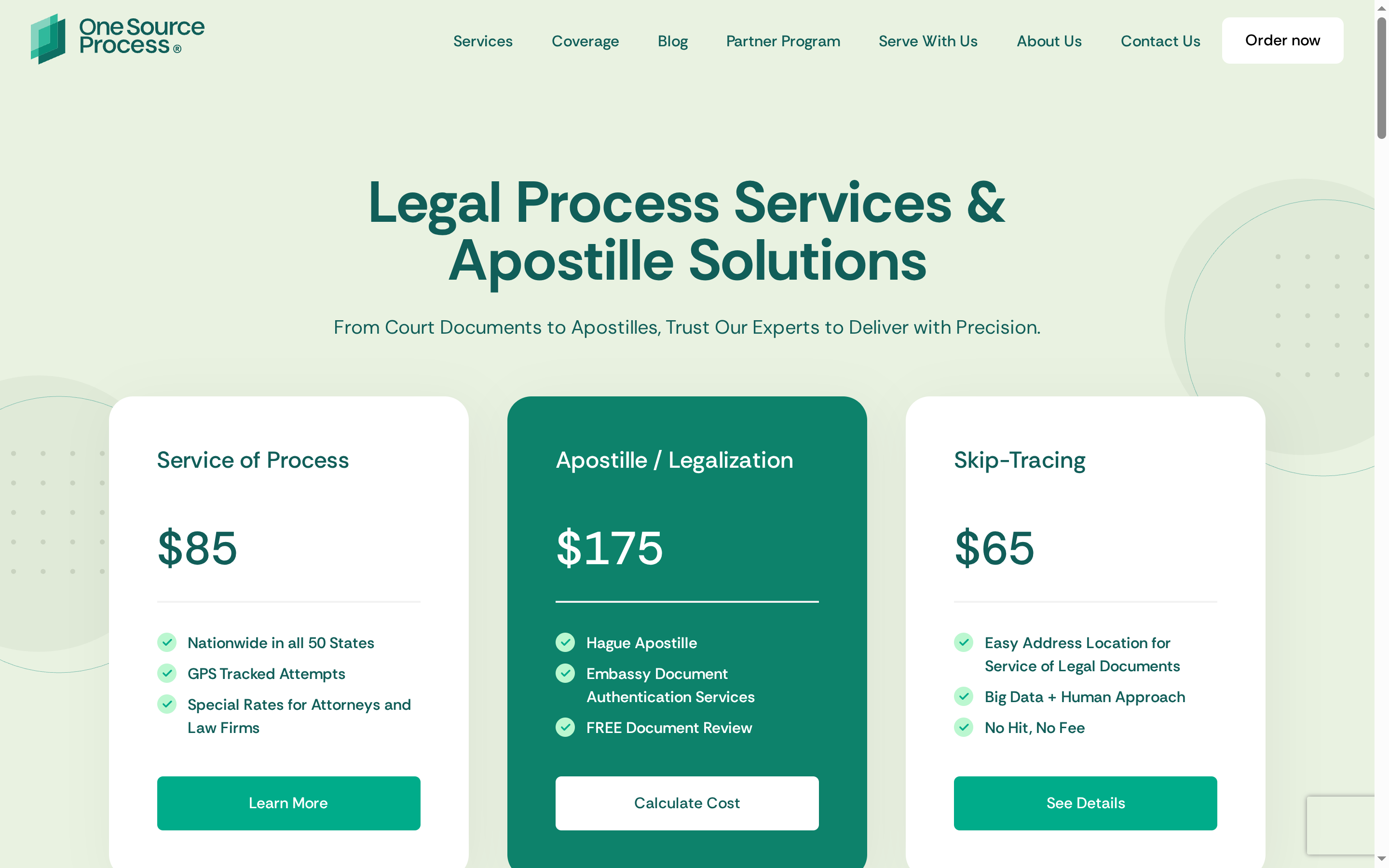
One Source Process

Product Screenshot

At a Glance

One Source Process is a full-service process serving and document processing provider with true nationwide reach, positioned to support attorneys, law firms, and individuals who need reliable, trackable legal document handling. They combine local expertise across all 50 states with fast turnaround—often within 24 hours—and visible proof of service via GPS and photo tracking. That mix of speed, scope, and technology makes them a practical choice when timelines are tight. Caveat: details about a customer portal or extended support hours are unclear.

Core Features

One Source Process handles service of process across every state and territory and offers complementary services that minimize handoffs: apostille and legalization (including Hague apostilles and embassy authentication), skip-tracing to locate individuals or entities, traveling notary services, court filing, document retrieval, and subpoena preparation. Their nationwide network leverages local knowledge while providing centralized coordination, and their process serving technology captures GPS coordinates and photo proof to document attempts and completions.

Pros

  • Nationwide coverage with local expertise: They operate in all 50 states and territories while emphasizing local knowledge to reduce service delays and compliance issues.
  • Transparent and competitive pricing: The company publishes straightforward service fees, which helps you budget case costs without guesswork.
  • Fast turnaround in many cases: Many requests are handled within 24 hours when circumstances allow, which helps meet tight filing windows and court deadlines.
  • Advanced tracking technology: GPS and photo tracking provide verifiable evidence of attempts and successful service, strengthening your proof chain.
  • Comprehensive legal document processing: From apostilles to subpoenas, they bundle multiple services so you can avoid juggling separate vendors.

Cons

  • No clear online customer portal or mobile app is described: The absence of details about a client portal or mobile app may limit self-service status checks for some users.
  • Limited information on after-hours support: There is sparse information about customer support availability outside standard business hours, which could matter for urgent filings.
  • Possible higher rates for specialized tasks: Certain niche or expedited services may carry higher fees, but specific surcharges are not listed in the available data.

Who It’s For

One Source Process is well suited for attorneys, law firms, bail bondsmen, and legal professionals who need consistent, nationwide process serving and document processing without managing multiple vendors. It also fits individuals and companies that require notarization, apostilles, or skip-tracing with reliable proof of execution.

Unique Value Proposition

The service’s primary value is combining nationwide reach with local execution and verifiable service evidence. That single-provider approach reduces coordination overhead and risk, especially for multi-jurisdiction matters that need both speed and documentation.

Real World Use Case

A law firm needs to serve papers in three states on a tight schedule, track each attempt for court records, and obtain apostilles for documents going overseas. One Source Process coordinates the multiple actions, provides GPS/photo proof of service, and handles apostille steps to meet international compliance.

Pricing

Service of process: $85 nationwide; Apostille/legalization: $175; Skip-tracing: $65; additional special rates are available for attorneys and law firms. Prices are listed per service and may vary for specialized or expedited requests.

Website: https://onesourceprocess.com

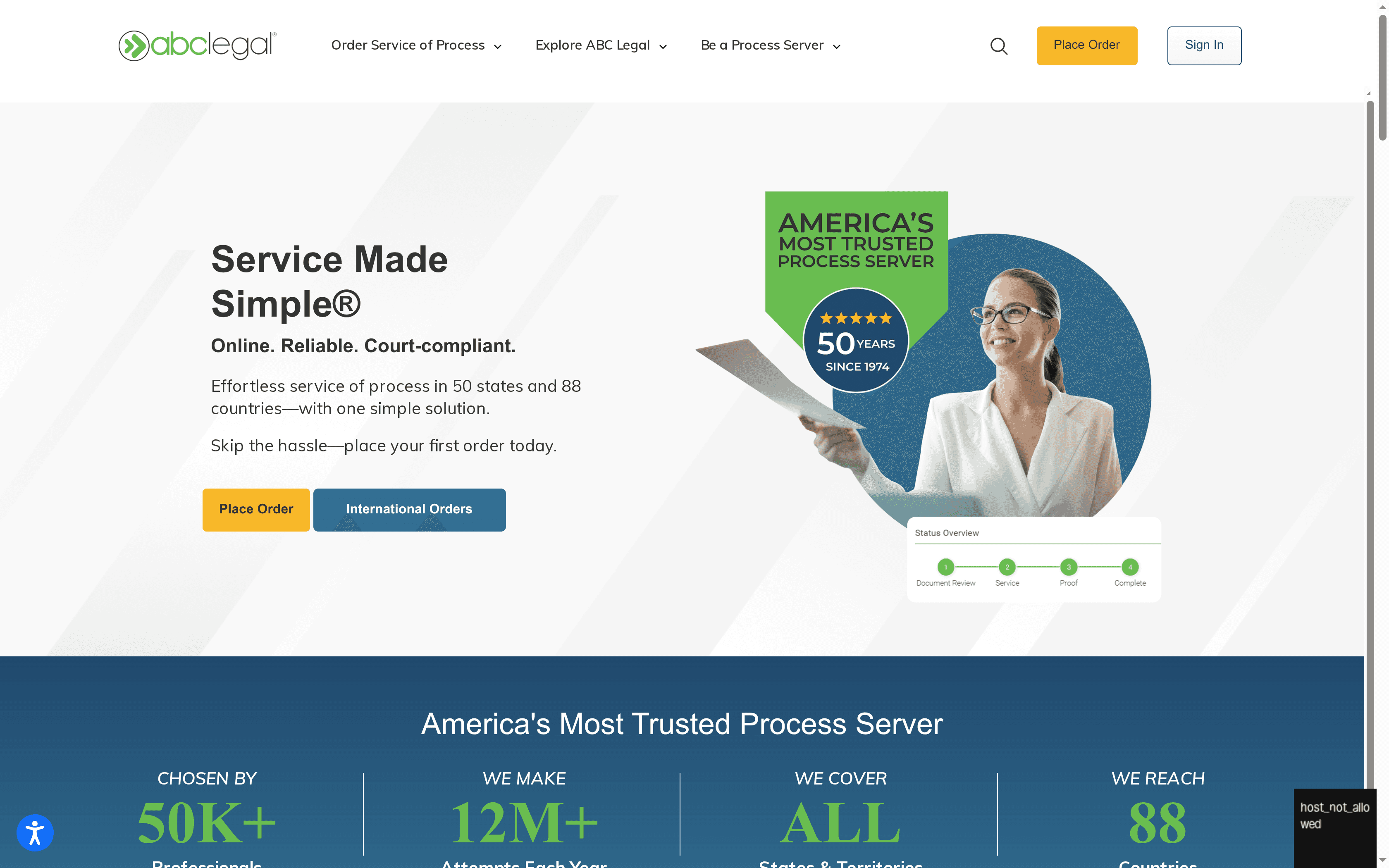
Product Screenshot

At a Glance

ABC Legal streamlines nationwide and international service of process with a large, tech-enabled network and clear flat-rate pricing. Since 2003 the company has built scale—over 10,000 process servers and an exclusive contract with the U.S. Department of Justice—that supports law firms, corporations, government agencies, and individuals. Real-time GPS-tracked updates and photo evidence make tracking deliveries straightforward, though pricing nuances and client eligibility for certain investigative services warrant attention. Bottom line: dependable, transparent, and built for legal professionals who need consistent, auditable service of process.

Core Features

ABC Legal’s core capabilities center on broad geographic reach, operational scale, and technology-driven proof of service. The service operates in more than 50 states and 88 countries through a network of 10,000+ process servers, offers a mobile app that captures GPS and photo evidence with real-time status updates, and provides flat-rate pricing with state-by-state cost transparency. Additional services include e-filing, advanced investigations, and skip tracing for qualified legal clients.

Pros

  • Extensive national and international coverage ensures you can serve documents across more than 50 U.S. jurisdictions and 88 countries without juggling multiple vendors.
  • A network of over 10,000 process servers gives ABC Legal scale to handle multi-jurisdiction matters and tight timelines reliably.
  • Technology-enabled service provides GPS-tracked evidence, timestamped photos, and real-time updates that improve chain-of-custody documentation.
  • Transparent flat-rate pricing simplifies budgeting by offering state-level rates that are easy to compare.
  • Longevity and trusted government work—operating since 2003 with government contracts—signal institutional reliability for sensitive or high-stakes matters.

Cons

  • The focus on legal and government clients means some investigative and skip-tracing features may be restricted to qualified legal entities and may not be available to all individual users.
  • While rates are flat by state, some additional fees can apply beyond the base flat rates, which can complicate final cost expectations for complex requests.
  • Publicly available information provides limited detail on direct customer service interactions or measured satisfaction scores, leaving prospective clients to evaluate responsiveness during onboarding.

Who It’s For

ABC Legal is ideal for attorneys, paralegals, corporate legal departments, government agencies, and individuals managing formal service of process across state lines or internationally. If you require auditable proof of service, centralized ordering, and consistent pricing across jurisdictions, ABC Legal fits the bill. If you need ad hoc investigations but aren’t a qualified legal entity, plan to confirm eligibility before ordering.

Unique Value Proposition

ABC Legal combines scale, government-level experience, and technology to deliver auditable, fast service of process nationwide and abroad. The mix of flat-rate pricing, GPS/photo verification, and an expansive server network positions it as a single provider for multi-jurisdiction matters that demand consistency and evidentiary detail.

Real World Use Case

A law firm needs coordinated service across several states. Using ABC Legal’s online portal the firm uploads documents, obtains state-specific flat-rate estimates, and tracks each service in real time with GPS and photo proof—reducing follow-up calls and ensuring compliance with local rules.

Pricing

Flat-rate pricing varies by state, typically ranging from approximately $75 to $145 for standard service, with rush options offered at higher costs; final prices are provided during checkout.

Website: https://abclegal.com

LegalZoom

Product Screenshot

At a Glance

LegalZoom provides accessible, guided legal services for individuals and small businesses, serving millions of users daily across the U.S. Its platform combines step-by-step document tools with consultations from vetted attorneys, making common legal tasks faster and more predictable. If you need document preparation, business formation, or straightforward legal guidance without an ongoing law firm relationship, LegalZoom offers a reliable, cost-transparent option. It’s efficient—but it’s not a substitute for full legal representation.

Core Features

LegalZoom centers on guided tools that lead you through legal processes via online questionnaires and a secure personalized dashboard available 24/7 for document storage and updates. The service pairs those tools with attorney guidance from a vetted network of experienced lawyers, and it highlights upfront, flat-fee pricing so cost surprises are minimized. The product scope covers wills, trusts, business formation, compliance, and one-off consultations, all delivered through an interface designed to simplify busy legal workflows.

Pros

  • Easy and convenient access to legal services: The guided tools and online dashboard let you complete document tasks from anywhere without multiple in-person appointments.
  • Trusted network of experienced attorneys: LegalZoom connects you with vetted attorneys who offer expertise across common legal areas relevant to individuals and small businesses.
  • Predictable pricing with full transparency: Flat fee pricing is disclosed before purchase, helping you budget for legal work without surprise bills.
  • Efficient process with guided tools and online questionnaires: Step-by-step workflows reduce time spent on form preparation and lower the risk of errors.
  • Support for a wide range of legal needs: From wills and trusts to incorporation and compliance, the platform covers many routine legal matters in one place.

Cons

  • Service guarantees are limited to filings and not full representation: The platform’s assurances focus on document and filing accuracy, but they do not extend to courtroom representation or long-term legal advocacy.
  • Attorney quality may vary because attorneys are independent: Legal advice is provided by independent attorneys whose responsiveness and approach can differ from case to case.
  • Not a full law firm or comprehensive referral service: For complex litigation or ongoing legal work beyond document preparation and consultation, you may need additional legal steps and resources.

Who It’s For

LegalZoom is best for individuals and small businesses seeking affordable, accessible legal solutions that combine online tools with attorney support. You should choose LegalZoom if you want predictable, DIY-friendly document preparation or occasional attorney consultation rather than continuous, full-scope legal representation.

Unique Value Proposition

LegalZoom’s core advantage is the blend of guided, user-friendly document workflows with access to vetted attorneys and transparent flat-fee pricing. That combination reduces friction for routine legal tasks and lowers the barrier for users who otherwise might delay important legal steps due to cost or complexity.

Real World Use Case

A small business owner uses LegalZoom to incorporate their company, complete compliance paperwork, store corporate documents in the secure dashboard, and consult an attorney for a one-time compliance question—streamlining launch and reducing administrative burden.

Pricing

LegalZoom uses flat fee pricing that varies by service, with most fees disclosed before purchase so you can confirm costs upfront.

Website: https://legalzoom.com

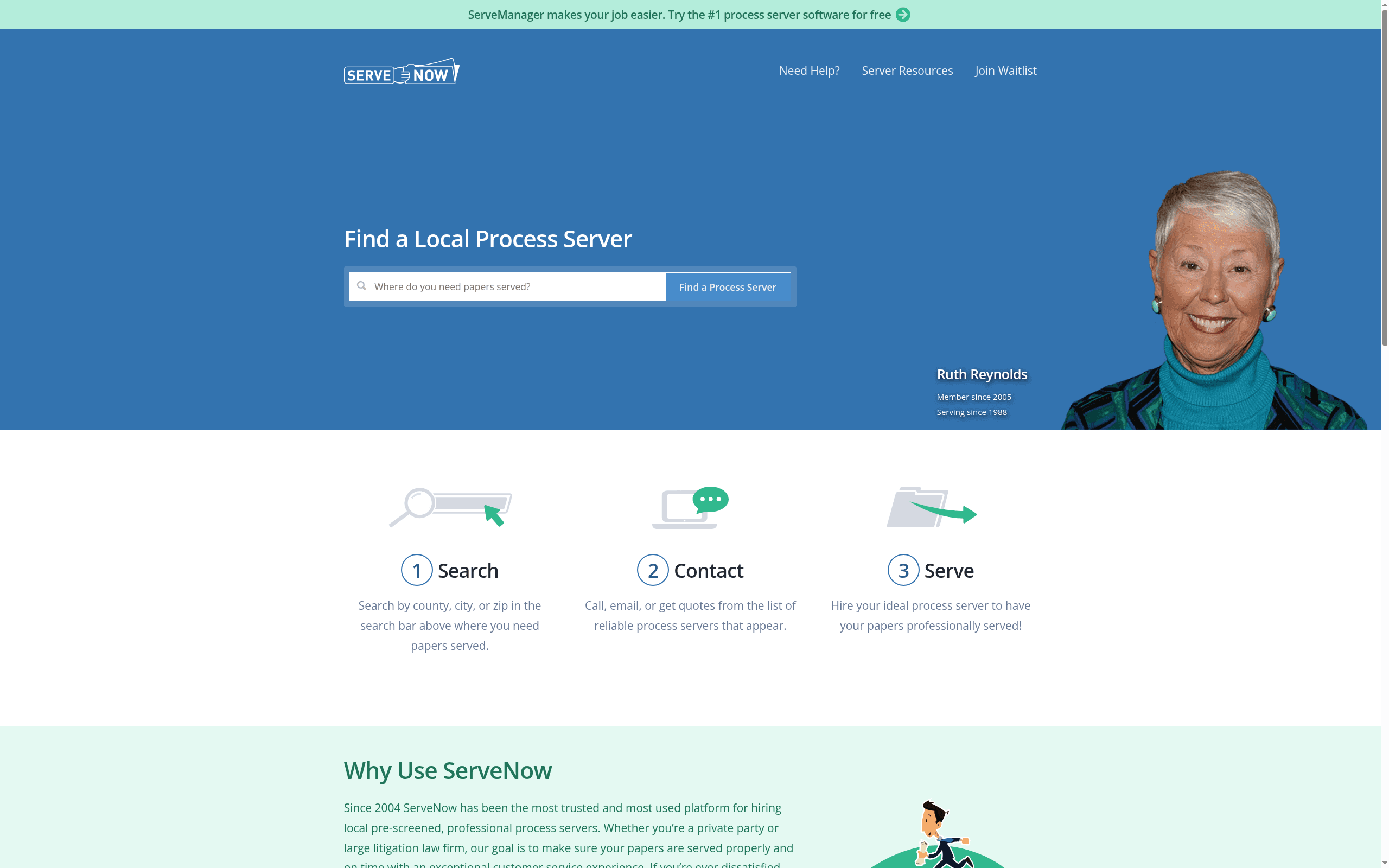
ServeNow

Product Screenshot

At a Glance

ServeNow is a long-established platform—trusted since 2004—that connects you with pre-screened, professional process servers through a searchable local directory. It simplifies hiring by letting you search by county, city, or ZIP code and compile quotes from multiple servers, which speeds up decision-making. The interface focuses on reliability and timeliness, though final costs vary by provider and region. If you need consistent access to local process-serving resources, ServeNow is a solid, dependable option.

Core Features

ServeNow’s core capabilities center on a comprehensive directory of local process servers combined with a quote-and-request workflow that streamlines hiring and management. You can search by county, city, or ZIP code to find nearby, pre-screened professionals, request electronic service options, and access related legal support like court filing, notarization, document retrieval, skip tracing, photocopying, and courier services. The platform’s long history speaks to its operational maturity and customer service orientation.

Pros

  • ServeNow has been trusted and widely used since 2004, which demonstrates longevity and accumulated industry experience.
  • The platform lists pre-screened, professional process servers, ensuring a baseline of vetting before you request services.
  • Its comprehensive directory provides local options, making it easier to find servers who are familiar with your target jurisdiction.
  • ServeNow supports multiple service options, including electronic service and legal courier services, which broadens how you can complete service tasks.
  • The search and quote request system is user-friendly, allowing you to compile quotes and compare providers without lengthy phone calls.

Cons

  • Prices vary and may be higher depending on the server and service region, which means your final cost can be unpredictable.
  • Specific costs are not fixed and depend on case details, so budgeting for service may require additional follow-up with providers.
  • You may need additional legal support services outside of standard process serving for complex matters, which can increase coordination overhead.

Who It’s For

ServeNow is aimed at legal professionals, law firms, businesses, and private individuals who need reliable, local process service and related administrative support. If you manage multiple cases across jurisdictions or need quick access to pre-vetted servers in different counties, ServeNow reduces the friction of finding and comparing providers. You. Get local expertise when and where you need it.

Unique Value Proposition

ServeNow’s primary value is its combination of a vetted local directory and a streamlined quote-request system backed by over a decade of industry presence. That mix reduces the risk of hiring unknown vendors and accelerates the procurement process for service providers and legal teams alike.

Real World Use Case

A law firm handling civil litigation uses ServeNow to hire a pre-screened process server in a specific county. The firm searches by county, compiles quotes from several servers, selects a professional, and obtains proof of service on schedule—helping the team meet court deadlines and maintain complete documentation.

Pricing

Prices vary depending on the provider, location, and case requirements, generally ranging from $20 to $100+ per case, so expect variability based on distance, complexity, and additional services requested.

Website: https://serve-now.com

This table provides an overview of various legal document service providers, highlighting their key features, pros, cons, target users, and pricing information.

Provider Key Features Pros Cons Pricing
YM Doc Services Process serving, skip tracing, document retrieval, court filings, notary Experienced team, legal specialization, comprehensive services, accuracy and timeliness No pricing specified Not specified
One Source Process Nationwide coverage, apostille/legalization, GPS/photo tracking Nationwide reach, transparent pricing, fast turnaround, advanced tracking No clear online portal, limited after-hours support, possible higher rates for special tasks $85 process service, $175 apostille, $65 skip tracing
ABC Legal National/international coverage, 10,000+ servers, real-time tracking Extensive coverage, large network, tech-enabled service, flat-rate pricing, government contracts Some features may be restricted to legal entities, additional fees possible, limited customer interaction detail Varies by state ($75-$145)
LegalZoom Guided legal tools, attorney consultations, business formation Easy access, vetted attorneys, predictable pricing, efficient processes Limited to filings, varied attorney quality, not a full law firm Flat fees vary
ServeNow Local process server directory, quote system, electronic service options Established platform, pre-screened servers, local expertise, multiple service options Varying prices, no fixed costs, additional services may increase coordination $20-$100+ per case

Managing legal documents while ensuring strict compliance and timely delivery is a challenge that many attorneys, businesses, and individuals face daily. The article highlights how critical reliable process serving, skip tracing, and court filing services are to preventing missed deadlines and reducing administrative stress. If you want to avoid delays and maintain clear proof of service with expert help tailored to legal requirements, it is essential to partner with a provider who understands the stakes.

YM Doc Services specializes in exactly these pain points by offering a comprehensive suite focused on accuracy, legal compliance, and professionalism. Whether you need process serving, document retrieval, or immigration-related support, their experienced team is committed to helping you meet demanding court timelines and documentation standards. Discover how their streamlined ordering system and bilingual support make your workflow more efficient and stress-free.

https://ymdocservices.com

Take control of your legal document management and meet every deadline confidently. Explore YM Doc Services for expert process serving and legal support solutions. Get started now by visiting YM Doc Services Homepage and see how easy it is to place your order today. For detailed service options, check out their full range of offerings at YM Doc Services. Your reliable partner in legal document delivery is only a click away.

Frequently Asked Questions

Top legal document support services typically offer process serving, document retrieval, court filing, and skip tracing. Explore each service to understand how they can assist with your specific legal needs.

To ensure compliance, verify that the service provider follows local, state, and federal regulations for each task. Ask for documentation that demonstrates their adherence to legal standards, such as proof of service or compliance certificates.

Consider factors such as the provider’s experience, range of services, turnaround times, and pricing transparency. Creating a checklist based on these criteria will help you make a more informed decision.

Many legal document support services offer tracking features that provide real-time updates on the status of your requests. Inquire about the tracking options available and confirm that they can provide you with prompt updates during the service process.

Pricing for legal document support services can vary based on task complexity and urgency. Request detailed estimates for each service so you can effectively budget and avoid unexpected costs.

Processing times can differ among services, but many aim to complete requests within 24 to 72 hours under normal circumstances. Confirm expected timelines upfront to align them with your deadlines.

Posted in Uncategorized

7 Key Examples of Notarized Documents for Legal Processes

Over half of american adults will encounter a situation where having the right legal document can shape their future. From real estate deals to choosing a trusted power of attorney, understanding these core papers is essential for protecting your family, finances, and peace of mind. This guide breaks down the most important documents every american should know, highlighting the crucial steps and facts you need to confidently manage your legal affairs.

Table of Contents

Quick Summary

Takeaway Explanation
1. Validate Power of Attorney properly Ensure notarization and witness signatures to protect your interests legally.
2. Notaries cannot provide legal advice Understanding notary limitations helps prevent complications in legal transactions.
3. Details are critical in loan agreements Review all terms carefully to clarify responsibilities and avoid future disputes.
4. Specific actions in parental consent forms Clearly outline authorized actions to prevent misunderstandings about children’s activities.
5. Careful planning for wills and trusts Detailed asset distribution planning helps avoid family disputes and secures wishes.

A Power of Attorney (POA) provides critical legal authorization for someone to make decisions and act on your behalf in specific situations. Understanding how to create and validate this document becomes essential for protecting your personal and financial interests.

This legal instrument allows you to designate an trusted individual to manage your affairs when you cannot do so yourself. According to Rutgers Law, ensuring the validity of a Power of Attorney requires specific steps:

  • Notarization is crucial for legal recognition
  • The document must be witnessed by two individuals over 18 years old
  • The notary cannot serve as a witness for the document

To create a robust Power of Attorney, work with a legal professional who can help you draft a document that clearly outlines the specific powers you want to grant. These might include managing financial accounts, making healthcare decisions, or handling real estate transactions.

While notarization significantly strengthens the document’s legal standing, if professional notarization is not immediately possible, completing the form accurately remains important. Always ensure your designated agent understands their responsibilities and the extent of their authorized actions.

A comprehensive guide on notary roles can provide additional insights into the legal nuances of document certification and authorization.

2. Real Estate Deeds: Securing Property Transfers

Real estate deeds are legal documents that officially transfer property ownership from one party to another. These critical instruments represent more than just paper documents they serve as the foundational proof of your property rights and legal ownership.

According to the National Notary Association, notaries play a crucial role in real estate deed authentication but have strict limitations. Their primary responsibilities include:

  • Witnessing signatures on property transfer documents
  • Verifying the identity of individuals signing the deed
  • Ensuring the authenticity of the documentation

Notably, notaries cannot provide legal advice or prepare property transfer documents. This restriction protects both the notary and the individuals involved in the transaction from potential legal complications.

When preparing a real estate deed, working with a legal professional becomes essential. They can help you navigate complex property transfer requirements and ensure all necessary documentation is properly completed and notarized.

For comprehensive guidance on managing legal paperwork in real estate transactions, check out our legal paperwork for real estate guide. This resource can help you understand the intricate details of property ownership transfers and documentation requirements.

3. Affidavits: Verifying True Statements

An affidavit serves as a powerful written statement made under oath, providing a legally binding method for individuals to confirm the truthfulness of specific information. These sworn documents play a critical role in various legal proceedings, offering a formal mechanism for verifying facts and personal accounts.

According to the National Notary Association, notaries have specific responsibilities when handling affidavits. Key guidelines for notarization include:

  • Ensuring the signer fully understands the document
  • Verifying the individual is signing willingly
  • Avoiding providing legal advice about the document’s content
  • Confirming the identity of the person signing

When preparing an affidavit, accuracy and truthfulness are paramount. You must provide detailed information that can be verified and be prepared to stand behind your statements under legal scrutiny. This means carefully reviewing every statement before signing and understanding the potential legal consequences of false claims.

Interestingly, some jurisdictions have specific requirements for document submission. For instance, according to legal updates, Arkansas requires paper notarization for affidavits even when electronic filing is permitted, highlighting the continued importance of traditional verification methods.

For those seeking to understand document verification more comprehensively, our guide on verifying legal documents can provide additional insights into best practices and legal requirements.

4. Loan Agreements: Protecting Financial Interests

Loan agreements represent critical legal documents that establish the terms and conditions of financial transactions between lenders and borrowers. These comprehensive contracts outline the specific responsibilities, repayment schedules, interest rates, and potential consequences of non payment.

According to the National Notary Association, notaries play a crucial role in loan agreement authentication while maintaining strict professional boundaries. Their primary responsibilities include:

  • Verifying the identity of individuals signing the document
  • Ensuring the signer is willingly participating in the agreement
  • Maintaining neutrality and avoiding legal advice about the document
  • Witnessing the signature process

When preparing a loan agreement, careful attention to detail becomes paramount. You should thoroughly review all terms, understand your financial obligations, and ensure every aspect of the agreement is clearly defined. This includes examining interest rates, repayment schedules, potential penalties, and collateral requirements.

Interestingly, legal variations can impact notarization processes. Recent legislative updates demonstrate the evolving landscape of document authentication, such as Tennessee Senate Bill 3110 which allows licensed court reporters to administer oaths in certain contexts.

For comprehensive guidance on navigating the complexities of legal document verification, explore our guide on verifying legal documents, which can help you understand best practices for protecting your financial interests.

5. Business Contracts: Formalizing Business Deals

Business contracts represent the foundational legal instruments that transform verbal agreements into binding, enforceable commitments between parties. These documents outline the specific terms, expectations, and obligations that define professional relationships and commercial interactions.

According to the National Notary Association, notaries have a critical yet limited role in business contract authentication. Their primary responsibilities include:

  • Verifying the identity of individuals signing the contract
  • Witnessing signatures to ensure document authenticity
  • Confirming participants are signing willingly
  • Maintaining strict neutrality without providing legal advice

When preparing a business contract, meticulous attention to detail becomes crucial. You must carefully articulate every aspect of the agreement, including payment terms, deliverables, timelines, and potential contingencies. This comprehensive approach helps prevent misunderstandings and provides clear legal protection for all parties involved.

Interestingly, legal nuances can significantly impact contract validation. Recent legislative updates demonstrate how jurisdictions like Utah are tightening document authentication requirements, with House Bill 304 prohibiting Apostille issuance for improperly notarized documents.

For small business owners seeking comprehensive guidance, our small business legal paperwork guide offers valuable insights into navigating the complex landscape of business documentation.

Parental consent forms represent critical legal documents that empower parents or guardians to authorize specific actions involving their children. These important forms provide legal protection and clear authorization for activities ranging from medical treatments to educational programs and travel.

According to Rutgers Law, there are specific requirements for creating a valid parental consent form. Key guidelines for proper documentation include:

  • Notarization of the document
  • Witnessed by two individuals over 18 years old
  • The notary cannot serve as a witness
  • Clear identification of the child and authorized actions

The National Notary Association emphasizes that notaries play a crucial role in document authentication without providing legal advice. Their primary responsibility is to verify the identity of the signer and ensure the document is signed willingly.

When preparing a parental consent form, be extremely specific about the exact actions you are authorizing. Include full names, dates, specific activities, and any time limitations. This precision helps prevent misunderstandings and provides clear legal protection for both the child and the authorized parties.

For parents navigating complex legal documentation, understanding the nuances of consent forms becomes essential. Each situation may require slightly different documentation, so careful attention to detail is crucial when protecting your child’s interests.

7. Wills and Trusts: Safeguarding Estate Planning

Wills and trusts represent critical legal instruments that enable individuals to protect and distribute their assets according to their specific wishes. These essential documents provide a structured approach to estate planning, ensuring your financial legacy is managed precisely as you intend.

According to the National Notary Association, notaries play a specific role in estate planning documentation. Their key responsibilities include:

  • Verifying the identity of individuals signing the documents
  • Witnessing signatures to ensure document authenticity
  • Maintaining strict neutrality without providing legal advice
  • Confirming signers are acting voluntarily

Creating a comprehensive will or trust requires careful consideration of your entire financial landscape. You must clearly outline asset distribution, designate beneficiaries, and potentially establish guardianship provisions for dependents. This meticulous planning helps prevent potential family disputes and ensures your wishes are legally recognized.

Interestingly, legal environments continue to evolve. Recent legislative updates demonstrate how jurisdictions like Georgia are adjusting administrative processes, such as modifying notary commissioning fees, which can impact estate planning documentation.

To navigate the complex world of legal document authentication, our guide on witnessing legal documents offers comprehensive insights into ensuring your estate planning documents meet all necessary legal standards.

Below is a comprehensive table summarizing the main legal documents discussed in the article and their essential aspects.

Document Type Description Key Considerations
Power of Attorney Legal authorization for someone to make decisions on your behalf. Requires notarization and two witnesses; notary cannot be a witness.
Real Estate Deeds Transfers property ownership. Notaries authenticate signatures but cannot give legal advice.
Affidavits Sworn statements made under oath. Ensure accuracy and willingness; notaries confirm identity and understanding.
Loan Agreements Establishes terms of a financial transaction. Detail-oriented review of terms; neutrality of notaries in the signing process.
Business Contracts Formalizes business agreements. Precise detailing of terms; notaries verify identity without legal advice.
Parental Consent Forms Authorizes child-related actions. Requires notarization; must include specific activities and identification.
Wills and Trusts Manage and distribute assets after death. Includes asset distribution and guardianship; precise planning needed.

Navigating the complexities of notarized documents such as Powers of Attorney, affidavits, and real estate deeds can be overwhelming. Common challenges include ensuring proper notarization, verifying identities, and meeting strict legal requirements without missing deadlines or risking invalidation. The detailed examples in this article highlight the importance of accuracy and legal compliance for your peace of mind.

At YM Doc Services, we understand these hurdles and offer professional solutions that simplify managing your critical legal paperwork. Our services include reliable document handling, court filings, and administrative support designed to keep your transactions smooth and compliant. Whether you need assistance with loan agreements, business contracts, or parental consent forms, you can trust us to reduce your stress and deliver timely results.

https://ymdocservices.com

Take control of your legal document process today. Visit YM Doc Services to explore how our comprehensive support can help you avoid costly mistakes and ensure your notarized documents meet every legal standard. For expert guidance on managing complex paperwork, check out our legal paperwork for real estate guide and the guide on verifying legal documents. Start securing your documents with confidence now.

Frequently Asked Questions

What is a Power of Attorney, and why is it important?

A Power of Attorney (POA) is a notarized document that grants someone legal authority to make decisions on your behalf when you are unable to do so. To ensure its effectiveness, clearly outline the specific powers you are granting and work with a legal professional to draft the document appropriately.

How do I create a valid real estate deed?

To create a valid real estate deed, ensure that it includes accurate property details and is signed in the presence of a notary. After notarization, make sure to file the deed with the appropriate government office to officially transfer ownership.

What steps do I need to take to prepare an affidavit?

To prepare an affidavit, draft a sworn statement that includes detailed information to substantiate your claims. Verify your identity before a notary, who will witness your signature and ensure that you understand the document, prior to filing it in the required jurisdiction.

How do I ensure my loan agreement is legally binding?

To ensure your loan agreement is legally binding, include all pertinent terms such as interest rates and repayment schedules and have it signed in front of a notary. This process confirms the identities of all parties involved and protects your financial interests by making the agreement enforceable.

What should be included in a business contract for it to be valid?

A valid business contract should clearly outline the obligations, terms, and expectations between all parties involved. Have each party sign the contract in the presence of a notary to confirm the legitimacy of the agreement and ensure all signatures were given willingly.

Notarization is essential for parental consent forms to verify the identity of the signers and to ensure that the consent is given voluntarily. This helps to protect all parties involved, especially when it comes to sensitive actions regarding a child’s welfare.

Posted in Uncategorized

Notarization Requirements Explained: Legal Guide USA

Every american depends on properly notarized documents at some point, whether closing on a home or signing a will. Without notarization, more than 40 percent of legal disputes could become far harder to resolve. This process matters because it protects against fraud and ensures trust in agreements that shape our lives and finances. Understanding how notarization works can help everyone navigate important personal and business transactions with greater confidence.

Table of Contents

Key Takeaways

Point Details
Legal Purpose of Notarization Notarization authenticates signatures and verifies identities, providing legal protections in transactions.
Types of Notarizations Acknowledgments and jurats are the primary types, serving different legal functions depending on the document.
Structured Notarization Process The notarization process involves identity verification, signature witnessing, and proper documentation to prevent fraud.
Notary Responsibilities and Risks Notaries must maintain professional boundaries, avoid common mistakes, and adhere to state-specific regulations to uphold legal standards.

Notarization represents a critical legal process that authenticates document signatures and provides crucial verification of identity and intent. National Notary Association defines a notary public as a state-appointed official responsible for witnessing document signings and administering oaths, fundamentally increasing public trust in legal and financial transactions.

At its core, notarization serves three primary legal functions: identity verification, signature authentication, and fraud prevention. When a document is notarized, the notary public confirms the identities of signatories, ensures they are signing willingly and understand the document’s contents, and applies an official seal that transforms the document into a legally recognized instrument. As Wikipedia explains, a notarial act creates an authenticated written record providing lawful proof of a transaction.

The legal significance of notarization extends across numerous document types, including:

  • Real estate transactions
  • Mortgage and loan agreements
  • Affidavits and sworn statements
  • Power of attorney documents
  • Contractual agreements
  • Inheritance and estate planning documents

By requiring an impartial third-party witness who verifies identities and intentions, notarization adds a layer of legal protection that helps prevent fraud, reduces potential disputes, and creates a reliable record of important agreements. Learn more about the role of notaries in legal documents.

Types of Notarizations: Jurats, Acknowledgments, More

Notarization encompasses several specialized types, each serving distinct legal purposes. According to National Notary Public, two primary types of notarizations are acknowledgments and jurats, which differ significantly in their legal requirements and application.

An acknowledgment is a formal process where the signer personally appears before the notary, proves their identity, and declares that they have willingly signed a document. This type of notarization is commonly used for documents like deeds, mortgages, and powers of attorney. In contrast, a jurat requires the signer to not only appear in person and prove their identity but also to swear or affirm under oath that the contents of the document are true. Office of the Secretary highlights that jurats are typically used for affidavits, sworn statements, and other documents where the truthfulness of the content is paramount.

Additional types of notarizations include:

  • Signature Witnessing: Verifying that an individual signed a document in the notary’s presence
  • Copy Certification: Confirming that a reproduction is a true and accurate copy of an original document
  • Oath or Affirmation: Administering a formal pledge of truthfulness

The specific type of notarization required depends on the document’s purpose, legal jurisdiction, and intended use. Learn more about notary roles in legal documents to understand how these different notarization types protect legal integrity and prevent fraud.

Step-By-Step Notarization Process Explained

The notarization process is a structured legal procedure designed to authenticate document signatures and prevent fraud. Notary Public Seminars outlines the critical steps involved, emphasizing the importance of thorough verification and proper documentation.

The process typically involves several key stages. First, the signer must personally appear before the notary and provide valid government-issued photo identification. The notary carefully examines the identification to confirm the individual’s identity and legal capacity to sign. Office of the Secretary highlights the importance of specific language during this process, such as using phrases like ‘acknowledged before me’ or ‘subscribed and sworn to before me’ depending on the type of notarization.

Here’s a detailed breakdown of the notarization process:

  1. Document Preparation
  • Ensure the document is complete
  • Check for any signs of alteration or fraud
  • Verify all required signatures are present
  1. Identity Verification
  • Examine government-issued photo ID
  • Confirm signer’s identity
  • Assess legal capacity to sign
  1. Signature Witnessing
  • Observe the actual signing
  • Confirm signer is signing willingly
  • Ensure no coercion or undue influence
  1. Notarial Certificate Completion
  • Apply official notary seal
  • Add required notarial language
  • Record details in notary journal

identity verification notary

Learn more about verifying legal documents to understand the critical role of precise documentation in legal processes.

Notary regulations in the United States are governed by complex and nuanced state-level requirements that create significant variations in legal standards across different jurisdictions. Wikipedia – Florida Notary illustrates this complexity, highlighting how notaries are typically appointed by state governors and empowered with specific legal responsibilities that can differ dramatically between states.

Each state maintains unique notarial standards that define the scope of a notary’s authority and professional limitations. Wikipedia – Pennsylvania Notary provides a clear example, noting that Pennsylvania notaries are explicitly prohibited from providing legal advice or drafting legal documents, while being authorized to perform six specific official acts such as taking acknowledgments and administering oaths.

Key variations in state notary regulations include:

Comparison of notary requirements in California, Florida, and Pennsylvania.

  • Appointment Process

    • Governor or secretary of state appointments
    • Background check requirements
    • Term length and renewal procedures
  • Professional Limitations

    • Scope of authorized notarial acts
    • Restrictions on legal advice
    • Geographical jurisdiction
  • Documentation Requirements

    • Specific seal and stamp regulations
    • Mandatory journal keeping
    • Identification verification standards
  • Training and Certification

    • Mandatory educational courses
    • Examination requirements
    • Continuing education credits

Learn more about notary roles in legal documents to understand the critical nuances of state-specific notarial regulations and professional standards.

Notary Responsibilities, Risks, and Common Mistakes

Notaries play a critical role in legal documentation, but their responsibilities come with significant professional risks and potential legal consequences. National Notary Association emphasizes that notaries are strictly prohibited from preparing legal documents or providing legal advice unless they are licensed attorneys, with violations potentially leading to prosecution for unauthorized practice of law.

Professional boundaries are paramount in notarial work. Notary Public Seminars warns that notaries must exercise extreme caution to avoid common mistakes that could compromise their professional standing. This includes ensuring documents are complete and free from fraud, and strictly avoiding any assistance in document preparation that might be construed as legal advice.

Common risks and mistakes for notaries include:

  • Improper Identification Verification

    • Accepting inadequate or expired identification
    • Failing to personally witness signature
    • Overlooking signs of identity fraud
  • Boundary Violations

    • Providing legal interpretations
    • Helping clients complete documents
    • Selecting notarial certificate wording
  • Documentation Errors

    • Incomplete notarial certificates
    • Incorrect date or location
    • Failing to maintain proper journal records
  • Seal and Signature Mistakes

    • Using an expired notary commission
    • Improper seal application
    • Inconsistent signature practices

Learn more about notary roles in legal documents to understand the critical importance of maintaining professional integrity and avoiding potential legal pitfalls.

Understanding notarization requirements is essential to protect your legal interests and avoid costly mistakes. This detailed guide highlights common challenges like verifying identities, choosing the right type of notarization, and complying with state-specific regulations. If navigating these complex steps feels overwhelming or risks delaying your important transactions, you are not alone.

At YM Doc Services, we specialize in reducing the stress of managing legal documents by offering reliable and timely support tailored for lawyers, businesses, and individuals. From assisting with accurate notarization procedures to handling document workflow efficiently, our professional services ensure your notarized documents meet all legal standards without hassle. Feel confident knowing your documents are processed correctly and delivered promptly.

Ready to streamline your notarization process and ensure compliance every step of the way?

https://ymdocservices.com

Explore how our expert team can help simplify notarization and legal document management today. Visit YM Doc Services to learn more. Discover detailed guidance on verifying legal documents and the role of notaries in legal documents to stay informed and empowered. Take control now and experience peace of mind with trusted legal document services.

Frequently Asked Questions

What is the purpose of notarization?

Notarization serves to authenticate document signatures, verify identities, and prevent fraud during legal transactions. It provides public trust in documents by confirming that signers understand and willingly enter agreements.

What are the main types of notarizations?

The two primary types of notarizations are acknowledgments and jurats. An acknowledgment involves a signer confirming they willingly signed a document, while a jurat requires the signer to swear or affirm that the contents of a document are true before the notary.

What is the notarization process?

The notarization process includes several steps: the signer must personal appear before the notary, provide valid identification, confirm their signature willingness, and the notary must complete a notarial certificate, applying their official seal and recording details in their journal.

What are common mistakes notaries make?

Common mistakes include improper identification verification, boundary violations like providing legal advice, documentation errors such as incomplete certificates, and seal or signature mistakes, which can all jeopardize the integrity of the notarization process.

Posted in Uncategorized

Step by Step Process Serving: Complete Guide for Legal Delivery

Serving legal documents can be a complex task even for experienced american professionals. One error in procedure or missing detail can derail an entire case and create serious setbacks. Whether you work for a law office or handle documents independently, mastering each step matters. This guide breaks down the essential process so you can serve papers efficiently and avoid the common pitfalls that lead to costly mistakes.

Table of Contents

Quick Summary

Key Point Explanation
1. Gather complete legal documents Ensure all required documents are original, accurate, and meet legal standards before attempting service.
2. Verify recipient details thoroughly Double-check recipient information using multiple official sources to prevent delivery failures and legal complications.
3. Choose the right service method Select a service method that aligns with legal requirements and recipient availability to maintain document validity.
4. Execute service with precision Follow procedural guidelines meticulously to ensure proper handoff and documentation of the service.
5. Document proof of service correctly Complete and file proof of service forms accurately to ensure legal compliance and protect all parties involved.

Five-step legal process serving infographic with icons and arrows. |

Gathering the correct legal documents is the foundational first step in the process serving workflow. Your success depends on collecting comprehensive and accurate paperwork that meets all legal requirements for proper document delivery.

According to the U.S. Department of Justice, effective document preparation involves collecting multiple critical components. Start by identifying the specific type of legal document you need to serve. These might include court summons, subpoenas, complaints, or other legal notices. Create a comprehensive checklist that includes:

  • Original documents with official court stamps
  • Multiple copies for service and record keeping
  • Proof of service forms
  • Recipient contact information
  • Accurate address details for the recipient

Verify each document is complete and current before proceeding. Missing or outdated paperwork can invalidate your entire service attempt, potentially causing significant legal complications. When in doubt, consult with the issuing court or a legal professional to confirm document requirements.

As you compile your documents, organize them systematically. Keep original documents separate from copies, and ensure all pages are intact and legible. In the next step, you will prepare these documents for official delivery.

Step 2: Verify Recipient Information and Location

Verifying the precise recipient information and location is a critical step that determines the success of your legal document service. Accurate information ensures legal compliance and increases the likelihood of successful document delivery.

According to the U.S. Department of Justice, meticulous verification of recipient details is essential for proper legal service. Begin by cross referencing multiple sources to confirm the recipient identity and current residential or business address. Utilize resources such as:

  • Public records databases
  • County assessor records
  • Utility bill registrations
  • Employment verification systems
  • Social media and professional networking platforms

Pay special attention to potential address changes or multiple residence scenarios. Some individuals might have different mailing addresses, residential addresses, or work locations. If you encounter conflicting information, prioritize the most recent and official sources.

recipient verification location

A critical warning: inaccurate recipient information can result in failed service attempts, legal complications, and potential case dismissals. When location verification becomes challenging, consider engaging a professional skip tracing service to help locate hard to find recipients. In the next step, you will prepare for the actual document delivery process.

Step 3: Select Appropriate Service Method

Selecting the right service method is crucial for ensuring legal document delivery meets all necessary requirements and maintains legal validity. Your choice of service method can significantly impact the effectiveness and legal standing of your document delivery.

According to the U.S. Department of Justice, legal documents can be served through multiple methods including personal delivery, certified mail, and electronic means. Evaluate each method carefully based on specific case requirements and legal jurisdiction. Consider these key factors when choosing your service method:

  • Recipient accessibility
  • Legal jurisdiction requirements
  • Document sensitivity
  • Time sensitivity of delivery
  • Proof of service documentation needed

Personal service remains the most reliable method when possible. This involves directly handing documents to the recipient, which provides immediate confirmation of delivery and eliminates potential disputes about document receipt. For situations where personal delivery proves challenging, certified mail with return receipt offers a documented alternative that creates a verifiable paper trail.

Warning: Incorrect service methods can invalidate legal proceedings. Always confirm local court rules and specific requirements for your particular type of legal document. When in doubt, consult with a legal professional who can guide you through jurisdiction specific service protocols.

Your next step will involve preparing the documentation for your selected service method.

Step 4: Complete the Physical Service Delivery

Physical service delivery represents the critical moment when legal documents are officially transferred to the intended recipient. Your precision during this step determines the legal validity and admissibility of the entire service process.

According to the U.S. Department of Justice, executing physical service requires meticulous attention to specific procedural guidelines. When delivering documents, follow these essential protocols:

  • Confirm the recipient identity before document handoff
  • Maintain a professional and neutral demeanor
  • Clearly explain the nature of the documents being served
  • Obtain signature or acknowledgment when possible
  • Avoid confrontational or aggressive interactions

During personal service, timing and approach matter significantly. Serve documents at appropriate times avoiding early morning or late evening hours. If the recipient is unavailable, check local regulations about alternative service methods such as leaving documents with another adult at the residence or mailing certified copies.

A critical warning: Documentation is everything. Immediately after service completion, complete your proof of service form with precise details including date, time, location, and manner of delivery. Inaccurate or incomplete documentation can render the entire service invalid. Your next step involves preparing and filing the official proof of service with the requesting court or legal authority.

Step 5: Document Proof of Service and Confirm Compliance

Documenting proof of service represents the final critical step in ensuring legal validity and maintaining a clear record of your document delivery process. Thorough documentation protects both the server and the requesting legal entity by creating an official record of service.

According to the U.S. Department of Justice, proof of service documentation must include specific comprehensive details to maintain legal compliance. Your proof of service form should meticulously capture the following essential elements:

  • Exact date and time of service
  • Location of document delivery
  • Method of service used
  • Description of recipient identification
  • Server identification and contact information
  • Specific documents served
  • Recipient response or acknowledgment

Prepare multiple copies of the proof of service form immediately after completing the delivery. One copy should be filed with the requesting court or legal authority while maintaining a duplicate for your personal records. Digital scanning and secure electronic storage provide an additional layer of documentation protection.

A critical warning: Even minor errors or omissions in your proof of service can potentially invalidate the entire legal process. Double check every detail before submission and consider consulting a process server compliance guide if you have any uncertainties. Your meticulous documentation ensures the legal effectiveness of the service and protects all parties involved in the legal proceedings.

Navigating the complexities of legal document delivery can be overwhelming. From gathering the right paperwork to verifying recipient details and ensuring compliant delivery methods, every detail matters for a successful service. Missed documents, incorrect addresses, and incomplete proof of service can cause costly delays and legal challenges. If managing these critical steps feels stressful or time-consuming, you are not alone.

At YM Doc Services, we specialize in providing professional process serving solutions designed to eliminate uncertainty and elevate reliability. Whether you need expert skip tracing to locate hard-to-find recipients or thorough management of proof of service documentation, our team is committed to ensuring every step complies with legal standards. Visit our main page to learn how we help lawyers, businesses, and individuals deliver documents accurately and efficiently.

https://ymdocservices.com

Ready to avoid the pitfalls of improper legal service and meet your deadlines with confidence Explore how our trusted process serving services can support your legal needs. Don’t let paperwork errors jeopardize your case. Contact YM Doc Services now at https://ymdocservices.com to request your professional legal document service and experience peace of mind today.

Frequently Asked Questions

Gather the original legal documents, copies for service, proof of service forms, and accurate recipient contact information. Ensure each document is current and complete to prevent invalid service attempts.

How can I verify a recipient’s information and location accurately?

Cross-reference public records, utility registrations, and social media to confirm a recipient’s identity and address. Prioritize the most recent official sources to avoid complications during service delivery.

You can choose from personal delivery, certified mail, or electronic means based on case requirements. Evaluate recipient accessibility and legal jurisdiction to ensure compliance with local service methods.

Confirm the recipient’s identity and provide a clear explanation of the documents being served. Maintain professionalism and, if possible, obtain an acknowledgment or signature to confirm receipt of the documents.

How do I document proof of service effectively?

Complete the proof of service form immediately after delivering the documents, capturing essential details like the date, time, and method of service. Make multiple copies for the court and your records to ensure a valid service process.

What are the consequences of errors in the proof of service?

Even minor mistakes in your proof of service can invalidate the legal process. Review every detail carefully before submission to avoid complications or dismissals in court.

Posted in Uncategorized

Emerging Trends in Process Serving Explained

More than 80 percent of american legal professionals are now using digital tracking and automation in process serving. This shift marks a significant move away from traditional paperwork, making document delivery faster and more transparent for everyone involved. As these new technologies take hold, legal teams and process servers need to stay informed about the latest trends to remain effective and compliant in an industry that is changing quickly.

Table of Contents

Key Takeaways

Point Details
Rapid Technological Transformation The process serving industry is enhancing efficiency through digital tools and platforms for document delivery and tracking.
Mobile Technology Integration Process servers are leveraging mobile applications for real-time case management, improving security and communication.
Evolving Compliance Standards Legal requirements are increasingly strict, requiring digital documentation and secure proof of service to meet regulatory expectations.
Professional Growth Opportunities Continuous learning and adaptation to technology are essential for process servers to maintain a competitive edge in the changing landscape.

The process serving industry is undergoing rapid technological transformation, reshaping how legal documents are delivered and tracked. According to CEO Today Magazine, digital tools and online platforms are revolutionizing service delivery, introducing unprecedented levels of efficiency and transparency.

Digital Tracking Systems have become a game-changer in modern process serving. These advanced technologies enable real-time case status updates, allowing law firms and clients to monitor progress remotely. Process servers now leverage mobile technologies that provide instant access to case details, GPS tracking for optimal routing, and encrypted communication channels to ensure secure document transmission.

mobile process server

Key emerging trends in process serving include:

  • Integration of mobile technology for instant case management
  • Advanced GPS tracking and routing optimization
  • Enhanced digital verification processes
  • Secure, encrypted communication platforms

The integration of mobile technologies represents a significant shift in process serving methodologies. CEO Today Magazine highlights how these digital tools are elevating security standards and communication efficiency. Process servers can now provide instantaneous updates, document proof of service, and maintain comprehensive digital records that streamline legal workflows.

As technology continues to evolve, the process serving industry is positioned to become more transparent, efficient, and client-focused. By embracing digital transformation, process servers are not just delivering documents but providing comprehensive, trackable, and secure legal support services. Understanding these emerging trends is crucial for legal professionals seeking to optimize their document service strategies.

Infographic comparing traditional and digital process serving methods with icons and statistics.

Technology Advancements Transforming Process Serving

Technology is rapidly revolutionizing the process serving industry, introducing innovative solutions that enhance efficiency, accuracy, and security. Modern process servers are leveraging cutting-edge digital tools to transform traditional document delivery methods, creating more streamlined and transparent legal support services.

Digital Automation stands at the forefront of these technological advancements. Advanced software platforms now enable process servers to:

  • Automatically track and log document delivery attempts
  • Generate real-time status reports
  • Capture geolocation data for precise verification
  • Maintain comprehensive digital records

Mobile technology has particularly transformed field operations. Smartphone applications now allow process servers to instantly capture proof of service, upload documents securely, and communicate directly with clients. These digital solutions reduce human error, provide immediate documentation, and create transparent communication channels that were previously impossible.

The integration of artificial intelligence and machine learning is further pushing technological boundaries in process serving. Advanced algorithms can now predict optimal delivery times, recommend most efficient routing strategies, and help process servers navigate complex service scenarios. By combining technological innovation with traditional legal service principles, process servers are creating more reliable, faster, and more accountable document delivery systems.

The legal landscape for process serving continues to evolve, with increasing emphasis on strict compliance, digital documentation, and enhanced verification protocols. Modern process servers must navigate a complex regulatory environment that demands meticulous attention to legal requirements and technological standards.

Regulatory Compliance has become significantly more sophisticated, requiring process servers to adhere to multiple layers of legal guidelines. Key compliance factors now include:

  • Precise documentation of service attempts
  • Verifiable digital proof of delivery
  • Strict privacy and data protection protocols
  • Comprehensive record-keeping standards
  • Compliance with state and federal legal requirements

The emergence of electronic service methods has fundamentally transformed legal compliance frameworks. Process servers must now demonstrate not just successful document delivery, but also maintain rigorous digital audit trails that can withstand potential legal scrutiny. Process Server Compliance Guide emphasizes the critical importance of maintaining comprehensive digital records that protect both the server and the client.

Legal jurisdictions are increasingly recognizing digital documentation as equivalent to traditional paper trails. This shift requires process servers to implement robust technological solutions that can authenticate service attempts, track precise locations, and provide immutable evidence of document delivery. By embracing these evolving compliance standards, process servers can ensure they meet the highest levels of legal accountability while protecting the integrity of the legal communication process.

Challenges And Opportunities For Process Servers

The process serving landscape is rapidly transforming, presenting both unprecedented challenges and exciting opportunities for professionals in the field. Modern process servers must continuously adapt to technological disruptions, evolving legal frameworks, and increasingly complex service requirements that demand sophisticated skills and innovative approaches.

Professional Challenges for process servers now include:

  • Navigating increasingly complex digital verification protocols
  • Maintaining rigorous privacy and data protection standards
  • Adapting to rapidly changing technological infrastructure
  • Managing complex legal jurisdictional requirements
  • Developing advanced technological literacy

Technology is simultaneously creating significant opportunities for professional growth. Role of Process Server Guide highlights how emerging digital tools are enabling process servers to expand their service capabilities, increase operational efficiency, and provide more comprehensive legal support. The ability to leverage advanced tracking systems, digital documentation, and real-time communication platforms now separates exceptional process servers from traditional practitioners.

Professionals who invest in continuous learning and technological adaptation will be best positioned to thrive in this dynamic environment. By embracing digital transformation, developing specialized skills in data management, and maintaining a proactive approach to regulatory compliance, process servers can transform potential challenges into strategic advantages. The future of process serving belongs to those who can seamlessly integrate technological innovation with rigorous legal professionalism.

Best Practices For Modern Service Of Process

Modern process serving requires a sophisticated approach that balances technological innovation with rigorous legal compliance and professional standards. Successful process servers must develop a comprehensive strategy that integrates advanced digital tools, precise documentation protocols, and adaptable service methodologies.

Core Best Practices for contemporary process serving include:

  • Implement robust digital tracking and verification systems
  • Maintain meticulous and secure digital documentation
  • Develop comprehensive understanding of jurisdictional legal requirements
  • Utilize advanced geolocation and communication technologies
  • Prioritize privacy and data protection standards
  • Continuously update technological and legal knowledge

Service of Process Workflow emphasizes the critical importance of developing a systematic approach to document delivery. Process servers must now leverage sophisticated technologies that provide real-time tracking, instant verification, and comprehensive audit trails. This means going beyond traditional service methods and embracing digital solutions that offer transparency, efficiency, and legal compliance.

Professional development has become a crucial component of modern process serving. Success now depends on the ability to seamlessly integrate technological skills with legal expertise. Process servers who invest in continuous learning, develop advanced digital literacy, and maintain a proactive approach to regulatory changes will be best positioned to excel in this dynamic legal support environment. The most effective practitioners are those who view technological adaptation not as a challenge, but as an opportunity for professional growth and enhanced service delivery.

The article reveals key challenges in modern process serving such as maintaining rigorous compliance, managing complex digital verification, and adapting to fast-evolving technology. If you find it overwhelming to keep up with GPS tracking, encrypted communication, and digital documentation while meeting strict legal standards, you are not alone. These pain points are common for legal professionals striving to deliver timely and transparent service with absolute accuracy.

At YM Doc Services, we understand these demands and offer a comprehensive solution tailored to streamline your workflow. Our expert team combines advanced digital tools with proven legal expertise to ensure every document is served reliably and efficiently. Whether you require precise proof of service, real-time tracking, or secure communication, our platform simplifies the process and reduces your stress.

Explore how our professional legal document services can help you stay ahead of emerging trends and compliance requirements today.

https://ymdocservices.com

Ready to revolutionize your process serving tasks? Visit YM Doc Services to order services that guarantee precision and peace of mind. Discover more about Process Server Compliance and learn about the critical role process servers play in the legal ecosystem with our Role of Process Server Guide. Take control of your legal document delivery now with proven expertise at your side.

Frequently Asked Questions

Emerging trends in process serving include the integration of mobile technology, advanced GPS tracking, enhanced digital verification processes, and secure communication platforms that improve efficiency and transparency in document delivery.

How is technology transforming the process serving industry?

Technology is transforming the process serving industry by introducing digital automation, enabling real-time case management, and utilizing artificial intelligence for optimized delivery strategies, thereby increasing accuracy and security in document handling.

What compliance factors should modern process servers consider?

Modern process servers must consider precise documentation of service attempts, verifiable digital proof of delivery, adherence to privacy and data protection protocols, and maintaining comprehensive records to comply with evolving legal standards.

Best practices for process servers include implementing robust digital tracking systems, utilizing advanced geolocation technologies, maintaining secure documentation, and continuously updating legal and technological knowledge to ensure compliance and efficiency.

Posted in Uncategorized

Process Server vs. Courier: Key Legal Differences Explained

Over 90 percent of legal cases rely on proper document delivery for due process. Choosing between a process server and a courier can shape the entire outcome of a legal matter. While both move important papers, the stakes, regulations, and consequences differ greatly. Understanding these distinctions ensures your documents reach the right hands without risking invalidation or delays. This overview highlights what sets process servers and couriers apart and why the right choice matters for your peace of mind.

Table of Contents

Key Takeaways

Point Details
Difference in Roles Process servers focus on legally mandated document delivery, while couriers handle routine package transport without legal obligations.
Service Methods Process servers may use complex strategies involving personal service and multiple attempts, unlike couriers who perform single delivery methods.
Legal Responsibilities Process servers are bound by rigorous legal standards and must provide proof of service, unlike couriers who face minimal legal scrutiny.
When to Use Choose process servers for legally sensitive documents requiring proof of delivery; use couriers for non-legal, transactional deliveries.

Defining Process Servers and Couriers

Legal document delivery involves specialized professionals with distinct roles and responsibilities. Process servers and couriers might seem similar at first glance, but they operate under fundamentally different legal frameworks and operational requirements. According to reliablecouriers, process servers are specifically responsible for delivering legal documents that compel individuals to take legal action, such as appearing in court.

A process server serves an essential function in the legal system by formally notifying individuals about legal proceedings. Their primary objective goes beyond simple document delivery – they must ensure legal documents are served in compliance with strict procedural requirements. This means verifying the recipient’s identity, documenting the service, and maintaining a chain of evidence that can be presented in court if challenged. For instance, when someone is being sued or summoned to appear in a legal proceeding, a process server will personally deliver the documentation and often require a signature or provide proof of attempted service.

By contrast, couriers operate in a more straightforward commercial delivery environment. Their role is primarily transactional: moving packages, letters, or documents from one location to another quickly and safely. Unlike process servers, couriers are not typically required to verify the legal implications of the documents they transport or ensure personal notification. Their focus remains on efficient, timely delivery without the complex legal responsibilities that process servers must navigate.

process server courier Learn more about the role of process servers in our comprehensive guide, which explores the intricate legal requirements of this specialized profession.

Core Duties and Service Methods Compared

Legal document delivery demands unique approaches depending on the professional handling the task. Process servers and couriers employ dramatically different strategies when executing their core responsibilities. According to reliablecouriers, process servers may need to employ complex strategies like stakeouts and multiple delivery attempts to serve evasive individuals, which sets them apart from traditional couriers who typically make single delivery attempts.

For process servers, service methods are intricate and legally mandated. They must locate and personally serve legal documents to specific individuals, which often requires advanced tracking and investigative skills. This might involve determining an individual’s current residence, workplace, or frequented locations. When standard delivery methods fail, process servers can use techniques such as substitute service (leaving documents with another responsible adult at the recipient’s address) or service by publication in certain legal circumstances.

In contrast, couriers operate under straightforward commercial protocols. Their primary objective is swift and secure document or package transportation. Unlike process servers, couriers are not legally required to confirm the recipient’s identity or ensure personal acknowledgment. Their success is measured by timely delivery and package integrity, not legal compliance or personal verification.

VIDEO:video_content] [Discover the nuanced world of professional process serving in our comprehensive guide, which illuminates the critical distinctions between these professional delivery approaches.

A comparative breakdown highlights the fundamental differences:

  • Process Server Delivery

    • Legally mandated personal service
    • Multiple delivery attempts permitted
    • Must document and verify service
    • Requires detailed recipient tracking
  • Courier Delivery

    • Commercial transportation focus
    • Single standard delivery attempt
    • Prioritizes speed and package security
    • No legal verification requirements

Infographic comparing key duties of process servers and couriers with icons and summary boxes.

Legal document delivery involves complex regulatory frameworks that dramatically distinguish process servers from standard couriers. According to FTC, process servers are subject to state-specific regulations that include rigorous requirements such as licensing, comprehensive background checks, and strict adherence to service procedures. For instance, some states like Alaska mandate that process servers be U.S. citizens over 21 years old with clean criminal records.

In major metropolitan areas, the compliance standards become even more intricate. New York City rules illustrate this complexity by requiring process servers to obtain specific licenses, maintain detailed electronic records of service attempts, and follow meticulous record-keeping protocols. These requirements ensure the legal integrity of document service and protect the rights of individuals involved in legal proceedings. Unlike couriers, who operate under commercial delivery regulations, process servers must navigate a labyrinth of legal standards that vary significantly across jurisdictions.

The critical distinction lies in the legal accountability. Process servers are essentially officers of the court, responsible for formally documenting and executing legal notifications. They must provide verifiable proof of service, which can become crucial evidence in court proceedings. Learn more about process server compliance in our comprehensive guide, which breaks down the intricate legal requirements that govern this specialized profession.

Key Compliance Requirements for Process Servers:

  • State-specific licensing
  • Mandatory background checks
  • Detailed record-keeping
  • Proof of service documentation
  • Adherence to jurisdictional service protocols

By contrast, couriers face minimal legal scrutiny, focusing primarily on timely and secure package delivery without the complex legal responsibilities that process servers must consistently manage.

When to Use a Process Server or Courier

Document delivery requires strategic decision-making based on the specific nature and legal implications of the communication. According to reliablecouriers, professionals should choose a process server when delivering documents with legal implications that require strict compliance with specific laws, and opt for a legal messenger for routine document deliveries that do not involve legal enforcement.

Legal proceedings demand precise document service that only process servers can provide. Scenarios requiring a process server include serving court summons, lawsuit notifications, divorce papers, restraining orders, and other legal documents where personal verification and official documentation of delivery are critical. These professionals ensure that recipients are legally notified, with documented proof that can withstand potential court scrutiny. The recipient’s acknowledgment or documented attempt of service becomes a legally binding record that protects all parties involved.

Conversely, standard couriers are ideal for non-legal, transactional document transfers. Businesses and individuals should select a courier when sending contracts, business correspondence, academic transcripts, or personal documents that do not require formal legal notification. Learn more about professional process serving approaches in our comprehensive guide, which helps you understand the nuanced selection process.

Quick Decision Guide:

Use a Process Server When:

  • Delivering legally sensitive documents
  • Requiring proof of personal service
  • Serving court-related notifications
  • Needing documented delivery verification
  • Handling potentially confrontational situations

Use a Courier When:

  • Sending routine business documents
  • Transporting non-legal correspondence
  • Requiring standard package delivery
  • Needing quick, simple document transfer
  • Handling non-confrontational shipments

Legal document delivery involves substantial risks that can significantly impact legal proceedings and individual rights. When errors occur during document service, the consequences extend far beyond simple administrative mistakes. Improper document delivery can result in case dismissals, legal challenges, and potentially invalidating entire legal actions.

Process servers bear an extraordinary legal burden that couriers never encounter. A single misstep in serving legal documents can compromise an entire case. Critical errors might include delivering documents to incorrect recipients, failing to document service attempts, or not following precise jurisdictional requirements. These mistakes can lead to summary judgments, procedural delays, or complete case rejections. Learn more about navigating complex legal documentation processes in our comprehensive guide, which provides insights into minimizing potential legal risks.

Couriers, by contrast, face minimal legal exposure when delivering standard documents. Their primary risks involve package integrity and timely delivery, which rarely involve long-term legal consequences. Process servers, however, must meticulously track every interaction, maintain detailed records, and ensure absolute compliance with local and state regulations. Their documentation must withstand potential court scrutiny, making their role substantially more complex and legally demanding.

Key Potential Risks for Process Servers:

  • Improper service invalidating legal proceedings
  • Failure to accurately document delivery attempts
  • Violating jurisdictional service requirements
  • Potential personal liability for service errors
  • Compromising legal timelines and case progression

Key Potential Risks for Couriers:

  • Package damage or loss
  • Delivery delays
  • Incorrect address routing
  • Basic shipment tracking issues
  • Commercial contract penalties

Navigating the critical differences between process servers and couriers can be challenging, especially when legal compliance and proof of service are on the line. The stakes are high when delivering court summons, restraining orders, or lawsuit notifications. Mistakes like improper service or missing documentation can jeopardize your entire case. If you need a trusted partner who understands these complexities and guarantees legally compliant delivery, YM Doc Services is here to help.

https://ymdocservices.com

Choose YM Doc Services for professional process serving and legal support that protects your rights and advances your case with confidence. Our expertise in process serving, court filings, and skip tracing ensures timely, thorough, and verifiable document delivery. Don’t leave your legal notifications to chance. Visit YM Doc Services now to streamline your legal document management and meet every compliance requirement with ease.

Frequently Asked Questions

What is the primary role of a process server?

A process server’s primary role is to formally deliver legal documents to individuals to notify them of legal proceedings, ensuring that service is executed in compliance with specific legal requirements.

How do process servers differ from couriers in their delivery methods?

Process servers use complex strategies, including multiple delivery attempts and verification of the recipient’s identity, while couriers focus on straightforward, swift transportation of packages without legal obligations.

Process servers must adhere to state-specific regulations, including obtaining licenses, completing background checks, and maintaining detailed records of their service attempts to ensure the integrity of legal document delivery.

When should I choose a process server over a courier?

You should choose a process server for delivering legally sensitive documents that require proof of personal service, such as court summons, while a courier is suitable for routine business documents that do not have legal implications.

Posted in Uncategorized

Complete Guide to Small Business Legal Paperwork

Over 60 percent of small businesses face compliance issues due to incomplete or missing legal paperwork. The paperwork behind the scenes can define how securely your business operates and whether it stays on the right side of the law. Understanding the must-have legal documents, proper record keeping, and common pitfalls can guard your company’s future and help you avoid costly penalties.

Table of Contents

Key Takeaways

Point Details
Essential Legal Paperwork Small businesses must manage critical legal documentation including registrations, tax IDs, licenses, and contracts for compliance and operational legitimacy.
Compliance Requirements Businesses must adhere to regulatory demands like tax reporting, license renewals, and accurate employee documentation to avoid penalties.
Document Management Strategies Implementing digital archiving, retention schedules, and robust security ensures efficient document management and compliance.
Proactive Risk Management Business owners should develop systematic approaches to maintain legal documents to prevent costly legal issues and ensure sustainable growth.

Legal paperwork represents the foundational documentation that establishes and protects a small business’s operational and regulatory framework. According to the U.S. Small Business Administration, small business legal paperwork encompasses critical documents that formally recognize and structure a business entity.

Small business legal paperwork typically includes several key categories of documentation essential for legal compliance and operational legitimacy:

  • Business Registration Documents: Formal paperwork establishing your business’s legal structure
  • Tax Identification Paperwork: Federal and state documents for tax reporting
  • Licensing and Permit Documentation: Required authorizations for specific business activities
  • Contractual Agreements: Legal forms defining business relationships and obligations

The process of managing legal paperwork involves more than just filing documents. As outlined by the Commerce Research Library, these documents serve multiple critical functions, including protecting business owners, defining organizational structure, and ensuring compliance with local, state, and federal regulations.

Navigating the complex landscape of legal documentation requires careful attention to detail and understanding of specific requirements for your business type. For small business owners, investing time in properly preparing and maintaining these documents can prevent potential legal challenges and provide a solid foundation for future growth. Learn more in our comprehensive legal documentation tips guide.

Navigating the legal landscape of business documentation requires a strategic understanding of essential paperwork. According to the U.S. Small Business Administration, several critical legal documents form the backbone of establishing and operating a business in the United States.

Key legal documents for U.S. businesses typically include:

  • Articles of Incorporation: Formal document establishing a corporation’s legal existence
  • Operating Agreements: Internal documents defining business ownership and operational structure
  • Employer Identification Number (EIN): Federal tax identification for businesses
  • Business Licenses: Required permits for legal operation in specific industries
  • Partnership Agreements: Contracts defining relationships between business partners

The process of preparing these documents goes beyond simple paperwork. Each document serves a specific purpose in protecting the business, defining its legal structure, and ensuring compliance with federal and state regulations. Careful preparation and maintenance of these documents can prevent potential legal challenges and provide a clear framework for business operations.

business legal documents

Business owners must approach legal documentation with precision and attention to detail. Our comprehensive guide on legal document types can help you understand the nuanced requirements for different business structures and industries. Remember, the right documentation is not just a legal requirement but a strategic tool for long-term business success.

Compliance Requirements and Filing Processes

Navigating the complex world of business compliance requires a strategic and methodical approach. According to the U.S. Small Business Administration, small businesses must carefully manage their legal obligations through systematic filing processes and adherence to regulatory requirements.

Compliance requirements for businesses typically involve several critical components:

  • Tax Reporting: Timely and accurate federal and state tax submissions
  • License Renewals: Maintaining current professional and operational permits
  • Regulatory Filings: Documenting changes in business structure or ownership
  • Annual Reports: Providing updates on business financial and operational status
  • Employee Documentation: Maintaining accurate records for workforce management

The filing process extends beyond mere paperwork submission. Each document serves as a critical communication channel between the business and government regulatory bodies. Precise documentation demonstrates a commitment to transparency and legal accountability. Our step-by-step guide on legal process filing can help businesses navigate these complex requirements with confidence.

Business owners must remain proactive in understanding evolving compliance landscapes. By developing robust systems for tracking and managing legal documentation, companies can minimize risks, avoid potential penalties, and create a solid foundation for sustainable growth. Attention to detail and consistent follow-through are the cornerstones of effective regulatory compliance.

Maintaining Records and Document Management

Effective document management is the backbone of organizational efficiency and legal compliance. According to the Commerce Research Library, proper record-keeping is not just a bureaucratic requirement but a critical strategic process for businesses of all sizes.

Document management involves several key strategies:

  • Digital Archiving: Creating secure electronic repositories for critical documents
  • Retention Scheduling: Establishing clear timelines for document preservation and disposal
  • Access Control: Implementing robust security protocols for sensitive information
  • Backup Systems: Developing redundant storage solutions to prevent data loss
  • Compliance Tracking: Monitoring document lifecycles against regulatory requirements

The complexity of record management extends far beyond simple file storage. Modern businesses must balance accessibility with security, ensuring that important documents remain protected yet readily retrievable when needed. Our guide on legal document organization workflow can help businesses develop comprehensive strategies for managing their critical paperwork.

Technology has transformed document management, offering sophisticated tools that enable businesses to streamline their record-keeping processes. From cloud-based storage solutions to advanced document indexing systems, companies now have unprecedented capabilities to manage their legal and operational documentation with precision and efficiency.

Infographic showing legal paperwork management steps: preparation, compliance filing, archiving.

Risks, Penalties, and Common Mistakes

Legal compliance is a minefield that can quickly become costly for unprepared businesses. According to the U.S. Small Business Administration, organizations frequently encounter significant risks when they fail to manage their legal documentation and regulatory requirements effectively.

Common legal mistakes that businesses often make include:

  • Incomplete Record Keeping: Failing to maintain comprehensive documentation
  • Missed Filing Deadlines: Overlooking critical submission dates for regulatory documents
  • Incorrect Business Classification: Misrepresenting business structure on official forms
  • Inadequate Tax Documentation: Poor tracking of financial transactions and expenses
  • Neglecting Permit Renewals: Allowing critical operational licenses to expire

The financial and legal consequences of these errors can be devastating. Penalties can range from modest fines to substantial financial sanctions, and in extreme cases, complete business dissolution. Our guide on essential legal paperwork tips offers practical strategies to help businesses avoid these costly pitfalls.

Proactive risk management is the key to preventing legal complications. Business owners must develop a systematic approach to tracking, maintaining, and updating their legal documentation. By implementing robust compliance strategies and maintaining meticulous records, companies can protect themselves from potential regulatory challenges and focus on sustainable growth.

Managing small business legal paperwork can feel overwhelming. From maintaining accurate records to meeting strict compliance deadlines and submitting complex filings, the risk of costly mistakes is real and stressful. You are not alone in facing challenges like incomplete documentation or missed permit renewals that can threaten your business’s future.

YM Doc Services understands these pain points and offers a reliable solution to ease your burden. Whether you need help with process serving, court filings, or document retrieval, our professional services are designed to save you time and reduce risk. By partnering with us, you gain a trusted ally committed to accuracy, timeliness, and compliance with legal standards. Visit our main page to learn how we can streamline your legal paperwork management.

https://ymdocservices.com

Take control of your business’s legal documentation now. Don’t wait for deadlines or compliance issues to catch you off guard. Explore the seamless support available at YM Doc Services, and find clear, stress-free solutions tailored to the unique demands of small business legal paperwork. For detailed guidance on legal document preparation check out our tips on legal documentation and learn about the filing process explained. Act today to safeguard your business future.

Frequently Asked Questions

Legal paperwork for small businesses includes essential documents that establish and protect the business’s operational and regulatory framework, such as registration documents, tax identification paperwork, licenses, permits, and contractual agreements.

Why is document management important for small businesses?

Effective document management ensures organizational efficiency and legal compliance, helping to maintain critical records, protect sensitive information, and streamline access to necessary documents when needed.

Failing to manage legal documentation can lead to significant risks, including incomplete records, missed filing deadlines, incorrect business classifications, inadequate tax documentation, and expired permits, which can result in financial penalties and legal complications.

Small businesses can enhance compliance by developing a systematic approach to track, maintain, and update legal documents, implementing rigorous filing processes, and utilizing tools for digital archiving and compliance tracking.

Posted in Uncategorized

Why Verify Legal Documents: Complete Guide for 2025

Nearly 80 percent of legal disputes hinge on the validity of documents. Verifying legal paperwork is not just a formality, it is the key to making contracts, deeds, and agreements stand up in court. Without a careful check of authenticity, even the most important document can be dismissed or challenged. Understanding what legal document verification involves helps you protect your rights and avoid costly mistakes when accuracy matters most.

Table of Contents

Key Takeaways

Point Details
Importance of Verification Legal document verification ensures authenticity, validity, and integrity, transforming documents into legally recognized instruments.
Types of Documents Essential documents including contracts, affidavits, and birth certificates require rigorous verification to prevent fraud.
Compliance Standards Legal verification adheres to federal and state regulations, ensuring personal and organizational rights are safeguarded.
Risks of Non-Verification Failing to verify documents can lead to legal invalidation, financial losses, and damage to reputation.

Legal document verification is a critical process that ensures the authenticity, validity, and integrity of important paperwork. According to Law Cornell, verification involves a declaration swearing that statements within a document are true, typically made under oath or in the presence of a notary public.

The core purpose of document verification goes beyond simple authentication. Verification serves as a legal safeguard that confirms multiple essential elements, including:

  • The document’s origin is legitimate
  • Signatures are genuine and authorized
  • Content has not been altered or tampered with after signing
  • All required information is accurate and complete

As Certinal explains, document verification is a comprehensive process that scrutinizes every aspect of a legal document to guarantee its reliability. This meticulous examination helps prevent fraud, reduces legal risks, and provides confidence that the document represents a true and accurate representation of its intended purpose.

Whether you’re dealing with contracts, agreements, property deeds, or court filings, understanding the verification process is crucial. It transforms a simple piece of paper into a legally recognized and trustworthy instrument that can withstand potential legal challenges. Learn more about document verification techniques in our comprehensive guide on verifying legal documents.

Legal document verification is essential for numerous critical paperwork types that impact personal and professional lives. According to National Notary, common documents requiring verification include affidavits, contracts, deeds, and powers of attorney, which often necessitate notarization to confirm their authenticity.

In personal documentation, several key document types demand rigorous verification:

  • Birth certificates
  • Marriage licenses
  • Property transfer documents
  • Academic transcripts and diplomas
  • Passport and immigration papers

For official and public records, Wikipedia highlights that certified copies of public records like birth and marriage certificates require meticulous verification to confirm they are true representations of original documents. This process ensures that individuals can confidently use these documents for legal, administrative, and personal purposes.

Business and professional environments also rely heavily on verified documents. Contracts, partnership agreements, real estate transactions, and financial instruments all require comprehensive verification to protect all parties involved. Learn more about the essential types of legal documents in our comprehensive guide.

Verification isn’t just a bureaucratic formality—it’s a critical safeguard that prevents fraud, establishes legal authenticity, and provides confidence in the integrity of important personal and professional documentation.

document verification process

Legal document verification involves navigating a complex landscape of federal and state regulations designed to ensure authenticity and protect individual rights. As Wikipedia highlights, the Real ID Act sets critical federal standards for identification documents, requiring rigorous verification of identity and legal status for accessing federal facilities and air travel.

Key compliance requirements span multiple domains, including:

  • Government identification
  • Employment authorization
  • Immigration documentation
  • Professional licensing
  • Financial and banking transactions

Employment-related document verification represents another crucial compliance area. Wikipedia notes that Form I-9 mandates employers to verify both the identity and employment authorization of individuals hired in the United States, ensuring strict adherence to immigration laws and preventing unauthorized workforce participation.

These legal standards serve multiple critical purposes.

They protect against identity fraud, ensure national security, maintain workforce integrity, and provide a standardized framework for document authentication across various professional and governmental contexts. Learn more about navigating complex legal document workflows with our comprehensive guide.

Understanding and implementing these compliance requirements isn’t just about following rules—it’s about creating a transparent, secure ecosystem where legal documents serve their fundamental purpose of establishing trust, verifying identity, and protecting individual and organizational interests.

Risks and Consequences of Non-Verification

Legal document verification is not merely a bureaucratic formality—it’s a critical safeguard against potentially devastating consequences. According to Wikipedia, failing to verify legal documents can critically undermine one’s ability to meet the burden of proof in legal proceedings, potentially resulting in catastrophic and unfavorable outcomes.

The risks of non-verification span multiple critical domains:

  • Legal invalidation of critical documents
  • Financial losses and potential lawsuits
  • Identity theft and fraudulent representations
  • Professional and personal reputation damage
  • Potential criminal prosecution

Wikipedia emphasizes that without proper verification, documents may be summarily deemed invalid or unenforceable, exposing individuals and organizations to significant legal disputes and potentially severe financial penalties. This risk extends across personal, professional, and governmental contexts—from employment contracts to real estate transactions.

Beyond immediate legal ramifications, non-verification can trigger long-term consequences that ripple through an individual’s or organization’s entire operational ecosystem. These might include contract nullification, loss of professional credentials, blocked financial transactions, and irreparable damage to professional credibility. Explore our comprehensive guide to understanding legal document workflows and minimizing verification risks.

Ultimately, document verification is an investment in protection—a proactive measure that shields you from potential legal, financial, and personal vulnerabilities. The small effort required for thorough verification pales in comparison to the potential catastrophic consequences of neglecting this critical process.

Infographic comparing risks and benefits of legal document verification

Best Practices for Reliable Document Verification

Reliable document verification requires a systematic and comprehensive approach that goes beyond superficial checks. According to National Notary, utilizing notary services provides a robust method for ensuring document authenticity and compliance with critical legal standards.

Key best practices for document verification include:

  • Verify the identity of all signatories
  • Check document physical condition and original status
  • Confirm signatures match official records
  • Validate supporting documentation
  • Maintain detailed verification records
  • Use multiple verification methods

Certinal emphasizes the importance of implementing thorough verification processes that comprehensively examine a document’s authenticity, validity, and overall integrity. This means looking beyond surface-level characteristics and conducting deep, systematic examinations that leave no room for uncertainty.

Technological advancements have significantly enhanced verification capabilities. Digital verification tools, biometric authentication, blockchain technologies, and advanced forensic techniques now provide unprecedented levels of document validation. Explore our comprehensive guide to legal documentation tips for clients.

Successful document verification is not about perfection—it’s about creating a rigorous, repeatable process that minimizes risk and maximizes confidence. By adopting a multi-layered approach that combines traditional verification methods with cutting-edge technologies, individuals and organizations can protect themselves from potential fraud and legal complications.

Verifying your legal documents is not just important it is essential. The article highlights the real risks of non-verification like legal invalidation, financial loss, and damage to your reputation. If you have ever felt overwhelmed by ensuring every signature is genuine or that each document complies with legal standards this is a common challenge. You want confidence that your documents can stand up to scrutiny while avoiding costly delays or disputes.

If you’re looking for a reliable solution that ensures compliance, accuracy, and timely processing, YM Doc Services is here to help. Our professional team specializes in process serving, document retrieval, and court filings—streamlining the verification and delivery you need to stay secure and compliant.

https://ymdocservices.com

Take control of your legal documentation today by choosing a trusted partner who understands verification risks and legal workflows inside and out. Don’t leave your important documents to chance. Visit YM Doc Services now and discover how our expert services reduce stress, prevent fraud, and keep your records solid. Learn more about how we support your needs with dependable legal document services and start your order with confidence.

Frequently Asked Questions

Legal document verification is the process of ensuring the authenticity, validity, and integrity of important legal paperwork. It verifies that a document’s origin is legitimate, signatures are genuine, and the content is accurate and complete.

Verifying legal documents is crucial because it protects against fraud, establishes legal authenticity, and provides confidence that the document can withstand legal challenges. It minimizes risks associated with financial losses, identity theft, and reputation damage.

Common types include affidavits, contracts, deeds, powers of attorney, birth certificates, marriage licenses, property transfer documents, and academic transcripts. These documents often require rigorous verification to ensure they are accurate and valid.

What best practices should be followed for reliable document verification?

Best practices for document verification include verifying the identity of all signatories, checking the physical condition of the document, confirming signatures against official records, validating supporting documentation, maintaining detailed records, and using multiple verification methods.

Posted in Uncategorized
Verified by MonsterInsights