
Nearly 80 percent of legal disputes hinge on the validity of documents. Verifying legal paperwork is not just a formality, it is the key to making contracts, deeds, and agreements stand up in court. Without a careful check of authenticity, even the most important document can be dismissed or challenged. Understanding what legal document verification involves helps you protect your rights and avoid costly mistakes when accuracy matters most.
Table of Contents
- Defining Verification of Legal Documents
- Common Types of Legal Documents Requiring Verification
- Legal Standards and Compliance Requirements
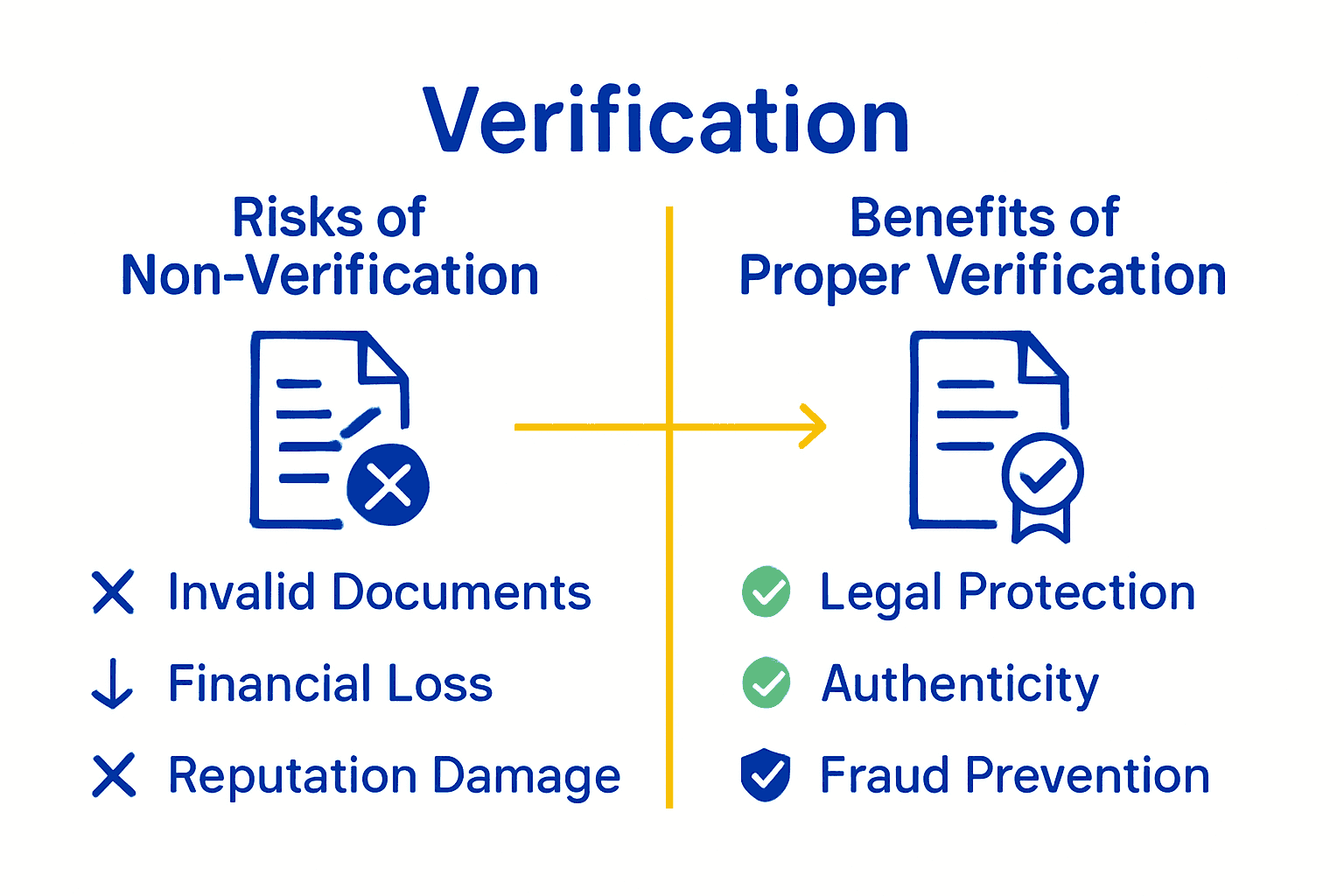
- Risks and Consequences of Non-Verification
- Best Practices for Reliable Document Verification
Key Takeaways
| Point | Details |
|---|---|
| Importance of Verification | Legal document verification ensures authenticity, validity, and integrity, transforming documents into legally recognized instruments. |
| Types of Documents | Essential documents including contracts, affidavits, and birth certificates require rigorous verification to prevent fraud. |
| Compliance Standards | Legal verification adheres to federal and state regulations, ensuring personal and organizational rights are safeguarded. |
| Risks of Non-Verification | Failing to verify documents can lead to legal invalidation, financial losses, and damage to reputation. |
Defining Verification of Legal Documents
Legal document verification is a critical process that ensures the authenticity, validity, and integrity of important paperwork. According to Law Cornell, verification involves a declaration swearing that statements within a document are true, typically made under oath or in the presence of a notary public.
The core purpose of document verification goes beyond simple authentication. Verification serves as a legal safeguard that confirms multiple essential elements, including:
- The document’s origin is legitimate
- Signatures are genuine and authorized
- Content has not been altered or tampered with after signing
- All required information is accurate and complete
As Certinal explains, document verification is a comprehensive process that scrutinizes every aspect of a legal document to guarantee its reliability. This meticulous examination helps prevent fraud, reduces legal risks, and provides confidence that the document represents a true and accurate representation of its intended purpose.
Whether you’re dealing with contracts, agreements, property deeds, or court filings, understanding the verification process is crucial. It transforms a simple piece of paper into a legally recognized and trustworthy instrument that can withstand potential legal challenges. Learn more about document verification techniques in our comprehensive guide on verifying legal documents.
Common Types of Legal Documents Requiring Verification
Legal document verification is essential for numerous critical paperwork types that impact personal and professional lives. According to National Notary, common documents requiring verification include affidavits, contracts, deeds, and powers of attorney, which often necessitate notarization to confirm their authenticity.
In personal documentation, several key document types demand rigorous verification:
- Birth certificates
- Marriage licenses
- Property transfer documents
- Academic transcripts and diplomas
- Passport and immigration papers
For official and public records, Wikipedia highlights that certified copies of public records like birth and marriage certificates require meticulous verification to confirm they are true representations of original documents. This process ensures that individuals can confidently use these documents for legal, administrative, and personal purposes.
Business and professional environments also rely heavily on verified documents. Contracts, partnership agreements, real estate transactions, and financial instruments all require comprehensive verification to protect all parties involved. Learn more about the essential types of legal documents in our comprehensive guide.
Verification isn’t just a bureaucratic formality—it’s a critical safeguard that prevents fraud, establishes legal authenticity, and provides confidence in the integrity of important personal and professional documentation.

Legal Standards and Compliance Requirements
Legal document verification involves navigating a complex landscape of federal and state regulations designed to ensure authenticity and protect individual rights. As Wikipedia highlights, the Real ID Act sets critical federal standards for identification documents, requiring rigorous verification of identity and legal status for accessing federal facilities and air travel.
Key compliance requirements span multiple domains, including:
- Government identification
- Employment authorization
- Immigration documentation
- Professional licensing
- Financial and banking transactions
Employment-related document verification represents another crucial compliance area. Wikipedia notes that Form I-9 mandates employers to verify both the identity and employment authorization of individuals hired in the United States, ensuring strict adherence to immigration laws and preventing unauthorized workforce participation.
These legal standards serve multiple critical purposes.
They protect against identity fraud, ensure national security, maintain workforce integrity, and provide a standardized framework for document authentication across various professional and governmental contexts. Learn more about navigating complex legal document workflows with our comprehensive guide.
Understanding and implementing these compliance requirements isn’t just about following rules—it’s about creating a transparent, secure ecosystem where legal documents serve their fundamental purpose of establishing trust, verifying identity, and protecting individual and organizational interests.
Risks and Consequences of Non-Verification
Legal document verification is not merely a bureaucratic formality—it’s a critical safeguard against potentially devastating consequences. According to Wikipedia, failing to verify legal documents can critically undermine one’s ability to meet the burden of proof in legal proceedings, potentially resulting in catastrophic and unfavorable outcomes.
The risks of non-verification span multiple critical domains:
- Legal invalidation of critical documents
- Financial losses and potential lawsuits
- Identity theft and fraudulent representations
- Professional and personal reputation damage
- Potential criminal prosecution
Wikipedia emphasizes that without proper verification, documents may be summarily deemed invalid or unenforceable, exposing individuals and organizations to significant legal disputes and potentially severe financial penalties. This risk extends across personal, professional, and governmental contexts—from employment contracts to real estate transactions.
Beyond immediate legal ramifications, non-verification can trigger long-term consequences that ripple through an individual’s or organization’s entire operational ecosystem. These might include contract nullification, loss of professional credentials, blocked financial transactions, and irreparable damage to professional credibility. Explore our comprehensive guide to understanding legal document workflows and minimizing verification risks.
Ultimately, document verification is an investment in protection—a proactive measure that shields you from potential legal, financial, and personal vulnerabilities. The small effort required for thorough verification pales in comparison to the potential catastrophic consequences of neglecting this critical process.
Best Practices for Reliable Document Verification
Reliable document verification requires a systematic and comprehensive approach that goes beyond superficial checks. According to National Notary, utilizing notary services provides a robust method for ensuring document authenticity and compliance with critical legal standards.
Key best practices for document verification include:
- Verify the identity of all signatories
- Check document physical condition and original status
- Confirm signatures match official records
- Validate supporting documentation
- Maintain detailed verification records
- Use multiple verification methods
Certinal emphasizes the importance of implementing thorough verification processes that comprehensively examine a document’s authenticity, validity, and overall integrity. This means looking beyond surface-level characteristics and conducting deep, systematic examinations that leave no room for uncertainty.
Technological advancements have significantly enhanced verification capabilities. Digital verification tools, biometric authentication, blockchain technologies, and advanced forensic techniques now provide unprecedented levels of document validation. Explore our comprehensive guide to legal documentation tips for clients.
Successful document verification is not about perfection—it’s about creating a rigorous, repeatable process that minimizes risk and maximizes confidence. By adopting a multi-layered approach that combines traditional verification methods with cutting-edge technologies, individuals and organizations can protect themselves from potential fraud and legal complications.
Secure Your Legal Documents with Trusted Verification Services
Verifying your legal documents is not just important it is essential. The article highlights the real risks of non-verification like legal invalidation, financial loss, and damage to your reputation. If you have ever felt overwhelmed by ensuring every signature is genuine or that each document complies with legal standards this is a common challenge. You want confidence that your documents can stand up to scrutiny while avoiding costly delays or disputes.
If you’re looking for a reliable solution that ensures compliance, accuracy, and timely processing, YM Doc Services is here to help. Our professional team specializes in process serving, document retrieval, and court filings—streamlining the verification and delivery you need to stay secure and compliant.
Take control of your legal documentation today by choosing a trusted partner who understands verification risks and legal workflows inside and out. Don’t leave your important documents to chance. Visit YM Doc Services now and discover how our expert services reduce stress, prevent fraud, and keep your records solid. Learn more about how we support your needs with dependable legal document services and start your order with confidence.
Frequently Asked Questions
What is legal document verification?
Legal document verification is the process of ensuring the authenticity, validity, and integrity of important legal paperwork. It verifies that a document’s origin is legitimate, signatures are genuine, and the content is accurate and complete.
Why is it important to verify legal documents?
Verifying legal documents is crucial because it protects against fraud, establishes legal authenticity, and provides confidence that the document can withstand legal challenges. It minimizes risks associated with financial losses, identity theft, and reputation damage.
What are the common types of legal documents that require verification?
Common types include affidavits, contracts, deeds, powers of attorney, birth certificates, marriage licenses, property transfer documents, and academic transcripts. These documents often require rigorous verification to ensure they are accurate and valid.
What best practices should be followed for reliable document verification?
Best practices for document verification include verifying the identity of all signatories, checking the physical condition of the document, confirming signatures against official records, validating supporting documentation, maintaining detailed records, and using multiple verification methods.
Recommended
- How to Verify Legal Documents: A Clear, Secure Process – YM Doc Services
- Complete Guide to Legal Document Certification – YM Doc Services
- 7 Essential Legal Documentation Tips for Every Client – YM Doc Services
- Legal Paperwork Basics: Everything You Need to Know – YM Doc Services
We provide GPS-stamped, court-compliant service of process throughout Orange County, Seminole County, and West Volusia County. Licensed Florida process server — FAPPS Member · NAPPS Member · Florida Statutes Chapter 48 Compliant.