7 Essential Legal Paperwork Tips for Smooth Processing

Over 65 percent of legal professionals report wasted hours searching for misplaced documents or correcting paperwork errors. The pressure to manage files precisely is real, especially when one missed detail can put an entire case at risk. Staying organized is not just about neatness—it is the difference between smooth progress and costly mistakes. Learn how smart practices can help you keep legal paperwork secure, compliant, and easy to access when you need it most.

Table of Contents

Quick Summary

Takeaway Explanation
1. Implement a standard naming convention A consistent naming protocol helps in quickly identifying and retrieving documents across the case lifecycle.
2. Verify all required signatures Confirming signatures ensures document validity and prevents legal disputes due to overlooked details.
3. Stay ahead of filing deadlines Use a master calendar and reminders to avoid missed deadlines that can jeopardize legal proceedings.
4. Secure confidential information effectively Utilize encryption and access controls to protect sensitive documents from unauthorized access.
5. Regularly review legal paperwork standards Keeping updated with changes in legal requirements shields you from compliance risks and maintains professionalism.

1. Organize Documents by Case or Transaction

Managing legal paperwork starts with a rock solid organizational strategy that transforms chaotic files into a streamlined system. The key is creating a structured approach that allows you to locate any document instantly.

A standardized naming convention becomes your secret weapon in document management. According to ILTA Network, implementing a format like Year.Month.Day [Docket Number] Title of Document contributes to uniformity and swift identification throughout the case lifecycle.

Your organizational method can take two primary forms: digital or physical. As Legal Clarity notes, a physical system using three-ring binders and manila folders remains straightforward for those who prefer paper copies and do not require advanced technical skills.

Best Practices for Document Organization:

  • Create a consistent naming protocol
  • Use chronological or numerical sorting
  • Separate active and archived files
  • Implement cross-referencing techniques

Whether you choose digital or physical systems, the goal remains the same: quick retrieval, clear tracking, and professional management of your legal documents. By investing time in establishing a robust organizational framework, you will save countless hours searching for critical paperwork.

2. Double-Check All Required Signatures

Signatures are the legal backbone of document validity, transforming a piece of paper into a binding agreement. Getting signatures right is not just a formality it is a critical step that protects your legal interests.

According to Help With My Bank, if multiple signatures are required on a document and those requirements are not met, significant legal and financial complications can arise. For instance, in banking transactions, a bank might be held liable for losses if they process a document without all necessary signatures.

Signature Verification Checklist:

  • Confirm total number of required signatures
  • Verify each signatory’s identity
  • Ensure signatures are in the correct order
  • Check that all signature lines are completed
  • Validate any notary requirements

Notarization adds an extra layer of authentication. As National Notary points out, even during a single assignment, multiple signatures might need official verification. Careful documentation is crucial.

Your signature process should be methodical and precise. A single overlooked signature can invalidate an entire document create delays or trigger legal disputes. Take the time to review thoroughly before considering any legal paperwork complete.

3. Comply With Filing Deadlines and Procedures

Missed deadlines can transform a promising legal case into a procedural nightmare. Understanding and meticulously tracking filing requirements is not just recommended it is absolutely critical for legal success.

According to ALTA Policies, best practices mandate submitting documents electronically or delivering them to the appropriate recording jurisdiction within two business days of settlement or document receipt.

Research from Bloustein Institute suggests creating a comprehensive tracking system. A strategic approach involves developing a detailed spreadsheet for each file that outlines case features and tracks critical timelines.

Deadline Compliance Strategies:

  • Create a master calendar of all critical filing dates
  • Set reminders at least one week before each deadline
  • Develop a systematic document review process
  • Maintain digital and physical backup copies of all submissions
  • Implement a redundant tracking mechanism

Your goal is proactive management. By anticipating deadlines and establishing a robust tracking system, you transform potential procedural risks into opportunities for professional excellence. Remember that in legal paperwork, timing is not just important it is everything.

4. Use Legible Formats for All Submissions

Legal documents are communication vehicles that require crystal clear presentation. Your submission format can make the difference between smooth processing and potential administrative roadblocks.

According to Oregon State Archives, establishing a standard naming convention is critical. For instance, when dealing with draft documents, professionals recommend clearly inserting ‘DRAFT’ at the end of the filename. Avoid cryptic abbreviations like ‘dft’ or ‘dr’ that could create confusion.

The Association of Legal Administrators suggests creating a consistent and logical filing structure that becomes second nature to all team members. This means organizing documents into hierarchical folders based on logical categories such as case type, client name, or practice area.

Submission Format Best Practices:

  • Use clear readable fonts
  • Maintain consistent font sizes
  • Create uniform margins
  • Label documents with precise descriptive titles
  • Include version control information

Think of your document formatting as a professional first impression. A well structured submission communicates attention to detail respect for the recipient and increases the likelihood of smooth administrative processing.

5. Secure Confidential Information Properly

Confidential legal documents are not just paperwork they are sensitive information that demands ironclad protection. Your security strategy can make the difference between maintaining client trust and risking potentially devastating data breaches.

According to the American Judges Society, physical security has evolved dramatically. Modern fire-proof home safes now offer advanced protection features including key locks, combination locks, and cutting edge technologies like fingerprint and iris scanners.

For digital management, Association of Legal Administrators recommends utilizing document management systems that provide systematic organization with robust access controls.

Confidential Information Protection Strategies:

  • Use multi factor authentication
  • Encrypt sensitive digital files
  • Limit document access to essential personnel
  • Maintain detailed access logs
  • Regularly update security protocols

Think of document security as a comprehensive shield. Whether physical or digital, your approach should create multiple layers of protection that safeguard sensitive information from unauthorized access while maintaining professional accessibility.

6. Keep Digital and Physical Copies Organized

Backup is not just a safety net it is a professional lifeline for legal documents. Your preservation strategy can mean the difference between seamless recovery and catastrophic information loss.

According to the American Judges Society, modern document management goes beyond traditional filing. Professionals are now recommended to scan physical documents and create secure digital folders with password protection.

The Association of Legal Administrators emphasizes the critical importance of comprehensive backup strategies. This means integrating both cloud based and local storage solutions to safeguard your critical files.

Document Preservation Best Practices:

  • Create redundant storage systems
  • Use encrypted digital folders
  • Implement regular backup schedules
  • Maintain chronological organization
  • Test backup recovery processes periodically

Think of your document management like a professional insurance policy. By maintaining synchronized digital and physical copies with strategic backup protocols, you create a robust safety net that protects your most valuable professional assets.

Legal standards are not static they evolve constantly. Staying current with paperwork requirements is not just recommended it is a professional imperative that protects you from potential compliance risks.

According to ALTA, organizations must proactively outline statutory and regulatory recording prerequisites within their internal policies and procedures. This means creating a systematic approach to tracking and implementing legal standard updates.

The Association of Legal Administrators emphasizes that every legal organization has unique document management preferences. Consequently, your review process should be both flexible and rigorous.

Tracking Legal Standard Updates:

  • Subscribe to professional legal journals
  • Attend continuing education seminars
  • Set quarterly review periods
  • Network with professional associations
  • Utilize online legal update resources

Think of legal standard updates like a professional fitness regimen. Regular checkups and proactive learning keep your practice agile resilient and ahead of potential compliance challenges.

Below is a comprehensive table summarizing the key strategies and practices for effective legal document management as discussed in the article.

Strategy/Aspect Implementation/Key Steps Benefits/Outcomes
Organize Documents by Case or Transaction Use a consistent naming convention like Year.Month.Day [Docket Number] Title of Document; organize digitally or physically. Quick retrieval and efficient management of legal files.
Double-Check Required Signatures Confirm the number of signatures, verify identities, and ensure notarization if needed. Prevents invalidation of documents and legal disputes.
Comply With Filing Deadlines Use a master calendar, set reminders, and maintain a backup of submissions. Avoids procedural issues and ensures timely document submission.
Use Legible Formats Standardize naming conventions, maintain readable fonts and sizes, and include version control info. Facilitates smooth processing and enhances professional presentation.
Secure Confidential Information Properly Implement multi-factor authentication, encrypt files, and limit access. Protects sensitive information and maintains client trust.
Keep Digital and Physical Copies Organized Create redundant systems, use encrypted folders, and follow regular backup schedules. Ensures seamless recovery and prevents information loss.
Regularly Review Legal Paperwork Standards Subscribe to journals, attend seminars, and set review periods. Keeps practices compliant and adaptive to changing standards.

Handling legal paperwork demands precision, timeliness, and strict compliance with filing standards. This article highlights common challenges such as meeting deadlines, securing signatures, and maintaining organized digital and physical files. These pain points can cause delays, legal risks, and costly frustration. When your documents are not organized or processed correctly, every missed detail adds stress and risk to your case.

YM Doc Services understands these challenges and offers reliable solutions to help you manage process serving, court filings, and document retrieval efficiently. Whether you need support with timely delivery or want to ensure your paperwork complies with legal standards, our expert team removes the burden so you can focus on your case.

Take control today. Visit our main website to see how our professional services can help you meet filing deadlines, secure documents properly, and maintain flawless organization. Ready to reduce stress and improve your workflow? See our legal document services and contact us now to streamline your case management with trusted support.

https://ymdocservices.com

Choose YM Doc Services as your partner for seamless legal document processing. Act now to protect your deadlines and keep your case moving forward without delay.

Frequently Asked Questions

To organize your legal documents efficiently, create a standardized naming convention and categorize your files by case or transaction. Start by implementing a consistent format, like Year.Month.Day [Docket Number] Title of Document, and maintain a separation between active and archived files for quick retrieval.

To collect all required signatures, create a signature verification checklist that confirms the total number of required signatures and verifies each signatory’s identity. Make it a habit to double-check the signature order and ensure all signature lines, including any notary requirements, are completed before considering the document finalized.

Stay compliant with filing deadlines by creating a master calendar that tracks all critical filing dates and setting reminders at least one week before each deadline. Implement a systematic document review process to ensure timely submissions and avoid potential legal ramifications of missed deadlines.

When formatting legal submissions, ensure that you use clear, readable fonts, maintain consistent font sizes and margins, and provide precise descriptive titles for your documents. Clearly label any drafts with ‘DRAFT’ in the filename to prevent confusion among team members or recipients.

To protect confidential information, use multi-factor authentication and encrypt sensitive digital files. Regularly update your security protocols and limit access to essential personnel only, ensuring that detailed access logs are maintained for added security.

The best way to back up legal documents is to create a redundant storage system that includes both cloud-based and local storage solutions. Schedule regular backups and keep both digital and physical copies organized to facilitate easy access and recovery in case of data loss.

Posted in Uncategorized

Master Legal Document Workflow 2025 for Fast, Compliant Delivery

More than 60 percent of legal professionals report that navigating compliance requirements causes major workflow delays. Each legal document carries its own set of risks and regulations, demanding careful attention from start to finish. Mastering the full process—from assessing compliance to archiving records—protects your practice from costly errors and ensures your documents always meet the latest legal standards.

Table of Contents

Quick Summary

Key Point Explanation
1. Ensure Document Compliance Review legal documents for adherence to cybersecurity and data protection regulations to avoid future legal issues.
2. Implement Digital Filing Systems Convert physical documents to a secure digital format, enhancing searchability and accessibility while reducing overhead.
3. Select Secure Delivery Methods Use compliant document service methods that ensure timely and secure transmission of legal documents to mitigate risks.
4. Track Document Delivery Progress Establish a tracking system to monitor document status and confirmations, ensuring accountability and compliance throughout the process.
5. Archive Service Records Securely Verify completion of document services and maintain organized, accessible records to support compliance and protect against disputes.

Step 1: Assess Document Requirements and Compliance Standards

Preparing legal documents requires a strategic approach to meet rigorous compliance standards. In this step, you will learn how to systematically evaluate and confirm that your legal documents satisfy all necessary regulatory requirements before submission.

Begin by thoroughly reviewing current cybersecurity and data protection regulations. According to Boston Institute of Analytics, 2025 compliance standards emphasize comprehensive data management practices. This means carefully examining how your documents handle sensitive information through multiple critical checkpoints.

Key assessment criteria include verifying:

  • Proper data collection protocols
  • Secure information storage mechanisms
  • Appropriate breach notification procedures
  • Precise documentation of data handling processes

To ensure full compliance, create a comprehensive checklist that cross references your specific document requirements with current legal standards. This proactive approach helps prevent potential legal complications and demonstrates professional diligence in document preparation.

If any aspect of the document fails to meet established standards, flag it immediately for revision. Waiting until later stages can create significant administrative complications and potential legal risks.

Once you have completed this thorough review, you will have a legally sound document ready for the next stage of processing.

Transforming physical legal case files into a streamlined digital system requires strategic planning and precise execution. In this step, you will learn how to convert your paper documents into an efficient digital workflow that enhances accessibility and reduces administrative overhead.

According to UMA Technology, effective digital organization hinges on implementing robust workflow management tools with centralized document repositories. Begin by selecting a secure digital platform that offers comprehensive version control and advanced document tracking capabilities. Your digital system should allow for:

  • Instant document retrieval
  • Comprehensive version tracking
  • Secure access management
  • Automated backup protocols

Start the digitization process by systematically scanning all physical documents using high resolution scanners. Ensure each document is clear and legible before uploading to your digital system. Create a logical folder structure that mirrors your physical filing system making future searches intuitive and efficient.

Pro tip: Always maintain multiple backup copies of your digitized files across different secure locations. This redundancy protects against potential data loss and ensures continuous access to critical legal documentation.

Infographic showing five legal document workflow steps with icons and arrows.

Through careful planning and methodical implementation, you will transform your physical case files into a robust digital archive ready for the next phase of your legal document workflow.

digitize legal files

Step 3: Select and Schedule Secure Document Service Methods

Choosing the right document service method is crucial for maintaining legal compliance and ensuring timely delivery. In this step, you will develop a strategic approach to selecting and scheduling document services that prioritize security and efficiency.

According to UMA Technology, compliance automation tools in 2025 offer advanced features like real-time regulatory feed processing to enhance document service security. When selecting your service method, look for platforms that provide:

  • Automated reporting capabilities
  • Real-time regulatory tracking
  • Comprehensive digital signature options
  • Secure execution protocols

Carefully evaluate different delivery channels based on your specific document requirements. Some documents may need certified mail, while others might be suitable for digital transmission. Consider factors such as confidentiality level, recipient accessibility, and legal authentication requirements when making your selection.

Pro tip: Always maintain a detailed audit trail of your document service methods. This documentation protects you from potential disputes and demonstrates your commitment to transparent and secure document management.

When you select an online legal document delivery service, prioritize platforms that offer multiple verification checkpoints and comprehensive tracking mechanisms. Your chosen method should provide clear evidence of document transmission and receipt.

By meticulously planning your document service approach, you will create a robust system that ensures fast, compliant, and secure legal document delivery.

Step 4: Track Delivery Progress and Confirm Receipt

Ensuring accurate tracking and confirmation of legal document delivery is critical for maintaining compliance and legal accountability. In this step, you will learn how to systematically monitor document transmission and verify successful receipt.

According to UMA Technology, modern contract management tools offer automated notifications and tracking features that streamline the receipt confirmation process. Implement a comprehensive tracking system that provides:

  • Real-time status updates
  • Automated delivery confirmations
  • Detailed transmission logs
  • Digital receipt verification

As insights from Disquantified suggest, effective tracking requires establishing clear visibility into document statuses. Begin by setting up a digital tracking dashboard that allows you to monitor each document’s journey from transmission to final receipt.

Pro tip: Always capture multiple verification points during document delivery. Screenshots, timestamps, and digital signatures can serve as crucial evidence if receipt disputes arise later.

Cross reference your tracking logs with the original delivery requirements to ensure every document meets the specified transmission standards. This meticulous approach guarantees you have comprehensive proof of successful document delivery.

By mastering these tracking protocols, you create a robust system that provides transparency and legal protection throughout your document delivery workflow.

Step 5: Verify Completion and Archive Service Records

The final stage of your legal document workflow involves meticulous verification and secure archiving of service records. In this step, you will learn how to systematically confirm document completion and create a robust, compliant record management system.

According to the Compliance Policy and Procedure Manual 2025, maintaining comprehensive documentation requires careful tracking of all policy changes and legal consultations. When verifying service records, focus on:

  • Comprehensive document validation
  • Accurate change documentation
  • Legal consultation logs
  • Systematic record maintenance

As UMA Technology highlights, modern validation tools can automatically flag potential compliance issues during the archiving process. Verify your legal documents by implementing a multi-step validation process that includes digital checks and manual review.

Pro tip: Create a standardized archiving protocol that includes timestamps, digital signatures, and comprehensive metadata for each document. This approach provides an irrefutable audit trail and protects your organization from potential future disputes.

Establish a secure digital archive with multiple backup locations and strict access controls. Regularly review and update your archiving system to ensure it meets the latest compliance standards and technological best practices.

By executing these final verification and archiving steps, you complete a robust legal document workflow that prioritizes accuracy, security, and regulatory compliance.

Navigating the complex steps of legal document preparation, delivery, and verification can be overwhelming. You need to follow strict compliance standards, track delivery in real time, and securely archive records without missing a beat. Missing a deadline or a regulatory detail can cause delays and risk legal challenges. Whether it is assessing document requirements, digitizing case files, or confirming receipt, every step demands precision and reliability.

YM Doc Services is here to remove that stress and keep your legal document process fast and compliant. With professional process serving, certified delivery options, and a secure tracking system, we help you meet all the standards described in the latest workflows. Benefit from expertise in secure document transmission and detailed audit trails documented for your peace of mind. Explore how our services can transform your legal operations at YM Doc Services.

Ready for flawless legal document handling backed by trusted service?

https://ymdocservices.com

Take control of your legal workflows now with our expert process serving and document management support. Visit YM Doc Services to get started and make sure your documents are always delivered on time with verified compliance. Learn more about how to verify your legal documents and why choosing the right online legal document delivery service matters for uninterrupted legal success.

Frequently Asked Questions

To assess legal document compliance, start by reviewing current cybersecurity and data protection regulations. Create a checklist that cross-references your document requirements with these legal standards to ensure every aspect is compliant.

Begin by selecting a secure digital platform with advanced document tracking features. Then, systematically scan and organize physical documents into logical folders to enhance accessibility and streamline your workflow.

What are the best practices for selecting secure document service methods?

Choose document service methods that prioritize security and efficiency, such as platforms that offer digital signatures and automated reporting. Evaluate your delivery channels based on confidentiality and legal authentication requirements to ensure compliance.

Implement a tracking system that provides real-time status updates and automated delivery confirmations. Set up a digital dashboard to monitor each document’s journey and capture multiple verification points during delivery to ensure accountability.

What should I include while verifying and archiving service records?

Focus on comprehensive document validation and systematic record maintenance when verifying service records. Establish an archiving protocol that includes timestamps and digital signatures to create a clear audit trail of your documents.

Streamline your workflow by integrating robust document management tools that enable real-time tracking and secure execution protocols. Aim to routinely review and update your processes to align with the latest compliance standards, ideally refining your system within 30–60 days.

Posted in Uncategorized

Service of Process Laws: Complete Guide for 2025

Mistakes in serving legal documents can halt a lawsuit before it even begins. Courts across the United States have dismissed cases due to improper notification, costing parties valuable time and resources. Proper service of process is not just a formality—it is the foundation that upholds everyone’s right to fair legal proceedings. This article breaks down the true role of service of process, clears up common myths, and helps you avoid issues that could derail your case.

Table of Contents

Key Takeaways

Point Details
Service of Process is Critical Effective service of process ensures fairness and due process, establishing court jurisdiction.
Role of Professional Process Servers Experienced servers provide essential compliance and accuracy in delivering legal documents.
Understanding Service Types Personal, substituted, and publication methods are essential for proper legal notification.
Importance of Compliance Adhering to jurisdictional rules is crucial to avoid delays, dismissals, and increased costs in legal proceedings.

Defining Service of Process and Common Misconceptions

Service of process represents a fundamental legal procedure that ensures fairness and due process in legal proceedings. According to Cornell Law, service of process is the procedure by which a party to a lawsuit provides appropriate notice of legal action to another party, court, or administrative body, ultimately establishing the court’s jurisdiction over the involved parties.

Legal notification is more complex than simply handing someone a document. Professional process servers play a critical role in executing this procedure correctly. The primary goal is guaranteeing that defendants are properly informed about legal actions initiated against them, giving them an opportunity to respond and defend themselves.

Common misconceptions about service of process can lead to significant legal complications. Many individuals mistakenly believe that anyone can serve legal documents or that service is a mere formality. As U.S. Courts explains, proper service is crucial for the court to exercise jurisdiction and proceed with a case. Incorrect service can result in:

  • Delays in legal proceedings
  • Potential dismissal of legal actions
  • Challenges to the court’s jurisdiction
  • Additional legal expenses

Professional process servers understand the nuanced requirements for legal document delivery. Service of Process Workflow: Everything You Need to Know provides comprehensive insights into the intricate steps involved in executing legal notifications accurately and efficiently. By working with experienced professionals, individuals and businesses can ensure their legal documents are served correctly, minimizing potential procedural errors and protecting their legal interests.

Types of Service: Personal, Substituted, and Publication

Legal proceedings require precise methods of delivering legal documents, with each service type serving a specific purpose and context. According to Wikipedia, service of process can be executed through three primary methods: personal service, substituted service, and service by publication.

Personal Service represents the most direct and preferred method of serving legal documents. This approach involves directly delivering legal papers to the intended recipient, ensuring they receive immediate and unambiguous notification of legal proceedings. Process servers must physically hand the documents to the named individual, providing concrete proof of delivery and minimizing potential disputes about notification.

Substituted Service becomes critical when personal service proves challenging. This method allows legal documents to be delivered to an alternative responsible person at the individual’s residence or place of business. Typical scenarios include:

  • Serving documents to an adult family member at the recipient’s home
  • Delivering papers to a designated corporate representative at a business address
  • Leaving documents with a receptionist or authorized workplace contact

Service by Publication emerges as a last resort when the defendant’s location remains unknown or direct contact seems impossible. 7 Essential Types of Process Serving Explained for Legal Use highlights this method’s importance in complex legal scenarios. By publishing legal notices in approved newspapers or official publications, courts can demonstrate reasonable attempts to notify the individual while protecting the plaintiff’s right to pursue legal action.

Understanding these service types is crucial for ensuring legal proceedings move forward effectively, protecting the rights of all parties involved and maintaining the integrity of the judicial process.

process serving scenarios

Navigating the complex landscape of service of process requires a nuanced understanding of legal requirements that can vary dramatically across different jurisdictions. According to Wikipedia, service of process laws differ significantly across the United States, with federal guidelines providing a general framework while individual states maintain their own specific procedures and requirements.

Jurisdictional complexity means that what works in one state may be entirely insufficient in another. What Is Process Server Compliance? underscores the critical importance of understanding these regional variations. For example, Cornell Law highlights specific regulations like 32 CFR 720.20, which outlines unique procedures for serving process on military personnel, demonstrating how specialized legal contexts demand precise, tailored approaches.

Key jurisdictional variations typically involve:

  • Acceptable methods of service
  • Required waiting periods
  • Documentation and proof of service requirements
  • Specific rules for different types of legal entities
  • Time limitations for completing service

Professional process servers must remain incredibly adaptable, maintaining comprehensive knowledge of both federal guidelines and state-specific nuances. This requires continuous education and meticulous attention to detail, as even minor procedural errors can potentially invalidate an entire legal action.

The stakes are high: incorrect service can result in case dismissals, delays, or the need to restart complex legal proceedings from the beginning.

Ultimately, understanding jurisdictional variations isn’t just about following rules—it’s about ensuring fair and proper legal notification across diverse legal landscapes. Professional process servers act as critical navigators, bridging the gap between complex legal requirements and successful document delivery.

Responsibilities of Process Servers and Parties Involved

The intricate world of legal document delivery demands precision, accountability, and a deep understanding of professional responsibilities. According to Wikipedia, process servers are entrusted with a critical mission: delivering legal documents to parties involved in legal proceedings while ensuring strict compliance with jurisdictional laws.

Professional process servers carry significant legal responsibilities that extend far beyond simple document delivery. Complete Guide to the Role of Process Server highlights the multifaceted nature of their role. Their primary responsibilities include:

  • Accurately identifying and locating the intended recipient
  • Delivering documents in compliance with legal requirements
  • Providing verifiable proof of service
  • Maintaining detailed and accurate documentation
  • Respecting legal and ethical boundaries during service

The proof of service is perhaps the most crucial element of a process server’s responsibilities. This typically involves creating a sworn affidavit that meticulously documents:

  1. Date and time of service
  2. Location of service
  3. Manner of service
  4. Identity of the person served
  5. Official certification of the service’s legality

Parties involved in legal proceedings also bear significant responsibilities. The plaintiff must provide accurate contact information and ensure the documents are prepared correctly. The defendant has the right to be properly notified and must respond within specified legal timeframes. Failure to comply can result in default judgments or additional legal complications.

Ultimately, successful service of process requires a collaborative effort between process servers, legal professionals, and involved parties. Transparency, accuracy, and strict adherence to legal protocols form the foundation of this critical legal communication process.

Risks, Costs, and Common Compliance Mistakes

Navigating the complex world of service of process involves understanding the potential pitfalls that can derail legal proceedings and incur substantial financial and legal consequences. Legal Document Templates Explained highlights the critical importance of precision in legal documentation and service procedures.

Financial Risks associated with improper service can be substantial. Common cost implications include:

  • Court filing fees for re-serving documents
  • Legal expenses for correcting procedural errors
  • Potential sanctions or monetary penalties
  • Extended litigation timelines
  • Additional attorney fees for rectifying mistakes

Compliance Mistakes frequently encountered by inexperienced process servers and legal professionals involve:

  1. Incorrect recipient identification
  2. Improper document delivery methods
  3. Failure to meet jurisdictional time requirements
  4. Incomplete or inaccurate service documentation
  5. Neglecting specific local or state service regulations

The consequences of these mistakes extend beyond immediate financial costs. Procedural errors can result in:

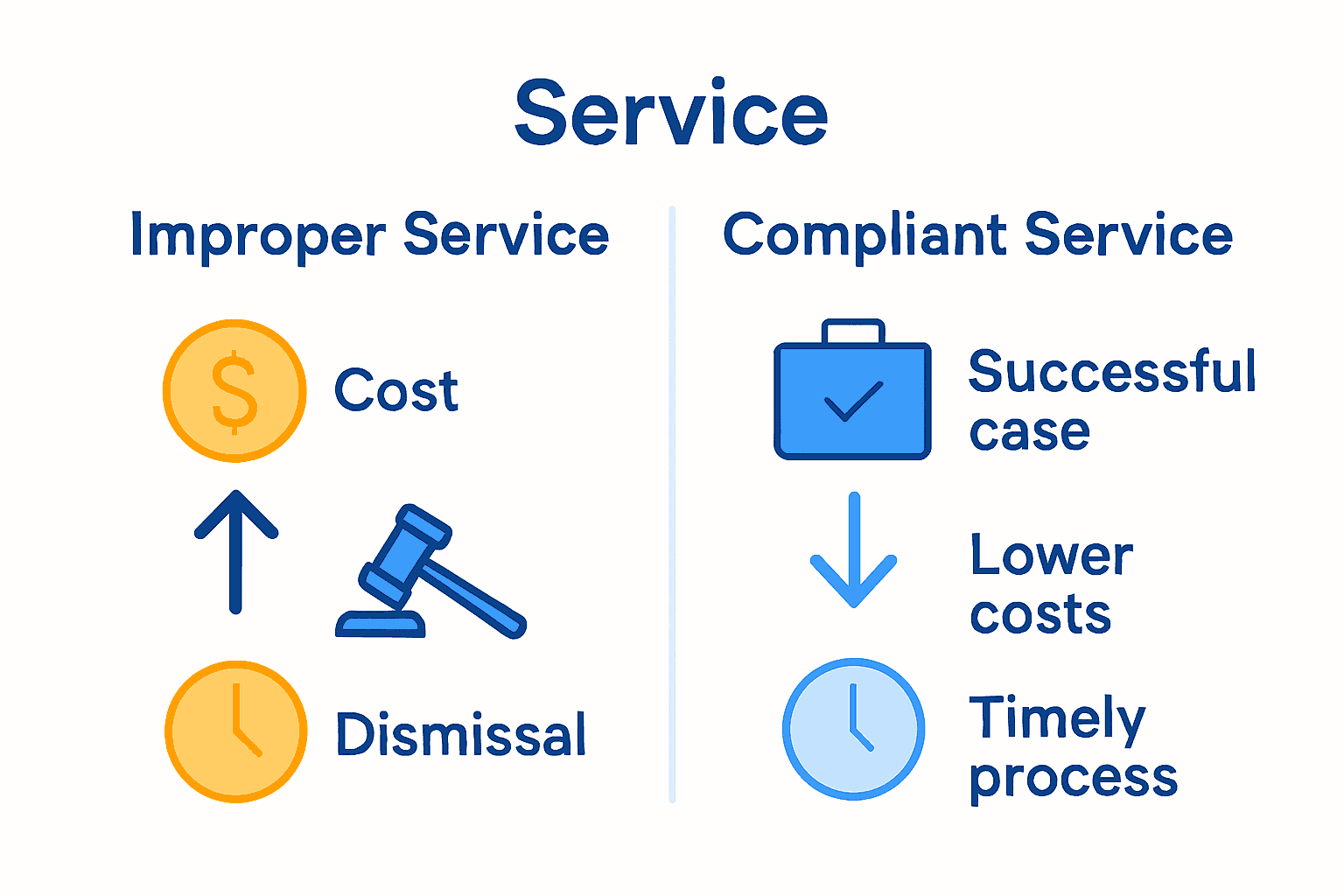
Comparison of improper and compliant service of process risks and outcomes

  • Case dismissals
  • Invalidation of legal proceedings
  • Loss of legal standing
  • Potential statute of limitations complications
  • Reputational damage for legal professionals

Successful navigation of service of process requires meticulous attention to detail, comprehensive understanding of legal requirements, and a proactive approach to compliance. Professional process servers must continuously update their knowledge, maintain rigorous documentation practices, and approach each service with the utmost precision to mitigate potential risks and ensure legal effectiveness.

Understanding the complex laws around service of process is essential yet challenging. If you are facing issues like proper legal notification, jurisdictional variations, or ensuring compliance with court requirements, you are not alone. Many struggle with risks such as incorrect delivery, missed deadlines, and rising costs that can delay or derail your legal case. Key terms like personal service, substituted service, and proof of service are critical but often confusing without professional guidance.

YM Doc Services offers reliable, timely, and compliant solutions tailored to ease these burdens. With services ranging from accurate process serving to comprehensive document retrieval and court filings, we handle every detail so you can focus on your case. Benefit from our expertise to avoid compliance mistakes and costly delays by choosing trusted professionals who understand jurisdictional nuances and meticulous documentation. Learn how we help streamline your legal processes by visiting our complete role of process server guide and explore the importance of process server compliance to stay ahead.

Ready to take control of your service of process challenges and protect your legal interests today?

https://ymdocservices.com

Experience peace of mind and legal efficiency now by starting your service order with YM Doc Services at https://ymdocservices.com. Act quickly to ensure proper service that keeps your case on track without costly setbacks.

Frequently Asked Questions

What is the service of process?

Service of process is the procedure by which a party to a lawsuit provides notice of legal action to another party, ensuring proper jurisdiction and the opportunity for the defendant to respond.

What are the different types of service of process?

The three main types of service of process are personal service, substituted service, and service by publication. Each type serves a specific purpose based on the circumstances of the case.

Proper service of process is crucial because it establishes the court’s jurisdiction over the parties involved. Incorrect service can result in delays, dismissals, and additional legal expenses.

What are the common compliance mistakes in the service of process?

Common compliance mistakes include incorrect recipient identification, improper delivery methods, failure to meet time requirements, and incomplete documentation, all of which can jeopardize legal proceedings.

Posted in Uncategorized

Legal Paperwork for Real Estate: Complete Guide

Over 80 percent of real estate disputes stem from issues in legal paperwork. Buying or selling property involves far more than a handshake or a simple agreement. Each document carries weight, spelling out rights, risks, and legal obligations for everyone involved. Understanding the details behind deeds, contracts, and disclosures helps protect your investment and ensures a clear, secure transfer of ownership from beginning to end.

Table of Contents

Key Takeaways

Point Details
Legal Documentation is Essential Legal paperwork in real estate is crucial for property ownership transfer, protecting involved parties, and compliance with HUD standards.
Diverse State Regulations Each state has unique real estate laws that affect transactions; professionals must stay informed to avoid legal complications.
Meticulous Document Preparation Careful preparation and filing of documents are vital to prevent legal errors and ensure compliance with regulatory requirements.
Risk Mitigation is Key Understanding and preventing common documentation errors can significantly reduce financial risks and legal liabilities in real estate transactions.

Legal paperwork in real estate represents the critical documentation that legally transfers property ownership, establishes rights, and protects all parties involved in a transaction. According to congress.gov, the U.S. Department of Housing and Urban Development (HUD) maintains Minimum Property Standards (MPS) that establish fundamental documentation requirements for housing transactions, particularly for federally insured properties.

These legal documents serve multiple essential functions in real estate transactions. They typically include property deeds, purchase agreements, mortgage contracts, title reports, and property disclosure statements. Each document plays a unique role in transferring ownership, defining property boundaries, confirming legal ownership status, and disclosing potential property issues or encumbrances.

The complexity of real estate legal paperwork continues to evolve. As noted by the American Bar Association, legislative changes can significantly impact documentation requirements. For instance, recent amendments to state environmental quality laws have introduced new disclosure and documentation standards that real estate professionals must navigate.

Key components of real estate legal paperwork include:

  • Property ownership verification
  • Financial transaction documentation
  • Legal rights and obligations
  • Risk mitigation for all parties
  • Compliance with local and federal regulations

Navigating these documents requires precision and understanding. While the paperwork might seem overwhelming, each document serves a critical purpose in protecting the interests of buyers, sellers, lenders, and other stakeholders in real estate transactions. Learn more about legal document essentials in our guide on legal document templates.

Common Real Estate Documents Explained

Real estate transactions involve a complex array of legal documents, each serving a specific purpose in protecting the interests of buyers, sellers, and financial institutions. According to congress.gov, the Department of Housing and Urban Development (HUD) establishes Minimum Property Standards (MPS) that define the necessary documentation for ensuring property quality, safety, and compliance in real estate transactions.

The most common real estate documents include property deeds, purchase agreements, mortgage contracts, title reports, property disclosure statements, and closing statements. Each document plays a critical role in transferring ownership, establishing financial obligations, and revealing potential property issues or legal encumbrances. For instance, a property deed legally transfers ownership from the seller to the buyer, while a mortgage contract outlines the terms of property financing.

Property documentation goes beyond simple ownership transfer.

HUD’s Minimum Property Standards highlight the importance of comprehensive documentation that covers property condition, safety standards, and compliance requirements. These documents protect all parties by providing transparent information about the property’s legal status, potential structural issues, and financial commitments.

Key documents every real estate transaction typically requires include:

  • Property Deed: Formal document transferring property ownership
  • Purchase Agreement: Detailed contract outlining transaction terms
  • Mortgage Contract: Financing terms and repayment conditions
  • Title Report: Verification of property ownership and potential liens
  • Property Disclosure Statement: Detailed information about property condition

Navigating these documents requires careful attention to detail and understanding of legal requirements. Explore our comprehensive guide to understanding essential legal documents to ensure you’re fully prepared for your real estate transaction.

State-Specific Laws and Compliance Standards

Real estate legal paperwork is far from uniform across the United States, with each state maintaining unique regulations and compliance requirements that significantly impact property transactions. According to alta.org, the American Land Title Association (ALTA) provides comprehensive State Compliance Guides that detail the intricate variations in title and closing regulations across all 50 states and Washington, D.C.

These state-specific laws can dramatically affect various aspects of real estate transactions, including property ownership, disclosure requirements, title transfers, and foreign investment regulations. congress.gov highlights recent legislative actions between January 2023 and July 2024 that demonstrate the dynamic nature of state regulations, particularly concerning foreign ownership of U.S. real estate. Compliance standards can differ widely, impacting everything from property taxation to disclosure obligations and transfer procedures.

Key areas where state laws significantly diverge include:

  • Property transfer procedures
  • Title insurance requirements
  • Disclosure of property defects
  • Foreign ownership restrictions
  • Closing and settlement processes
  • Environmental and zoning regulations

Professional real estate practitioners must stay continuously informed about these evolving state-specific requirements. Failure to comply with local regulations can result in legal complications, transaction delays, or potential financial penalties. Each state’s unique legal landscape demands meticulous attention to detail and a comprehensive understanding of local compliance standards.

Navigating this complex regulatory environment requires expert guidance and thorough research. Explore our guide to understanding legal document essentials to help you confidently manage the intricate world of state-specific real estate regulations.

Key Steps in Document Preparation and Filing

Document preparation and filing in real estate transactions requires meticulous attention to detail and comprehensive understanding of regulatory requirements. According to congress.gov, the Department of Housing and Urban Development (HUD) establishes Minimum Property Standards (MPS) that provide crucial guidelines for preparing and filing documentation, ensuring compliance with federal housing program requirements.

The document preparation process involves several critical stages. americanbar.org highlights the importance of staying informed about legislative changes that can impact document preparation and filing procedures. Real estate professionals must carefully compile, review, and organize multiple documents to ensure legal compliance and protect all parties involved in the transaction.

Key steps in document preparation and filing include:

  1. Gathering all necessary property documentation
  2. Verifying the accuracy of all information
  3. Completing required disclosure forms
  4. Obtaining necessary signatures
  5. Organizing documents in the correct order
  6. Submitting documents to appropriate authorities

Each step requires precision and thorough understanding of current legal requirements. Mistakes in document preparation can lead to significant delays, legal complications, or even transaction cancellation. Professional attention to detail is paramount in navigating the complex landscape of real estate documentation.

Real estate paperwork steps flowchart infographic with key stages and icons. Learn more about streamlining your legal document organization with our comprehensive workflow guide to ensure a smooth and efficient process.

Risks, Liabilities, and Error Prevention

Real estate documentation presents a complex landscape of potential risks and liabilities that can significantly impact property transactions. Legal errors in documentation can result in substantial financial consequences, ranging from transaction delays to complete contract invalidation. Professional attention to detail becomes paramount in mitigating these potential challenges.

The most common risks in real estate documentation stem from several critical areas of potential error. These include incomplete or inaccurate property descriptions, missing critical signatures, failure to disclose known property defects, and inconsistencies in financial documentation. Each of these errors can create significant legal vulnerabilities for both buyers and sellers, potentially exposing them to costly litigation or transaction cancellation.

Key risks that demand careful prevention include:

  • Title Defects: Unresolved ownership issues
  • Disclosure Failures: Incomplete property condition reporting
  • Financial Misrepresentation: Incorrect or misleading financial information
  • Boundary Disputes: Inaccurate property line descriptions
  • Contractual Ambiguities: Unclear or contradictory contract language

Preventing documentation errors requires a systematic approach that combines thorough review, professional expertise, and meticulous attention to detail.

review legal paperwork Real estate professionals must implement rigorous document verification processes, maintain current knowledge of legal requirements, and leverage technological tools to minimize human error. Learn more about our comprehensive legal document process tips to ensure smooth, error-free transactions.

Handling complex real estate documents like property deeds, purchase agreements, and title reports can feel overwhelming. The risk of errors, missed deadlines, or non-compliance with state-specific laws can lead to costly delays and increased stress. If you want to avoid these pitfalls and protect your transaction, trusting a reliable legal document service is essential.

https://ymdocservices.com

At YM Doc Services, we specialize in streamlining the entire process of document preparation, filing, and delivery so you can focus on closing deals with confidence. Whether you need help organizing your paperwork to meet HUD standards or navigating intricate state regulations, our professional services ensure accuracy, timeliness, and compliance with all legal requirements. Don’t let paperwork challenges hold you back. Visit our main site to get started and learn how our expert support can safeguard your real estate transactions today. For detailed guidance on managing documents effectively, explore our legal document organization workflow guide and legal document process tips.

Frequently Asked Questions

Legal paperwork in real estate refers to essential documentation that facilitates the transfer of property ownership, establishes rights, and protects all parties involved in a transaction, including property deeds, purchase agreements, and mortgage contracts.

What are the common real estate documents?

Common real estate documents include property deeds, purchase agreements, mortgage contracts, title reports, property disclosure statements, and closing statements, each serving a specific purpose in ensuring legal compliance and property ownership clarity.

How can state-specific laws affect real estate transactions?

State-specific laws can vary significantly, impacting property transfer procedures, disclosure requirements, and title insurance. Compliance with these regulations is crucial to avoid legal complications in real estate transactions.

What steps should I take for document preparation in real estate?

Key steps for document preparation include gathering necessary property documentation, verifying information accuracy, completing disclosure forms, obtaining signatures, organizing documents properly, and submitting them to the appropriate authorities.

Posted in Uncategorized

Service of Process Workflow: Everything You Need to Know

Over 90 percent of civil lawsuits depend on proper service of process to move forward in court. This single step does more than start a legal case, it safeguards everyone’s right to be notified and respond. Without it, lawsuits can stall or collapse entirely. Understanding how the service of process workflow works protects both legal professionals and individuals from costly mistakes that can jeopardize entire cases.

Table of Contents

Key Takeaways

Point Details
Service of Process Workflow It is essential to ensure proper notification and jurisdiction in legal proceedings, involving steps like document preparation and proof of service.
Variations in Service Methods Service methods vary by state and include personal service, substituted service, and electronic methods; the method chosen depends on case specifics.
Compliance and Risks Improper service can lead to dismissal or delays; adhering to jurisdictional, identification, and timing requirements is critical to avoid legal pitfalls.
Process Server Qualifications Qualifications for serving documents vary by state, emphasizing the need for legal knowledge and a clean background to ensure effective service.

Defining Service Of Process Workflow

A service of process workflow is the critical legal procedure that ensures proper notification and legal jurisdiction in civil legal proceedings. According to Cornell Law, service of process is the fundamental mechanism by which a party to a lawsuit gives appropriate notice of legal action to another party, establishing the court’s jurisdiction over the defendant.

The workflow typically involves several precise steps designed to guarantee fair legal communication. These include:

  • Identifying the defendant: Locating the exact person or entity who needs to be served
  • Preparing legal documents: Drafting the summons and complaint
  • Selecting an appropriate service method: Such as personal delivery, certified mail, or substitute service
  • Documenting proof of service: Confirming the legal notification was completed

As defined by the United States Courts, service of process fundamentally means delivering writs or summonses to the appropriate party. This process serves two crucial purposes: establishing court jurisdiction and notifying the defendant about pending legal action. Proper execution of this workflow is not just a procedural formality but a constitutional right that ensures individuals receive fair notice before legal proceedings commence.

To ensure a smooth service of process workflow for individuals, legal professionals must meticulously follow established protocols. Each step requires precision, from document preparation to actual service, to maintain the integrity of the legal process and protect the rights of all parties involved.

Variations In Service Of Process Methods

Service of process methods are not one-size-fits-all, but rather a flexible legal strategy adapted to different circumstances. According to National Conference of State Legislatures, these methods can vary significantly by state and include personal service, domiciliary service, service by mail, and service by publication.

The primary service methods include:

  • Personal Service: Direct hand delivery of legal documents to the defendant
  • Substituted Service: Leaving documents with an authorized person at the defendant’s residence or workplace
  • Service by Mail: Sending documents via certified or registered mail
  • Electronic Service: Serving documents through approved digital platforms
  • Service by Publication: Legal notice published in a newspaper when the defendant cannot be located

Cornell Law emphasizes that in exceptional cases, when an individual cannot be located within the jurisdiction, alternative methods like service by publication become necessary. The choice of method depends on specific case circumstances, legal requirements, and the ability to establish proper notification.

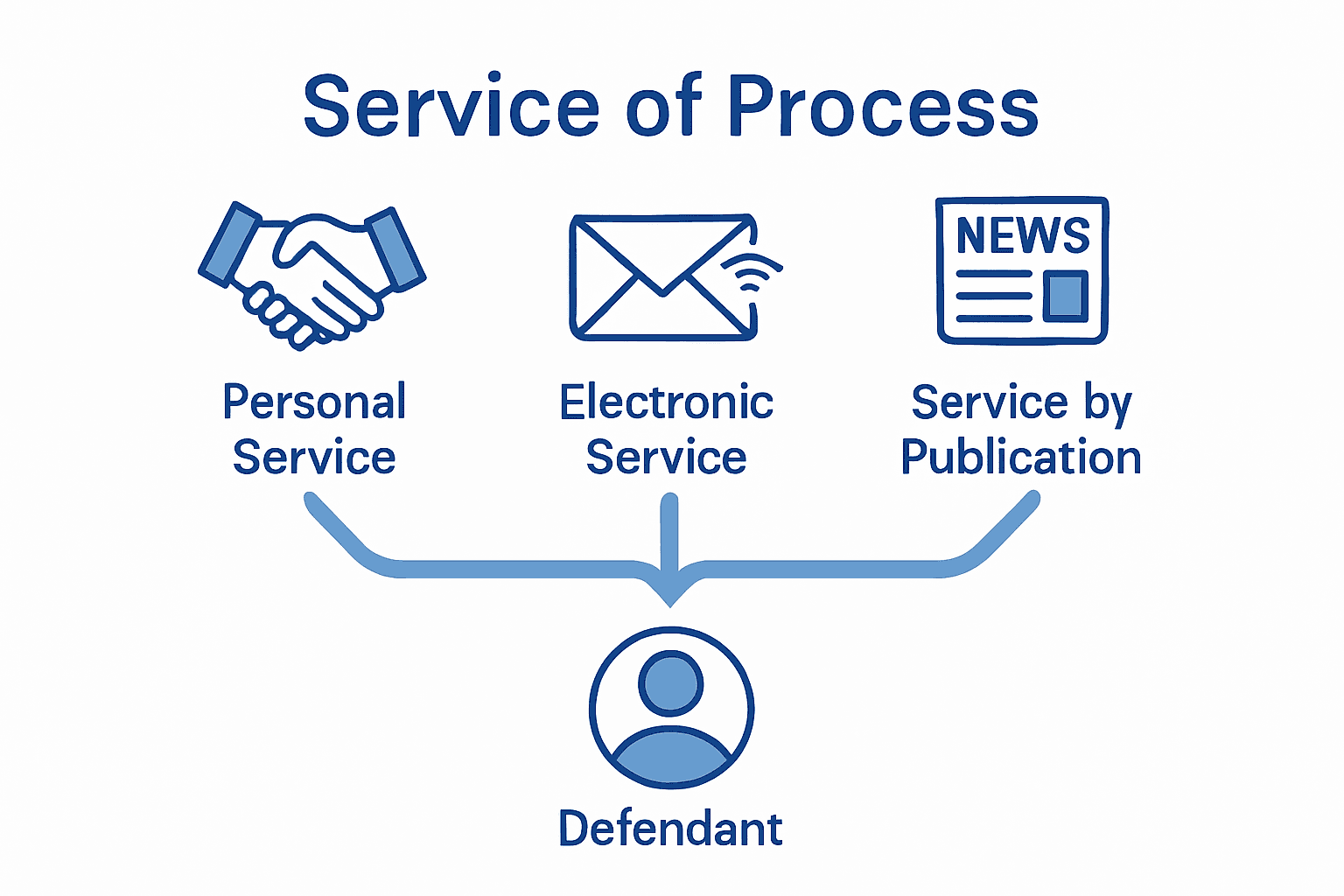
Comparison of service of process methods: personal, electronic, publication.

For legal professionals seeking comprehensive insights, our guide on types of process serving offers detailed exploration of these nuanced approaches. Understanding these variations ensures that legal notifications are executed effectively, maintaining the integrity of judicial proceedings and protecting the rights of all parties involved.

Step‑By‑Step Service Of Process Procedures

Service of process involves a structured, legally precise workflow that demands meticulous attention to detail. According to the U.S. Department of Justice, there are specific procedures for serving different types of entities, each requiring unique considerations and documentation.

The comprehensive service of process procedure typically follows these key steps:

  1. Case File Preparation
  • Gather all necessary legal documents
  • Verify the correct name and address of the recipient
  • Determine the most appropriate service method
  1. Document Verification
  • Ensure all legal documents are complete and accurate
  • Check jurisdictional requirements
  • Confirm the validity of the service documents
  1. Service Execution
  • Select appropriate service method (personal, substitute, mail)
  • Attempt service at designated locations
  • Document all service attempts
  1. Proof of Service
  • Complete official proof of service documentation
  • Record date, time, and method of service
  • File documentation with the court

Professional process servers understand that each step requires precision. Missed details can invalidate the entire legal process, potentially causing case dismissals or significant delays. For legal professionals seeking more nuanced insights, our tutorial on process serving examples offers comprehensive guidance on navigating these critical procedural requirements.

The ultimate goal of these procedures is to ensure fair legal notification. This means providing the defendant with proper notice of legal proceedings, protecting their right to respond, and maintaining the integrity of the judicial system. Strict adherence to these step-by-step procedures is not just a legal requirement but a fundamental aspect of due process.

court proof service

Process Server Qualifications And Licensing

Process server qualifications are far from uniform across the legal landscape. According to the National Conference of State Legislatures, licensing requirements vary dramatically between states, with some mandating strict certification and others maintaining minimal regulatory standards.

Typical qualifications for process servers generally include:

  • Age Requirements: Must typically be at least 18 years old
  • Background Check: Clean criminal record often mandatory
  • Legal Knowledge: Understanding of service of process rules
  • Physical Fitness: Ability to locate and safely approach individuals
  • Professional Certification: Optional or mandatory depending on jurisdiction

The core legal standard, as noted by Cornell Law, allows considerable flexibility, with some jurisdictions permitting any adult not involved in the case to serve process. However, professional process servers are increasingly preferred due to their specialized knowledge and reliability.

For legal professionals seeking comprehensive insights into professional standards, our guide to the role of process servers provides detailed exploration of these critical requirements. Professional certification isn’t just about meeting legal minimums—it’s about demonstrating expertise, reliability, and commitment to the highest standards of legal document delivery.

Legal service requirements are a complex web of precise timing and strict procedural protocols. According to the U.S. Department of Justice, service of process involves intricate legal requirements that vary depending on the type of defendant and specific jurisdictional rules.

Key time constraints and legal requirements typically include:

  1. Initial Service Window
  • Most jurisdictions mandate service within 30-90 days of filing
  • Failure to serve within specified timeframe can result in case dismissal
  • Different courts may have varying specific deadlines
  1. Defendant-Specific Requirements
  • Corporate entities often have different service protocols
  • Government agencies require specialized notification procedures
  • Individual defendants have standard personal service requirements
  1. Proof of Service Documentation
  • Detailed records must be filed with the court
  • Exact date and method of service must be documented
  • Affidavits of service require precise legal language

The primary objective of these constraints is ensuring fair legal notification while maintaining judicial efficiency. Missed deadlines or improper service can completely derail legal proceedings, making precision absolutely critical.

For legal professionals navigating these complex requirements, our guide to serving documents out of state offers comprehensive insights into managing intricate service protocols across different jurisdictions. Understanding these nuanced legal requirements isn’t just about following rules—it’s about protecting the fundamental rights of all parties involved in legal proceedings.

Risks, Pitfalls And Compliance Issues

Service of process compliance represents a minefield of potential legal complications. Cornell Law highlights that improper service can lead to devastating consequences, including complete case dismissal or significant legal delays.

The most critical risks and compliance challenges include:

  • Jurisdictional Errors

  • Serving documents outside authorized geographic boundaries

  • Misunderstanding state-specific service requirements

  • Failing to follow precise legal notification protocols

  • Identification Mistakes

  • Serving documents to incorrect individuals

  • Misidentifying legal entities or representatives

  • Incomplete or inaccurate recipient verification

  • Timing Violations

  • Missing critical service deadlines

  • Exceeding statutory service windows

  • Inconsistent documentation of service attempts

According to the National Conference of State Legislatures, compliance issues stem directly from the complex variations in state-specific rules. These variations can invalidate service attempts, potentially destroying entire legal proceedings.

For legal professionals seeking to navigate these intricate compliance landscapes, our process server compliance guide offers comprehensive strategies to mitigate risks. Understanding these potential pitfalls isn’t just about avoiding mistakes—it’s about protecting the fundamental integrity of legal processes.

Simplify Your Service of Process Workflow with Professional Support

Navigating the detailed steps of service of process can be overwhelming. From identifying the right service method to meeting strict legal deadlines and maintaining accurate proof of service, every mistake risks costly delays or case dismissals. Your goal is clear: ensure flawless legal notification and protect your clients’ rights while reducing the stress that accompanies these complex procedures.

https://ymdocservices.com

Take control of your legal document delivery with YM Doc Services. Our trusted process serving solutions are designed to uphold compliance, improve efficiency, and handle the toughest cases with care. Explore our guide to the role of process servers to understand how professional expertise makes a decisive difference. When deadlines matter most and accuracy is non-negotiable, rely on us for dependable service and complete peace of mind. Visit YM Doc Services today to get started and safeguard your legal workflows.

Frequently Asked Questions

What is service of process and why is it important?

Service of process is the legal procedure of notifying a party of pending legal action. It is crucial because it establishes the court’s jurisdiction and ensures that the defendant receives fair notice before legal proceedings commence.

What are the common methods of service of process?

Common methods of service of process include personal service, substituted service, service by mail, electronic service, and service by publication, depending on the circumstances of the case.

What steps are involved in the service of process workflow?

The service of process workflow typically includes preparing legal documents, verifying the defendant’s information, executing the service through appropriate methods, and documenting proof of service.

What risks are associated with improper service of process?

Improper service can lead to jurisdictional errors, identification mistakes, and timing violations, potentially resulting in case dismissal or significant legal delays.

Posted in Uncategorized

Process Serving for Businesses: Step-by-Step Guide to Compliance

Serving legal documents for your business is more than a routine task. Just one small error in paperwork or delivery can cause major court delays or even dismissals. With over 50 percent of legal cases facing setbacks due to improper service, following each step with care becomes critical for a smooth legal process. This guide breaks down exactly how to collect the right documents, choose a qualified process server, and keep your case on track from start to finish.

Table of Contents

Quick Summary

Key Point Explanation
1. Verify Business Legal Details Ensure accurate registration status, legal name, and agent contact for effective service.
2. Choose a Licensed Process Server Select an individual with proper licensing and relevant experience to ensure compliance in delivery.
3. Document Service Details Carefully Provide complete recipient information and delivery instructions to avoid delays.
4. Maintain Communication During Service Stay engaged with the process server and request updates to monitor service progress.
5. Obtain and Verify Proof of Service Collect and confirm the Proof of Service form to ensure legal requirements are met for court filing.

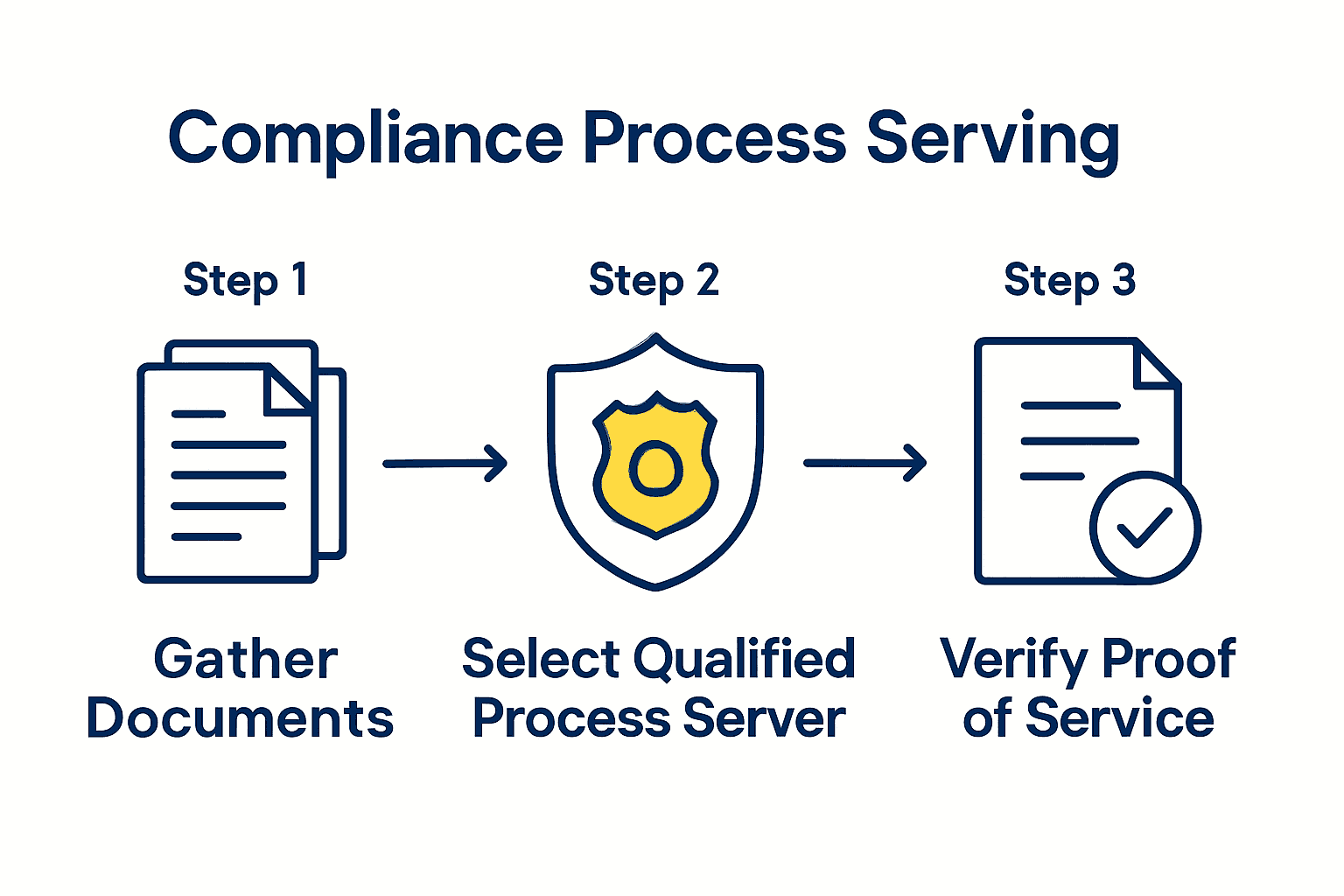
Infographic showing three steps: gather documents, choose process server, verify proof. |

Successfully serving legal documents for your business requires careful preparation and precise documentation. In this step, you will collect all necessary paperwork to ensure a smooth and compliant process.

Begin by verifying the complete legal details of the recipient business. According to MDCourts, it is essential to confirm the business’s registration status and obtain the full legal name and resident agent’s contact information. This verification helps prevent potential service errors and ensures accurate court documentation.

Prepare a comprehensive document package that typically includes:

  • Original lawsuit or legal complaint
  • Summons form
  • Any supporting legal documentation
  • Business identification records

As recommended by SelfHelp Courts, remember that proper service requires delivery through an authorized individual. Do not attempt to serve documents yourself, as self-service is not permitted.

Tip: Double-check all document details for accuracy. A single mistake can delay or invalidate your entire legal process. Confirm names, addresses, and court filing information before proceeding to the next step of service.

Step 2: Select a Qualified Process Server

Selecting the right process server is a critical step in ensuring legal document delivery meets all professional and regulatory standards. Your choice can significantly impact the effectiveness and legal validity of your service of process.

Start by understanding the key qualifications required for a professional process server. According to NYC Legal Guidelines, individuals serving legal documents multiple times annually must obtain specific licensing that demonstrates their expertise and adherence to established standards.

When evaluating potential process servers, focus on these essential criteria:

  • Proper state licensing and certification
  • Demonstrated experience in legal document delivery
  • Understanding of local and state service regulations
  • Professional track record and references
  • Ability to provide detailed documentation of service

As highlighted by Illinois Legal Aid, the server must be at least 18 years old and cannot be a party to the legal case.

process server business This ensures impartiality and compliance with legal requirements.

For a comprehensive understanding of professional process serving standards, check out our guide on certified process servers. Choosing the right process server is not just about meeting legal requirements it is about ensuring your documents are delivered accurately and professionally.

Step 3: Provide Accurate Service Details and Deadlines

Providing precise and comprehensive service details is crucial for ensuring legal document delivery meets all regulatory requirements. This step involves carefully documenting and communicating all necessary information to your process server.

According to Utah Courts, the process begins by preparing multiple copies of all legal documents. Specifically, you must create copies of all papers including the summons if initiating a new case. These documents will be provided to your qualified process server who will then complete a critical Proof of Service form documenting the delivery.

When preparing service details, focus on providing the following critical information:

  • Complete and accurate recipient contact information
  • Specific delivery instructions and preferences
  • Relevant case numbers and legal document references
  • Any time sensitive deadlines or court mandated timelines
  • Preferred methods of confirmation and documentation

New York Department of State guidelines emphasize the importance of completing a Service of Process Cover Sheet with meticulous attention to detail. This documentation serves as your official record of attempted or successful service.

For additional insights into managing legal document delivery timelines, review our legal document delivery guide. Precise documentation can make the difference between a successful and a problematic legal service process.

Step 4: Monitor Service Progress and Communication

Effective monitoring of your legal document service is crucial to ensuring successful delivery and maintaining legal compliance. This step involves staying proactively engaged with your process server throughout the entire service process.

According to Legal Clarity, hiring a professional process server requires maintaining open communication to track the progress of service and quickly address any potential issues that may arise during document delivery.

Implement these key communication strategies:

  • Request regular status updates from your process server
  • Establish clear communication channels phone, email, or dedicated tracking system
  • Ask for immediate notification of any service challenges or complications
  • Confirm receipt of proof of service documentation
  • Maintain a log of all communication and service attempts

Legal Clarity emphasizes that proper service involves more than just initial instructions it requires continuous monitoring to ensure all legal requirements are consistently met.

For comprehensive insights into tracking legal document services, explore our legal document delivery guide. Proactive communication can significantly streamline your legal document service process and prevent potential delays or complications.

Step 5: Verify Service Completion and Obtain Proof

Verifying the completion of legal document service is a critical final step that ensures your legal process moves forward smoothly. This stage involves carefully reviewing and documenting the proof of service to confirm all requirements have been met.

According to Utah Courts, the process server must complete a comprehensive Proof of Service form. This document provides crucial details including exactly how, when, and where the legal papers were served proving the delivery was executed properly.

When verifying service completion, focus on these key elements:

  • Obtain the fully completed Proof of Service form
  • Verify all details are accurate and complete
  • Confirm the date, time, and location of service
  • Check the method of delivery used
  • Validate the identity of the person served

California Self Help Courts emphasize that this proof of service form is essential for filing with the court and confirming that the other party has been officially notified.

To learn more about verifying legal document processes, our comprehensive guide offers additional insights. Meticulous documentation at this stage protects your legal interests and ensures your case can proceed without unnecessary complications.

Navigating the complex steps of process serving for your business can feel overwhelming. From gathering accurate legal documents and selecting a qualified server to monitoring service progress and verifying completion, every detail matters to avoid costly delays or compliance issues. If you want to eliminate stress and ensure your legal documents are served promptly and correctly, professional support is essential.

YM Doc Services understands these challenges and offers reliable, timely process serving tailored to your business needs. We handle everything from document retrieval to court filings, providing precise communication and full compliance with legal standards. Our team helps you stay ahead of deadlines with clear proof of service so you can focus on what really matters.

https://ymdocservices.com

Ready for a seamless process serving experience that protects your legal interests? Visit YM Doc Services to explore how our expert solutions can streamline your legal document delivery. Gain peace of mind today by ordering your service through our professional platform and never worry about missed or delayed service again. Learn more about why choosing certified process servers matters or get tips on legal document delivery to keep your case moving forward.

Frequently Asked Questions

What documents are needed for process serving in a business context?

To serve legal documents correctly, you need an original lawsuit, a summons form, supporting legal documents, and business identification records. Gather all these documents to ensure compliance before proceeding with service.

How do I choose a qualified process server for my business?

Select a process server who is properly licensed, experienced in legal document delivery, and knowledgeable about local service regulations. Request references to confirm their professional track record and ensure they can provide detailed documentation of the service.

What key details should I provide to my process server?

Provide essential contact information for the recipient, specific delivery instructions, relevant case numbers, and any deadlines involved. Clearly communicate this information to facilitate prompt and accurate service.

Implement a clear communication strategy by requesting regular updates from your process server. Maintain a log of all communications, and ask for immediate notification of any service challenges to ensure you stay informed throughout the process.

What steps should I take to verify the completion of service?

To verify completion, obtain and review the fully completed Proof of Service form from your process server. Confirm that all details, including date, time, and delivery method, are accurate before filing it with the court to ensure your legal process can proceed smoothly.

What should I do if there are issues with the service of process?

If issues arise, promptly communicate with your process server to identify the problem and discuss potential solutions. Act quickly to resolve any challenges, as delays can affect your legal compliance and timelines.

Posted in Uncategorized

Best 8 Legal Paperwork Processing Tools – Expert Comparison 2025

When legal matters get urgent, finding the right service to handle your documents or courtroom needs makes all the difference. Different providers promise accurate delivery, secure filings, and support for everything from simple papers to complex cases, but the details often vary. Some focus on technology while others rely on personal experience. Speed, price, and reliability are all on the table, but which approach truly fits your situation? Exploring the range of solutions out there can open up new ways to manage your deadlines and legal paperwork with less stress.

Table of Contents

YM Doc Services

Product Screenshot

At a Glance

YM Doc Services is a focused process serving agency that reliably delivers legal documents on time and in strict compliance with local, state, and federal laws. Serving attorneys, businesses, and individuals in Orlando and surrounding areas, the company blends hands-on process serving with administrative support like skip tracing, document retrieval, and court filings. If meeting deadlines and maintaining evidentiary compliance matter to you, YM Doc Services is built for that mission.

Core Features

YM Doc Services centers on five practical capabilities: legal document delivery and process serving, skip tracing, document retrieval, court filings, and notary services. Each capability is structured to reduce friction in legal workflows: servers execute service attempts and proofs, skip tracing locates hard-to-find parties, retrieval pulls court-stamped records, filings ensure submissions meet court deadlines, and notary services add official attestation when needed. Together these services create a single point of contact for end-to-end paperwork handling.

Pros

  • Experienced team of professional process servers: The staff’s professional experience means service attempts and affidavit preparation follow established legal practices reliably.
  • Reliable and on-time delivery: YM Doc Services emphasizes timeliness, which helps you meet tight deadlines and avoid procedural defaults.
  • Compliance with legal regulations: The company prioritizes adherence to local, state, and federal rules so you can rely on defensible service and filing procedures.
  • Wide range of legal document services in one agency: Combining serving, retrieval, filings, skip tracing, and notary work reduces vendor complexity and administrative overhead for your case.
  • Serves attorneys, businesses, and individuals: The service model is versatile, supporting solo attorneys, law firms, corporate legal teams, and private parties with the same operational rigor.

Who It’s For

Lawyers and legal teams who need dependable process serving and courtroom paperwork handled by experienced operators will benefit most from YM Doc Services. It’s also ideal for businesses that require coordinated filings and retrievals across case portfolios, and for individuals who need straightforward assistance serving or retrieving court documents in the Orlando area. If you need a local partner who understands procedural risk and deadline pressure, this fits.

Unique Value Proposition

YM Doc Services differentiates itself by combining hands-on process serving with administrative legal support in a single agency focused on reliability and compliance. Unlike fragmented models where serving, filing, and retrieval are outsourced to multiple vendors, YM Doc Services centralizes those tasks so your chain of custody and proofs of service remain consistent and auditable. That centralized workflow reduces errors, shortens turnaround, and minimizes the back-and-forth that costs time and increases risk. The firm’s local focus on Orlando and surrounding areas lets its team leverage jurisdictional knowledge to navigate court nuances and filing windows efficiently. Design choices such as not publishing standardized pricing reflect a commitment to case-specific quoting and compliance-driven workflows rather than one-size-fits-all packages.

Real World Use Case

An attorney serving a defendant in a civil suit needs proof of service before a court deadline in 10 days. YM Doc Services locates the defendant with skip tracing, completes process serving attempts, files the proof of service with the court, and retrieves the stamped filing—closing the loop so the attorney can file a motion with confidence.

Pricing

Not specified on website

Website: https://ymdocservices.com

Product Screenshot

At a Glance

abc legal delivers broad, reliable process-serving backed by technology and a massive network. With 8,000+ process servers and coverage in 88 countries, it’s built for high-volume, multi-jurisdictional needs. Real-time GPS and photo verification give you visibility into every serve, while flat-rate pricing keeps costs predictable—though you’ll still need to check state-specific rates. If you manage cross-state or international service regularly, abc legal is a time-saver. For one-off users, the platform can feel detailed and procedural.

Core Features

abc legal combines nationwide reach with online case management and verifiable delivery evidence. Key capabilities include a network of more than 8,000 process servers across all U.S. states and international options active since 2003, flat-rate pricing (set by state or nationwide packages), GPS and photo verification for each serve, simple online document upload, and case tracking that provides real-time status updates. The system emphasizes compliance and traceability so you can document chain-of-service for courts and clients.

Short. Clear. Verifiable.

Pros

  • Extensive nationwide and international network: abc legal’s 8,000+ process servers and presence in 88 countries mean you can coordinate multi-jurisdictional service from a single account.
  • Transparent flat-rate pricing: The company advertises flat-rate fees by state, which reduces surprise billing and helps with budgeting for caseloads.
  • Real-time verification technology: GPS stamps and photo evidence for each serve give you immediate proof of attempt and completion in court-ready formats.
  • Fast onboarding and online workflow: Instant account creation and simple document uploads let you move from intake to service quickly.
  • Experience with institutional clients: abc legal regularly handles work for law firms, corporations, government bodies, and individual clients, so it knows institutional compliance needs.

Cons

  • Pricing varies by state and can include extra fees: Although base rates are flat by state, additional attempts or special services may incur added costs that raise the final price.
  • Information density can overwhelm one-time users: The platform’s depth and corporate workflow may feel complex for occasional or low-volume users who need a simple, single-serve solution.
  • State-specific quoting is required for exact pricing: You must select the specific jurisdiction to get precise rates, which adds a small administrative step before budgeting.

Who It’s For

abc legal is aimed at legal professionals who coordinate service across multiple jurisdictions: law firms handling multi-state litigation, corporate legal departments with national footprints, government agencies, and individuals with complex or international needs. If you manage high-volume dockets or require verifiable, court-ready proof of service, this platform fits your workflow.

Unique Value Proposition

The service’s unique value lies in combining scale with verifiable technology and flat-rate transparency: a single platform that manages nationwide and international serves, documents GPS/photo evidence for each attempt, and standardizes pricing by state to reduce billing surprises. That blend makes it effective for organizations that value reliability and audit trails.

Real World Use Case

A law firm facing urgent, simultaneous serves in several states can upload documents to abc legal, obtain state-specific flat-rate quotes, and track each serve in real time with GPS and photos—cutting coordination time and producing immediate proof for file and court records.

Pricing

Starting at $85 (varies by state); for example, Alabama is $85 standard and Alaska is $135, with rush services available at higher rates.

Website: https://abclegal.com

Product Screenshot

At a Glance

One Legal centralizes court filing, process serving, and litigation support into a single platform tailored for legal professionals. It covers court filing across California and Nevada and offers nationwide process serving and document delivery, with options like rush or international services. If you need predictable workflows, clear tracking, and a concierge option to offload administrative work, One Legal delivers—though exact pricing often requires a quick consult.

Core Features

One Legal combines e-filing and physical filing for California and Nevada courts with nationwide service of process and document delivery. The platform includes concierge services to handle filings and service on your behalf, bundled litigation options (filing + service, case initiation, courier), and case management tools that organize orders, invoices, and tracking in one place. You get visibility into next-day service options, tracking updates, and a price estimator to project costs before you commit.

Pros

  • Comprehensive litigation support in one place: One Legal brings filing, serving, and delivery together so you don’t juggle multiple vendors for routine litigation tasks.
  • Nationwide process serving and document delivery: The platform supports service across the country, which reduces coordination overhead when cases span jurisdictions.
  • Speed and transparency: Next-day service options, tracking, and visible status updates make timelines predictable and reduce last-minute surprises.
  • User-friendly case management: The interface organizes orders and invoices so you can quickly find filings, confirmations, and evidence of service without digging through emails.
  • Expert support and concierge options: An available support team and concierge services let you offload complex or time-sensitive filings to experienced staff.

Cons

  • Pricing requires consultation: Detailed costs depend on service type and case needs, so you often must contact One Legal for an accurate quote.
  • Variable international costs: International services may carry additional fees and fluctuating rates, which can complicate budgeting for cross-border matters.
  • Primarily designed for litigators: The platform’s focus on litigation professionals means casual or non-legal users may find it less intuitive or more service-heavy than they require.

Who It’s For

One Legal is built for attorneys, law firms, solo practitioners, and parties actively engaged in litigation who want to streamline filing and service tasks. If you manage multiple cases, work across California and Nevada, or need reliable nationwide service with tracking and concierge options, this platform is a practical choice. If you rarely file court documents, the breadth of features may be more than you need.

Unique Value Proposition

One Legal’s strength lies in consolidation: it removes operational friction by combining e-filing, physical filing, process serving, and courier services with case-level organization. That consolidation saves time, reduces administrative errors, and gives you a single source for proofs of service and invoice management—critical when deadlines matter.

Real World Use Case

A medium-sized law firm juggling dozens of active matters uses One Legal to e-file in California, request rush service for urgent process serving, and keep all confirmations and invoices linked to each case. The firm cuts administrative time, improves compliance with filing rules, and avoids missed deadlines because the platform centralizes status updates and receipts.

Pricing

Starting at $40 for service of process; court filing fees are paid upfront and other services are priced individually. You can estimate costs using One Legal’s price estimator or request a quote for bundled and international services.

Website: https://onelegal.com

Product Screenshot

At a Glance

Rapid Legal is a technology-driven legal support service that combines e-filing, physical court filing, process serving, and document management into a single offering for U.S.-based law firms and legal departments. It emphasizes speed, compliance, and integrations with mainstream legal tech to reduce administrative friction. If you need reliable multi-jurisdictional filing and end-to-end case document handling, Rapid Legal delivers a focused, pragmatic solution.

Core Features

Rapid Legal’s core capabilities center on court filing and service workflows: e-filing and e-service, physical court filing, nationwide process serving, and document retrieval with proofs of service. It provides case and document management through a secure online portal with order tracking, status notifications, and analytic reports to monitor legal operations. Integrations with platforms like Clio, NetDocuments, and iManage let you connect filing and proofs to your existing matter management, preserving chain-of-custody and audit trails.

Pros

  • Built for speed and compliance: The platform prioritizes fast turnarounds and court-certified service workflows, which helps reduce missed deadlines and rejected filings.
  • Nationwide process serving: Rapid Legal supports process serving across multiple U.S. jurisdictions, so you can coordinate cross-state matters from a single account.
  • Good integration footprint: Native connections to common legal tech systems let you push documents and status updates into your existing tools without manual entry.
  • Comprehensive document access: You can retrieve documents and proofs of service anytime through the secure portal, which simplifies audits and client reporting.
  • Operational insights: Built-in analytics and reporting provide visibility into filing volumes, service success rates, and other metrics that improve administrative planning.

Cons

  • Pricing variability across jurisdictions can be significant: Costs differ by state and service type, which complicates budgeting for multi-state practices.
  • Limited to U.S. jurisdictions: The service is focused on U.S. courts and process serving, so it’s not suitable if you need international filings or global service.
  • Performance depends on internet quality: Optimal use requires reliable connectivity, so slow networks can hinder e-filing and portal access.

Who It’s For

Rapid Legal is built for legal professionals—small to mid-size law firms, in-house legal teams, and court clerks—who need fast, compliant handling of filings and service within the United States. If your practice files in multiple states or relies on integrations with matter-management systems, this tool reduces administrative overhead and centralizes case-document operations.

Unique Value Proposition

Rapid Legal differentiates itself by packaging both electronic and physical filing services with nationwide process serving and integrations into one workflow. That combination shortens turnaround times and preserves compliance—especially valuable when you juggle volumes across different jurisdictions.

Real World Use Case

A multi-state litigation team uses Rapid Legal to e-file pleadings in Illinois and Indiana, schedule process serving in another state, and pull proofs of service into their matter in Clio for client updates. The result: fewer manual handoffs, measurable time savings, and clearer audit trails for each case.

Pricing

Pricing varies by service and state, with e-filing starting at $5 in some states like Illinois and Indiana and higher fees for physical filing and service in states such as California. Exact rates are provided per order and may include additional fees for parties without attorneys.

Website: https://rapidlegal.com

Product Screenshot

At a Glance

ABC Legal is a purpose-built service-of-process and legal document delivery platform focused on nationwide reach, transparency, and verification. With an 8,000+ network of process servers and coverage in over 88 countries, it’s built for high-volume, cross-jurisdictional work. If you need predictable pricing, GPS/photo proof, and fast online setup, ABC Legal delivers — though some advanced services are restricted and state rates can vary.

Core Features

ABC Legal provides nationwide service of process across all U.S. states and territories plus international coverage in over 88 countries. Key capabilities include a large network of 8,000+ process servers, a mobile app that captures GPS and photo verification, and flat-rate pricing by state for clearer cost expectations. The platform also offers industry-leading investigations and skip tracing services—note: those investigative tools are restricted to law firms—plus an online workflow for quick setup and document uploads.

Pros

  • Extensive geographic coverage: ABC Legal supports service across every U.S. state and territory and in more than 88 countries, which simplifies multi-jurisdiction matters for busy practices.
  • Transparent pricing model: The flat-rate, state-based pricing reduces surprises by showing rates up front rather than hiding fees behind complex invoices.
  • Large, vetted server network: With more than 8,000 process servers, the platform scales for volume clients and increases the odds of timely attempts.
  • Strong verification tools: The mobile app’s GPS and photo evidence help create reliable proof of service for court filings and client reporting.
  • Proven operational scale: Trusted by over 50,000 professionals and executing more than 12 million attempts annually, ABC Legal demonstrates broad market adoption and operational maturity.

Cons

  • Variable state pricing: Although pricing is flat-rate by state, fees differ significantly between states and can include additional charges, which complicates budgeting for multi-state matters.
  • Restricted investigative services: Skip tracing and certain investigations are limited to law firms, so corporations or individuals may not access the full suite of reliability tools.
  • Narrow focus on legal process serving: The platform centers on process serving and related legal delivery; if your needs extend beyond legal paperwork management, ABC Legal may not be the right fit.

Who It’s For

ABC Legal is ideal for law firms, high-volume legal departments, government agencies, and individuals who need reliable, trackable legal document delivery across multiple jurisdictions. If you regularly file across states or require verifiable proof of service, this service streamlines operations and reduces administrative friction.

Unique Value Proposition

ABC Legal combines a large, distributed network of servers with GPS/photo-backed verification and upfront, state-based pricing to reduce uncertainty and increase compliance confidence. In short: it converts a traditionally manual, opaque process into a faster, auditable workflow.

Real World Use Case

A law firm must serve defendants in several states on tight deadlines. Using ABC Legal’s online portal, the team uploads documents, selects states, previews state-specific rates (e.g., California $75, Alabama $85, Alaska $135), and tracks GPS/photo evidence from attempts — all without chasing individual servers by phone. Faster. Verifiable. Less risk.

Pricing

Pricing is per party, per address, per document with state-specific rates; examples include California $75, Alabama $85, Alaska $135. Rush options are available at higher rates during checkout.

Website: https://abclegal.com

Docketly

Product Screenshot

At a Glance

Docketly connects law firms with a network of attorneys who provide appearance counsel and hearing coverage, letting firms offload day-to-day courtroom appearances and focus on growth. The platform’s biggest strengths are scale and flexibility: over 10,000 attorneys, mobile management, and real-time updates make coverage practical and reliable. Pricing is driven by volume discounts rather than flat rates, so cost-effectiveness depends on your usage patterns. Overall: strong for firms that need dependable hearing coverage, less useful if you need a wider suite of litigation services.

Core Features

Docketly’s core capabilities center on match-making and operational visibility: a network of over 10,000 attorneys for hearing coverage, flexible assignment acceptance so attorneys can pick opportunities that suit their schedules, mobile app support to manage hearings on the go, cost-effective pricing with volume and market discounts, and real-time updates plus professional reporting from assigned attorneys. Those elements combine to let firms outsource appearances while retaining oversight through timely status and reporting.

Pros

  • Large network of experienced attorneys: With over 10,000 attorneys in the platform, firms have broad coverage options across many jurisdictions.
  • Flexible scheduling for attorneys: Attorneys can accept assignments on their own terms, which increases availability and reduces no-shows.
  • Cost savings through smart pricing methods: Volume and bundling discounts can reduce per-hearing costs for firms that use the service regularly.
  • Mobile accessibility for attorneys and firms: A mobile app allows both sides to manage and track hearings quickly from the courthouse or office.
  • High user satisfaction with ease of use and reliability: Reported ease-of-use and reliable coverage help firms preserve client timelines and reduce administrative overhead.

Cons

  • Specific pricing details are not provided, requiring potential users to contact for quotes: You can’t see exact fees upfront, which complicates quick budget comparisons.
  • Focus primarily on hearing coverage, which may limit other legal services involved in litigation: If you need discovery support, filings, or broader litigation services, Docketly’s scope may feel narrow.
  • Potential geographical limitations based on attorney availability: Coverage depends on where attorneys are active, so availability can vary by market.

Who It’s For

Docketly is best for law firms and solo practitioners who regularly require courtroom appearances but lack the internal bandwidth to cover every hearing. It also serves attorneys who want flexible, local assignments to earn extra income without committing to full-time staffing. If you’re scaling a practice or expanding geographic reach, Docketly provides a practical operational layer.

Unique Value Proposition

Docketly’s promise is scale plus flexibility: match your firm’s hearing needs to a large, mobile-enabled attorney network and pay less per hearing when you bundle or operate at volume. That combination targets two pain points at once — staffing gaps and cost control — while preserving professional reporting and real-time visibility.

Real World Use Case

A mid-sized firm uses Docketly to outsource routine court appearances across multiple counties, freeing associates for client strategy and filings. Independently, local attorneys pick up nearby assignments to supplement income and gain additional courtroom experience.

Pricing

Quote-based: pricing follows a smart, volume-based model with discounts for bundled hearings, high-volume areas, and cross-client bundling; exact rates require contacting Docketly.

Website: https://docketly.com

ServeNow

Product Screenshot

At a Glance

ServeNow is a long-running marketplace that connects you with pre-screened professional process servers across the U.S. and internationally. It simplifies finding local servers by county, city, or ZIP and lets you request multiple quotes so you can compare price and availability. For attorneys and businesses chasing deadlines, ServeNow speeds the administrative work while leaving final control with you. It’s reliable — but results depend on the individual server you hire.

Core Features

ServeNow’s core capabilities center on matchmaking and management: a searchable directory of vetted process servers, location-based search (county, city, ZIP), and the ability to request and compare quotes from multiple providers. Beyond classic process serving it lists related legal support services — electronic process service, court filing, notary work, record retrieval, skip tracing, photocopying, and courier services — and provides an online interface to hire, communicate with, and manage a hired server.

Pros

  • Established track record: ServeNow has operated since 2004, giving it longevity and familiarity in the legal support space.
  • Wide, pre-screened directory: The platform collects vetted process servers across the U.S. and internationally, making it easier to locate qualified providers in unfamiliar jurisdictions.
  • Multi-service offering: You can request related services such as court filing, notary, skip tracing, and courier work alongside process serving, reducing the number of vendors to manage.
  • Straightforward search and request flow: Searching by county, city, or ZIP and requesting multiple quotes is user-friendly and saves time compared with cold-calling local services.
  • Trusted by legal professionals and individuals: The platform is positioned for both private clients and law firms that need dependable process-serving support.

Cons

  • Variable pricing and transparency: Pricing varies by server and case, so you may not see consistent, fixed costs upfront and must request quotes to know the true price.
  • Quality depends on individual servers: Because ServeNow is a marketplace, service quality can vary by provider and location, making outcomes dependent on the specific server you hire.
  • Limited detailed provider profiles in listings: The overview listings may not include the deep, comparative detail you need to fully vet individual servers before requesting quotes.

Who It’s For

ServeNow targets legal professionals, law firms, businesses, and private individuals who need reliable process serving and related legal support but don’t want to manage the vendor search manually. If you routinely handle out-of-area service or want bundled administrative services like filing and notarization, this platform saves time and centralizes outreach.

Unique Value Proposition

ServeNow’s main value is convenience at scale: a long-standing, pre-screened directory plus quote comparison tools that reduce legwork when you must serve papers across counties or states. It bundles adjacent admin services, which helps teams consolidate vendors and shorten turnaround.

Real World Use Case

A law firm must serve documents to a defendant in another city. Instead of calling multiple local offices, the firm searches by ZIP, requests three quotes, reviews availability, and hires a vetted server — then coordinates any necessary court filing through the platform. Faster. Less friction. Mission accomplished.

Pricing

Starting at $20; prices vary between $20 to $100+ depending on the server, case, and location.

Website: https://servenow.com

LegalConnect

Product Screenshot

At a Glance

LegalConnect is a litigation support platform built to centralize e-filing, process serving, and court services with an emphasis on security and operational scale. It combines court-certified e-filing in 5+ states, a customer-facing portal, mobile field tools, and QuickBooks integration into a single cloud service — now SOC 2 compliant. In short: it’s a secure, all-in-one backbone for legal support operations, though pricing and some integration specifics remain unclear.

Core Features

LegalConnect’s primary capabilities focus on end-to-end litigation support: court-certified electronic filing across multiple states, a secure online system with an intuitive interface, and unlimited access for customers, employees, and vendors through account portals. The platform includes payment collection and processing, operations portals for internal task management, AffiliateConnect for partner workflows, a mobile field agent app for real-time service-of-process updates, analytics and reports for performance insights, QuickBooks integration for billing reconciliation, and platform/e-filing APIs to automate repetitive work.

Stop. Think about that stack for a moment. Many shops use three or four tools to cover that scope. LegalConnect bundles them.

Pros

  • SOC 2 compliance ensures a high level of data security and privacy, giving firms confidence when handling sensitive client information. This is essential for litigation-focused workflows.
  • All-in-one platform that manages litigation support workflows, which reduces the need for stitching together multiple vendors and lowers the operational overhead for case intake, order management, and filings.
  • Cloud-native with no hardware requirements, making it faster to adopt and easier to scale for firms that need to add users or partners quickly.
  • Robust customer management, payments, and reporting features, enabling you to track orders, collect fees, and generate performance insights from a single interface.
  • Designed for high-volume filing with automation tools, which helps legal support firms expand filing capacity across states without proportional increases in staff.

Cons

  • Limited information on pricing and subscription plans is available on the website, which makes budgeting and vendor comparisons difficult before engaging sales.
  • No specific details about customer support options beyond a support team and knowledge base, so response times and SLAs are unclear for mission-critical incidents.
  • Integrations are only explicitly listed for QuickBooks and APIs, leaving uncertainty around out-of-the-box connectors for other common law firm systems.

Who It’s For

LegalConnect is best suited to legal support firms, litigation boutiques, and in-house teams that need a secure, scalable platform to manage e-filing, process serving, and court services across multiple jurisdictions. If your operation relies on partner networks or high-volume filings, LegalConnect caters to that profile.

Unique Value Proposition

LegalConnect differentiates itself by combining SOC 2-level security, multi-state court-certified e-filing, and both customer- and operations-facing portals into a single, cloud-hosted system — reducing tool sprawl while giving you automation hooks via APIs.

Real World Use Case

A legal support firm uses LegalConnect to expand court filing across several states: intake flows funnel through customer portals, affiliate orders route via AffiliateConnect, field agents update status in real time via the mobile app, and billing reconciles automatically into QuickBooks — all while maintaining SOC 2 controls.

Pricing

Not specified on the website.

Website: https://legalconnect.com

This table provides a concise comparison of various legal support services, focusing on their unique features, pros and cons, and pricing information to help legal professionals choose the right service for their needs.

Service Unique Features Pros Cons Pricing
YM Doc Services Focused on process serving and administrative legal support in Orlando. Experienced team, reliable delivery, compliance with regulations, wide range of services. Localized to Orlando, pricing not specified. Not specified
abc legal Nationwide and international service with real-time GPS and photo verification. Extensive network, flat-rate pricing, real-time verification, fast online workflow. State-specific pricing, complex for one-time users. Starts at $85 by state
One Legal Centralizes court filing, process serving, and litigation support with concierge options. Comprehensive support, nationwide service, user-friendly management. Pricing requires consultation, primarily for litigators. Starting at $40
Rapid Legal Combines e-filing, process serving, and tech integrations for speed and compliance. Built for speed, nationwide service, good integration footprint. U.S.-only focus, significant pricing variability. Varies by service
ServeNow Marketplace for connecting with process servers, offering related legal support services. Established track record, wide directory, multi-service offering. Variable pricing, quality depends on individual servers. $20 – $100+

Navigating the complex world of legal paperwork processing can feel overwhelming. Meeting tight deadlines while ensuring strict compliance with local, state, and federal laws is a challenge that many legal professionals and individuals face. The article highlights key pain points such as the need for reliable proof of service, seamless document retrieval, and coordinated court filings—all critical to avoid procedural risks and costly delays.

YM Doc Services understands these challenges deeply. With a local focus on Orlando and surrounding areas, they offer comprehensive solutions including process serving, skip tracing, document retrieval, court filings, and notary services. Their experienced team ensures your legal documents are handled with precision and delivered on time so you can focus on what matters most.

Discover how you can gain peace of mind with professional process serving and reduce stress around legal deadlines by visiting YM Doc Services. Whether you are an attorney, business, or individual, their streamlined approach removes the hassle from legal document management.

Take control of your case workflow today.

Need dependable support for your legal paperwork?

https://ymdocservices.com

Get started now by exploring how YM Doc Services can help you meet your legal paperwork deadlines efficiently and compliantly. Visit the website to learn more and place your order with confidence.

Frequently Asked Questions

Legal paperwork processing tools are software solutions that help legal professionals manage, organize, and automate the handling of legal documents and processes. They streamline tasks such as document filing, service of process, and case management to enhance efficiency and compliance in legal workflows.

To choose the best legal paperwork processing tool, assess your specific needs, such as case volume, types of services required (e-filing, serving, etc.), and your team’s tech proficiency. Compare features, user reviews, and pricing models or trials offered by various tools to find the most suitable option based on your operational requirements.

Look for features such as document management, e-filing capabilities, process serving, real-time tracking, and reporting tools. Consider tools that offer integrations with your existing systems, mobile access, and customer support options to ensure a seamless workflow.

Yes, legal paperwork processing tools can significantly reduce processing times by automating repetitive tasks and providing centralized access to documents. Aim to streamline your workflow, which can decrease processing time by approximately 20-30% in many cases.

Most reputable legal paperwork processing tools are designed to comply with local, state, and federal regulations. Verify that the tool you consider highlights its compliance measures and offers certifications as part of its service specifications.

Legal paperwork processing tools facilitate better collaboration through features like shared document access, real-time updates, and task management capabilities. Implementing a centralized platform can enhance communication and ensure that team members are always on the same page, boosting productivity efficiently.

Posted in Uncategorized

Service of Process for Individuals: Complete Guide

Missing a single detail during legal notification can mean a case never reaches court. Service of process forms the backbone of fair and transparent legal proceedings for individuals. Courts dismiss thousands of cases each year due to improper service or incomplete documentation. Understanding how official notice is delivered in legal matters is not just a technicality, it is critical for protecting your rights and ensuring your side of the story is heard.

Table of Contents

Key Takeaways

Point Details
Importance of Service of Process Service of process ensures individuals are legally notified of lawsuits, providing critical protection of their rights.
Various Serving Methods Methods include personal delivery, substitute service, and electronic service, each with specific legal requirements.
Compliance and Documentation Adhering to legal regulations and maintaining thorough documentation is essential for valid service of process.
Common Pitfalls Avoiding service mistakes, such as incorrect identification and timing errors, is crucial to uphold the integrity of legal proceedings.

Defining Service of Process for Individuals

Service of process represents the legal mechanism through which an individual receives official notice about a lawsuit or court proceeding. Formal legal notification is crucial because it ensures that all parties have an opportunity to respond and protect their legal rights. According to Cornell Law School, service of process is a fundamental aspect of due process in the legal system, guaranteeing that defendants are properly informed about legal actions against them.

The primary purpose of service of process is to provide legal notice to a defendant or interested party that a legal action has been initiated. This notification typically includes critical documents such as:

  • Summons
  • Complaint
  • Court orders
  • Subpoenas

Process serving involves delivering these documents through legally recognized methods to ensure the recipient understands the legal proceedings. Our comprehensive guide on process serving can provide more detailed insights into the intricacies of this legal procedure.

For individuals, service of process can occur through various methods, including personal delivery, substitute service, or sometimes even publication. Each method has specific legal requirements designed to ensure the defendant receives proper notification. The goal is always to provide a fair opportunity for the individual to respond to legal actions, protecting their rights while maintaining the integrity of the judicial process.

Understanding service of process is essential for anyone potentially involved in legal proceedings. Whether you are the person being served or seeking to serve legal documents, knowing the proper procedures can help you navigate complex legal situations more effectively and ensure your rights are protected.

Serving legal documents involves multiple strategic approaches designed to ensure defendants receive proper legal notification. Personal service remains the most direct and preferred method, where a licensed process server hand-delivers documents directly to the intended recipient. This method provides immediate confirmation that the individual has been officially notified about legal proceedings.

Legal professionals recognize several primary methods of serving documents:

  1. Personal Delivery
  • Direct hand-to-hand document transfer
  • Most legally reliable method
  • Provides immediate proof of notification
  1. Substitute Service
  • Documents left with a competent adult at recipient’s residence or workplace
  • Used when direct personal service proves challenging
  • Requires specific legal guidelines
  1. Service by Mail
  • Certified or registered mail with return receipt
  • Provides documented proof of attempted delivery
  • Often used for less time-sensitive communications
  1. Electronic Service
  • Increasingly accepted in modern legal environments
  • Requires explicit court approval
  • Must meet strict authentication requirements

Our comprehensive guide on legal document delivery offers deeper insights into navigating these complex service protocols. Understanding these methods helps ensure legal notifications meet jurisdictional requirements and maintain procedural integrity.

Each serving method carries specific legal implications and documentation requirements.

legal document review Process servers must meticulously follow local and state regulations to guarantee valid service. Factors like recipient location, document type, and jurisdictional rules significantly influence which method can be employed, making professional expertise crucial in executing proper legal document service.
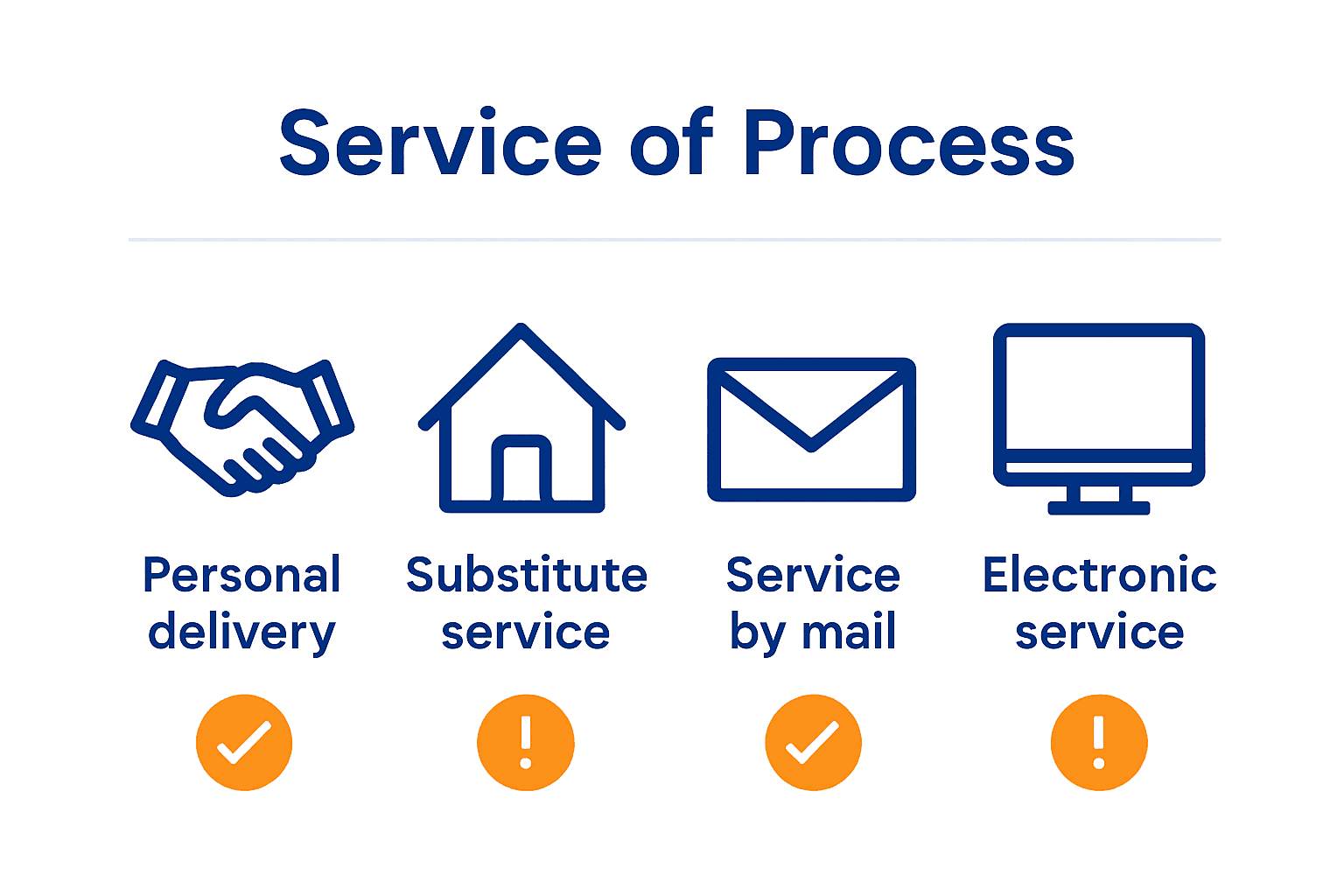


Successful document service goes beyond mere delivery.

It represents a critical step in maintaining fairness within the legal system, ensuring all parties have proper opportunity to understand and respond to legal actions initiated against them. Precise, legally compliant service protects both the plaintiff’s right to proceed and the defendant’s right to due process.

Infographic comparing four legal process serving methods

Legal compliance in service of process represents a complex landscape of strict regulations designed to protect individual rights and ensure fair legal proceedings. Process servers must navigate a intricate web of federal, state, and local requirements that govern how legal documents can be delivered and authenticated. These standards are not merely bureaucratic checkboxes but fundamental safeguards that maintain the integrity of the judicial system.

Key compliance standards typically encompass several critical areas:

  • Jurisdictional Authorization

  • Proper licensing and certification

  • Understanding local court rules

  • Maintaining professional credentials

  • Documentation Requirements

  • Detailed service verification

  • Accurate proof of service forms

  • Time-stamped delivery records

  • Ethical Conduct

  • Respect for individual privacy

  • Non-invasive serving techniques

  • Adherence to legal boundaries

Our comprehensive process server compliance guide offers deeper insights into the nuanced world of legal document service regulations. Professional process servers must demonstrate an intricate understanding of these standards to ensure legal documents are served correctly and legally.

Each jurisdiction maintains unique requirements that can dramatically impact service validity. Some regions mandate specific timeframes for document delivery, while others have strict rules about who can accept service on behalf of the intended recipient. These variations underscore the importance of local expertise and continuous professional education. Failure to comply with these standards can result in service being deemed invalid, potentially derailing entire legal proceedings.

Ultimately, compliance in service of process is about balancing legal precision with respect for individual rights. Process servers act as critical intermediaries in the judicial system, ensuring that legal notifications are delivered professionally, accurately, and in full accordance with established legal standards. Their role requires a delicate blend of legal knowledge, interpersonal skills, and unwavering commitment to procedural integrity.

Proof of Service and Documentation

Proof of service represents the critical legal documentation that verifies a defendant has been officially notified about pending legal proceedings. This formal record serves as an essential validation mechanism, ensuring transparency and accountability in the legal notification process. Every successful service requires meticulous documentation that can withstand potential legal scrutiny and court examination.

The standard proof of service typically includes several key components:

  1. Server Identification
  • Full name of process server
  • Professional licensing information
  • Contact details
  1. Service Details
  • Date and exact time of service
  • Location of document delivery
  • Method of service used
  1. Recipient Information
  • Name of person served
  • Relationship to primary recipient
  • Verification of personal identification

Our comprehensive legal document delivery guide provides in-depth insights into creating thorough and legally defensible service documentation. Professional process servers understand that these documents are more than administrative paperwork they are legal instruments that can determine the validity of entire legal proceedings.

Courts have strict requirements for what constitutes acceptable proof of service. Incomplete or improperly completed documentation can render an entire legal action invalid, potentially causing significant delays or dismissal of cases. This makes precision absolutely critical. Process servers must capture every relevant detail, from the exact moment of delivery to the specific circumstances surrounding the service.

Beyond the immediate legal requirements, comprehensive documentation protects all parties involved. For defendants, it provides clear evidence of when and how they were notified. For plaintiffs, it ensures their legal actions proceed according to established protocols. Ultimately, meticulous proof of service documentation represents a fundamental safeguard in maintaining the integrity and fairness of the judicial process.

Common Pitfalls and Mistakes to Avoid

Legal document service presents numerous potential challenges that can derail entire legal proceedings if not handled with precision and care. Process servers and individuals involved in serving legal documents must navigate a complex landscape of potential mistakes that could compromise the entire legal notification process. Understanding these common pitfalls is crucial for maintaining the integrity of legal communications.

Most frequent mistakes in service of process include:

  1. Improper Personal Identification
  • Serving documents to wrong individual
  • Failing to verify recipient’s identity
  • Assuming relationship or residence status
  1. Timing and Location Errors
  • Serving outside permitted hours
  • Attempting service at inappropriate locations
  • Ignoring jurisdictional time restrictions
  1. Documentation Deficiencies
  • Incomplete service records
  • Inaccurate time and date stamps
  • Missing critical verification details

Our essential legal document process tips guide provides comprehensive strategies for avoiding these potentially costly errors. Professional process servers understand that a single misstep can invalidate months of legal preparation and potentially derail critical legal proceedings.

Many individuals underestimate the complexity of proper legal document service. Common misconceptions can lead to significant legal complications, such as believing that any method of notification is acceptable or assuming family members can always accept service on someone’s behalf. Each jurisdiction maintains specific rules about acceptable service methods, recipient verification, and documentation requirements. These nuanced regulations demand meticulous attention to detail and a deep understanding of local legal protocols.
Ultimately, avoiding service of process mistakes requires a combination of professional training, careful documentation, and an unwavering commitment to procedural accuracy. Process servers must remain vigilant, continuously updating their knowledge of changing legal requirements and maintaining the highest standards of professional conduct. The consequences of errors can be severe, potentially resulting in case dismissals, legal challenges, and significant financial and professional repercussions.

Navigating the complexities of service of process can feel overwhelming when you consider the strict legal requirements and the risk of costly mistakes discussed in the article. Whether you are concerned about verifying proper identification, meeting jurisdictional rules, or securing airtight proof of service, these challenges demand a reliable partner who understands every step of the process.

YM Doc Services offers expert solutions designed to take the stress away from legal document delivery. With a steadfast focus on timeliness, compliance, and accuracy, our professional process servers guarantee your documents are served correctly according to local rules. We also assist with document retrieval and court filings so you can trust your entire legal notification process is handled professionally.

https://ymdocservices.com

Don’t leave your legal documents to chance. Visit YM Doc Services now to discover how our comprehensive service of process support can protect your rights and keep your case moving forward without delay. Learn more about our expert process serving and explore our tailored legal document delivery solutions that align perfectly with the needs detailed in the article.

Take control today and secure your peace of mind with trusted legal document services.

Frequently Asked Questions

What is the purpose of service of process?

Service of process provides formal legal notification to individuals about a lawsuit or court proceeding, ensuring they have the opportunity to respond and protect their legal rights.

Common methods include personal delivery, substitute service, service by mail, and electronic service. Each method has specific legal requirements and varying levels of reliability.

What constitutes proof of service?

Proof of service includes documentation that verifies a defendant has been notified of legal proceedings, specifying details like the server’s identity, service date and time, recipient information, and method of service.

What are common mistakes to avoid in the service of process?

Common pitfalls include improper personal identification, timing and location errors, and deficiencies in documentation. These mistakes can invalidate legal actions and complicate proceedings.

Posted in Uncategorized

7 Essential Types of Legal Documents Explained for You

Legal documents shape some of the most important moments in life, yet many people feel lost when faced with complicated paperwork or court notices. Missing a response deadline can lead to an automatic court ruling against you, making it vital to understand each document’s purpose and power. This guide breaks down seven essential legal documents, offering clear explanations so you know exactly what to expect and how to respond when the law comes knocking.

Table of Contents

Quick Summary

Takeaway Explanation
1. Respond to Summons Promptly You typically must file a formal response within twenty days to avoid default judgment against you.
2. Understand the Nature of Subpoenas Subpoenas require you to provide testimony or documents, and ignoring them can have serious legal repercussions.
3. Comply with Court Orders Failing to obey a court order can lead to penalties such as fines or contempt charges, so it’s essential to know your obligations.
4. Prepare Accurate Affidavits Affidavits must be based on personal knowledge and signed before a witness; inaccuracies can jeopardize their validity.
5. Clarify Contract Terms Clearly outline all contractual terms to prevent misunderstandings and protect your legal interests when entering agreements.

1. Summons and Complaints: Starting a Lawsuit

Ever wondered how a legal battle officially begins? Summons and complaints are the critical legal documents that launch a civil lawsuit, serving as the formal first step in seeking legal resolution. According to University of Vermont, these documents play a crucial role in initiating legal proceedings against entities or individuals for alleged rights violations.

A summons is an official court document that notifies a defendant they are being sued, while a complaint details the specific legal claims, damages sought, and legal basis for the lawsuit. Think of the summons as the official invitation to court and the complaint as the detailed explanation of why you are being invited.

The legal process requires defendants to take these documents seriously. Typically, you must file a formal response with the court within twenty days of receiving these documents. Failing to respond can result in a default judgment against you, meaning the court could automatically rule in favor of the plaintiff.

Practical steps for handling a summons and complaint include:

  • Read the documents carefully and note the response deadline
  • Do not ignore the documents
  • Consult with a legal professional to understand your rights
  • Prepare a formal written response to the court
  • Gather any evidence or documentation relevant to the claims

Whether you are the plaintiff seeking justice or the defendant responding to a lawsuit, understanding summons and complaints is your first step in navigating the complex world of civil litigation. Learn more about legal document processes in our guide on legal documents.

2. Subpoenas: Requiring Testimony or Records

Subpoenas are powerful legal tools that compel individuals to provide crucial information or testimony in legal proceedings. Cornell Law explains that these official court documents can require a person to attend court, produce documents, or permit inspection of specific premises.

There are two primary types of subpoenas: testimonial and documentary. A testimonial subpoena requires you to appear in person and provide verbal testimony under oath, while a documentary subpoena demands you submit specific documents or records relevant to a legal case.

According to the U.S. Department of Justice, these legal instruments can even extend internationally. Courts have the authority to issue subpoenas to U.S. citizens and permanent residents located abroad, requiring them to appear or produce evidence.

Important considerations when receiving a subpoena include:

  • Do not ignore the document
  • Read the subpoena carefully to understand requirements
  • Note the specific date, time, and location for testimony or document submission
  • Understand the potential legal consequences of noncompliance
  • Consider consulting with a legal professional if you have questions

Receiving a subpoena can be intimidating, but understanding its purpose and requirements helps you navigate the legal process effectively. Need more guidance on legal documents? Check out our guide on legal documents for comprehensive insights.

Court orders are powerful legal instruments that transform judicial decisions from abstract rulings into concrete actions. Cornell Law explains that these orders compel parties to perform specific actions, such as transferring property, delivering documents, or taking mandated steps to resolve a legal dispute.

When a court issues an order, it becomes a legally binding directive that must be followed. According to Federal Rules of Civil Procedure, these orders can extend beyond direct parties to the case, potentially affecting individuals or entities who are in a position to comply with the order’s directives.

Understanding court orders is crucial because noncompliance can result in serious legal consequences. The court has multiple enforcement mechanisms, including the ability to:

  • Impose financial penalties
  • Hold individuals in contempt of court
  • Authorize alternative methods of order fulfillment
  • Direct third parties to complete the required action
  • Seize assets or property

If you receive a court order, it is essential to read it carefully and understand your obligations. Seeking legal counsel can help you navigate the specifics and ensure proper compliance. For more insights into legal document processes, explore our legal document retrieval guide.

4. Affidavits: Written Sworn Statements

Affidavits are powerful legal documents that serve as written testimony, providing a sworn statement of facts under oath. Cornell Law explains that these documents must be based on personal knowledge and contain facts that would be admissible as evidence in court.

Unlike verbal testimony, an affidavit allows individuals to provide crucial information without physically appearing in court. According to Federal Rules of Civil Procedure, these written statements can be used in specific legal situations as an alternative to live testimony, making them a valuable tool in legal proceedings.

Key characteristics of a valid affidavit include:

  • Must be voluntarily written
  • Signed in the presence of an authorized witness
  • Based on firsthand personal knowledge
  • Contain specific and factual information
  • Sworn under penalty of perjury

When preparing an affidavit, accuracy and honesty are paramount. The document becomes a legal record that can be used in court proceedings, so every statement must be carefully considered and truthful. For those unfamiliar with the intricacies of legal documentation, our guide on witnessing legal documents can provide additional insights into the process of creating reliable legal statements.

5. Contracts and Agreements: Setting Terms Clearly

Contracts are the backbone of legal relationships, transforming verbal promises into binding, enforceable agreements. Cornell Law defines a contract as a legally binding agreement between two or more parties that requires specific essential elements to be valid.

At its core, a contract must include four critical components: a clear offer, acceptance of that offer, consideration (something of value exchanged), and a mutual intent to be legally bound. Think of it like a carefully crafted recipe where each ingredient is necessary to create a legally solid document.

Critical steps for creating a robust contract include:

  • Clearly define all parties involved
  • Specify exact terms and obligations
  • Outline precise payment or exchange details
  • Include conditions for termination
  • Add provisions for potential dispute resolution

Whether you are a business owner, freelancer, or individual entering a significant agreement, understanding contract fundamentals can protect your interests and prevent future misunderstandings. Careful preparation and clear communication are your best defenses against potential legal complications. For additional guidance on managing important documents, check out our legal document retrieval guide.

A power of attorney is a powerful legal document that allows you to delegate decision making authority to a trusted individual. Cornell Law defines this as a legal instrument granting one person the ability to act on behalf of another in specific legal or financial matters.

There are multiple types of power of attorney, each serving a unique purpose. A general power of attorney provides broad authority across various domains, while a special power of attorney limits actions to specific transactions. Durable power of attorney remains valid even if you become incapacitated, and a springing power of attorney only activates under predetermined conditions.

Key considerations when establishing a power of attorney include:

  • Select a trustworthy and responsible agent
  • Clearly define the scope of authorized actions
  • Specify exact limitations of the granted authority
  • Consider potential scenarios requiring legal representation
  • Understand the legal implications of the document

Carefully choosing your representative and clearly outlining their responsibilities can protect your interests and ensure smooth management of your affairs. For more insights into legal document processes, explore our legal document retrieval guide.

7. Wills and Trusts: Planning for the Future

Wills and trusts are essential legal documents that help you protect and distribute your assets according to your wishes. Cornell Law defines a will as a legal document that outlines how your property will be distributed after death, while explaining a trust as a fiduciary arrangement where one party manages property for another.

A will serves as your final instructions for asset distribution, requiring specific legal elements to be valid. You must demonstrate legal capacity, have the document witnessed, and clearly articulate your intentions. Trusts offer additional flexibility by allowing you to set conditions on how and when assets are transferred, providing more nuanced control over your estate.

Key steps in estate planning include:

  • Inventory all personal and financial assets
  • Determine beneficiaries and their specific allocations
  • Choose a reliable executor or trustee
  • Consider potential tax implications
  • Regularly review and update your documents

Planning for the future is not about dwelling on mortality but ensuring your loved ones are protected and your wishes are honored. For additional guidance on managing important legal documents, check out our witnessing legal documents guide.

Below is a comprehensive table summarizing the main legal document types discussed throughout the article and their key attributes.

Document Type Description Key Actions/Considerations
Summons and Complaints Launch civil lawsuits: summons notifies, complaints detail claims. Respond within 20 days, consult a legal professional, gather evidence.
Subpoenas Compel individuals for testimony or records. Do not ignore, note requirements, consult legal advice if needed.
Court Orders Enforce legal actions as per judicial decisions. Compliance is mandatory to avoid penalties. Seek legal counsel.
Affidavits Written sworn statements of facts. Must be accurate, based on firsthand knowledge, and sworn under penalty.
Contracts and Agreements Transform promises into binding agreements. Define terms clearly, outline obligations and dispute resolution.
Power of Attorney Delegate decision making authority to another. Define scope and limitations, choose a trustworthy agent.
Wills and Trusts Plan for asset distribution after death. Inventory assets, choose reliable executors, review regularly.

Navigating summons, subpoenas, court orders, or affidavits can be overwhelming when deadlines loom and legal accuracy matters most. The pain of missing a response date or mishandling a court order can put your case or rights at risk. YM Doc Services understands these challenges and is here to ease the stress by providing reliable and timely support for process serving, document retrieval, and court filings. Whether you are managing contracts, wills, or powers of attorney, we help you stay compliant and focused on what matters.

https://ymdocservices.com

Take control of your legal document needs now by partnering with YM Doc Services. Visit our main site to explore how our professional services can support your complex legal documentation. Find practical solutions and expert assistance in our legal document retrieval guide and learn how proper handling of legal papers secures your peace of mind. Don’t wait until deadlines pass or errors happen; act today to streamline your legal processes and protect your interests.

Frequently Asked Questions

What are summons and complaints in a lawsuit?

Summons and complaints are legal documents that officially start a civil lawsuit. To proceed, carefully read the documents and respond to the court within twenty days to avoid a default judgment.

How do I respond to a subpoena?

To respond to a subpoena, you must read it thoroughly and note the requirements for testimony or document submission. Ensure compliance by gathering the requested documents or preparing to appear in court on the specified date.

What should I include in a valid affidavit?

A valid affidavit must include sworn statements based on personal knowledge, be signed before a witness, and contain relevant facts. Prepare your affidavit carefully, ensuring all statements are accurate and truthful.

How can I create a legally binding contract?

To create a legally binding contract, clearly define the parties involved, state the terms and obligations, and include consideration. Review your contract for clarity and completeness before signing it to protect all parties’ interests.

What are the key considerations when setting up a power of attorney?

When setting up a power of attorney, select a trustworthy agent and define the scope of authority clearly. Review the document regularly to ensure it meets your current needs and circumstances.

How do wills and trusts differ in estate planning?

Wills outline how your assets will be distributed after your death, while trusts manage and allocate assets under specific conditions during your lifetime and beyond. Consider creating both to provide comprehensive management and distribution of your estate.

Posted in Uncategorized

8 Best Legal Document Support Solutions – Expert Comparison 2025

Getting important papers delivered or filed at the right time can make all the difference in legal work. Rules are strict and details matter. Many services offer to handle these tasks quickly, but how do you know which one fits your needs best? Some rely on technology for real time updates, some focus on local expertise, and others promise a mix of both. You might care about speed, accuracy, or personal support, but making the right choice is not always simple. Curious about how these options stack up? See what sets each apart and what really happens when deadlines are close and every document counts.

Table of Contents

YM Doc Services

Product Screenshot

At a Glance

YM Doc Services is a professional legal document service provider focused on process serving, document retrieval, court filings, and related administrative support. The firm delivers fast, reliable, and compliant document handling for attorneys, businesses, and individuals—especially in Orlando and surrounding areas. Its straightforward website, bilingual support, and emphasis on timeliness make it a practical choice for legal teams who need predictable execution and clear communication.

Core Features

YM Doc Services centers on core legal document functions: process serving, skip tracing, document retrieval, court filings, notary services, and immigration document handling. The site is designed to facilitate clients ordering and managing the delivery of legal documents efficiently, with dedicated sections that explain services, showcase testimonials, and provide a contact form to initiate orders. Multilingual options (English and Spanish) broaden accessibility, while a focus on compliance ensures procedures align with local, state, and federal requirements.

Pros

  • Experienced team of professional process servers: The company deploys trained servers familiar with legal protocols, which reduces the risk of rejected service attempts.
  • Reliable and timely delivery of legal documents: YM Doc Services prioritizes timeliness, helping clients meet court deadlines and procedural timeframes.
  • Compliance with local, state, and federal laws: Operations are built around legal compliance, so documents are handled in ways defensible in court.
  • Serving attorneys, businesses, and individuals in the Orlando area: The firm’s local focus provides practical knowledge of regional courts and filing practices.
  • Additional support like skip tracing, document retrieval, notary, and immigration services: A broad service scope reduces the need to manage multiple vendors during a single matter.

Who It’s For

YM Doc Services is ideal for busy legal professionals—attorneys, small to mid-size law firms, corporate legal teams—as well as businesses and individuals who require dependable, compliant document delivery in Orlando. If you handle cases with tight deadlines, service requirements, or need localized court filing expertise, this service is built for you. Need bilingual support? They’ve thought of that too.

Unique Value Proposition

YM Doc Services differentiates itself through an operational focus on reliability, compliance, and local expertise. Rather than presenting a feature-heavy tech facade, YM Doc Services emphasizes human-driven accuracy: experienced process servers, knowledge of regional court rules, and a full-service menu that includes skip tracing and immigration document handling. That combination reduces risk—fewer failed attempts, fewer procedural errors, and fewer last-minute scrambles. The website’s clear layout, service descriptions, testimonials, and direct contact form streamline order initiation so your team spends less time coordinating logistics and more time on case strategy. Bilingual service further expands access and mitigates communication friction. In short: YM Doc Services trades flash for consistency, delivering a dependable, legally grounded workflow that many competing options miss.

Real World Use Case

Imagine a law firm with dozens of time-sensitive filings across multiple county courts. A lead attorney assigns service, retrieval, and filing tasks to YM Doc Services through the contact form; the provider conducts skip tracing to locate a hard-to-find respondent, serves documents, and files proofs of service with the appropriate courts. The result: deadlines met, procedural steps documented, and fewer interruptions to the firm’s core legal work.

Pricing

Quote-based

Website: https://ymdocservices.com

Product Screenshot

At a Glance

ABC Legal is a nationwide process-serving and legal document delivery provider that combines local server networks with technology-driven tracking and transparent pricing. It serves all U.S. states and 88 countries, and it emphasizes simplicity: flat-rate pricing by state, real-time text and email updates, and mobile GPS/photo verification. If you need dependable, trackable service across jurisdictions, ABC Legal is a practical, technology-forward choice.

Core Features

ABC Legal’s core capabilities center on broad geographic coverage and technology-enabled verification. The platform offers service of process across all U.S. states and in 88 countries, flat-rate pricing by state, a mobile app that captures GPS coordinates and photos, and real-time text and email updates that let you monitor progress as servers work. In select markets you can download court-ready proof of service documents, helping you move quickly from service to filing.

Pros

  • Nationwide and international reach: ABC Legal covers every U.S. state and 88 countries, which simplifies multi-jurisdictional service projects without juggling multiple vendors.
  • Technology-enabled verification: The mobile app’s GPS pins and photo evidence provide visual, timestamped proof of attempts and successful service, which reduces ambiguity and saves court preparation time.
  • Transparent, flat-rate pricing: State-specific flat rates remove surprise fees and make budgeting straightforward for case managers and law firms.
  • Support for high-volume clients: ABC Legal offers dedicated support for law firms and high-volume customers, streamlining workflows for organizations that serve many matters simultaneously.
  • Real-time updates and proof of service: Text and email notifications plus downloadable proof of service improve case visibility and speed downstream filings.

Cons

  • Pricing varies by state and additional fees may apply: While rates are flat by state, costs differ materially (for example, Alabama listed at $85 vs. Alaska at $135), and rush or extra fees can increase the total.
  • Some services restricted to legal professionals: Specific offerings such as skip tracing are limited to law firms and legal professionals, which can be a barrier if you’re an individual or non-legal business seeking those services.
  • Turnaround times not specified: The platform emphasizes real-time updates but does not publish consistent, service-level turnaround times for every market, making exact scheduling harder for time-sensitive matters.

Who It’s For

ABC Legal is best suited for attorneys, law firms, government agencies, and businesses that need reliable, auditable process serving at scale. If you manage multi-state litigation or frequently outsource document delivery, ABC Legal gives you the coverage and verification tools you need to reduce administrative friction.

Unique Value Proposition

ABC Legal combines nationwide physical reach with digital accountability: local process servers backed by GPS, photo evidence, and downloadable court-ready proof where available. That mix of boots-on-the-ground coverage and transparent, tech-enabled reporting is its defining advantage.

Real World Use Case

A mid-size law firm coordinating service across multiple states uses ABC Legal’s online platform to select state-specific services, view flat-rate costs (e.g., $85 for Alabama, $135 for Alaska), dispatch servers, and monitor GPS/photo updates in real time—resulting in faster confirmation of service and smoother preparation for filing.

Pricing

Pricing: Flat-rate by state; example rates include Alabama $85 and Alaska $135, with rush and additional fees for expedited services.

Website: https://abclegal.com

Accurate Serve of Orlando

Product Screenshot

At a Glance

Accurate Serve of Orlando is a process-serving firm that promises fast, professional service across Orlando, Kissimmee, Lake Mary, and many other Florida counties, with nationwide and international reach. Its multiple Florida offices and a network covering over 50 counties position it as a practical choice for law firms and individuals who need reliable, deadline-driven service. Communication and affordability are emphasized, making it a strong operational partner for routine and complex process service. Bottom line: dependable local expertise with the scale to handle interstate and Hague Convention cases.

Core Features

Accurate Serve focuses on traditional and specialized process service: summons, complaints, petitions, motions, notices, interrogatories, and court orders. They handle mortgage foreclosure complaints and lis pendens, a range of writs and subpoenas (including garnishment, replevin, and eviction), and they offer international service that follows the Hague Convention. In addition to Florida-wide coverage via multiple offices and a county network, they advertise nationwide capabilities—useful when cases span jurisdictions. The feature set centers on reliable physical service of process and experienced handling of court-related paperwork rather than full digital case management.

Pros

  • Fast and professional service with clear communication: The company emphasizes timely execution and keeps clients informed, which reduces case uncertainty and calendar risk.
  • Wide geographic coverage in Florida and beyond: With multiple offices and a server network across 50+ counties, they can coordinate multi-county service efficiently.
  • Experienced, organized team: Multiple offices and a structured team suggest consistent procedures and institutional knowledge across common process types.
  • Affordable rates: The firm advertises low-cost services, which helps small practices and individuals control litigation expenses.
  • International service options available: Hague-compliant international service expands capability for cross-border matters and foreign defendants.

Cons

  • No explicitly stated cons in provided materials, which limits transparency about weaknesses.
  • Limited published pricing detail makes budgeting harder for some clients.
  • The website appears to lack clear online booking or robust digital service-tracking features, which may frustrate users who prefer self-serve portals.

Who It’s For

This service is tailored for legal professionals, small to mid-size law firms, and individuals who need reliable, affordable process service across Florida and sometimes beyond. If you value clear communication, coverage across multiple counties, and access to international service options, Accurate Serve fits well. If you require heavy digital case integration or published flat-rate pricing, plan to confirm those needs directly.

Unique Value Proposition

Accurate Serve of Orlando combines local Florida reach with nationwide and Hague Convention-capable international service, all delivered through a networked, multi-office team that prioritizes speed, accuracy, and cost-effectiveness. That mix makes them particularly useful for multi-jurisdictional matters where continuity and low cost are important.

Real World Use Case

A law firm needs to serve a complaint and summons across several Florida counties while also arranging service on a co-defendant in Germany. Accurate Serve coordinates local servers across the required Florida counties and initiates Hague-compliant international service, providing consolidated communication and handling logistics that would otherwise require multiple vendors.

Pricing

Low cost services with an emphasis on offering competitive rates; quote-based pricing for specific or complex assignments.

Website: https://accurateserveorlando.com

Central Florida Process and Investigations

Product Screenshot

At a Glance

Central Florida Process and Investigations has been a local legal support fixture since 1989, offering process serving, investigations, and surveillance across Orlando and Central Florida. Their long tenure suggests deep local knowledge and established relationships with courts and law firms. If you need timely, confidential fieldwork—service of process, surveillance, or fraud investigation—they position themselves as a practical, cost-conscious partner. Limited public detail on licensing and specific rates means you’ll likely need to request a quote before committing.

Core Features

Central Florida Process and Investigations focuses on three core capabilities: legal process serving within Orlando and Central Florida; a broad suite of investigation services (fraud, deception, espionage, infidelity, child custody, cohabitation); and staffed surveillance using appropriate equipment. They also provide legal support and consultation, which can help attorneys coordinate filings and evidence-gathering more efficiently. Competitive pricing is emphasized, though the company does not publish granular rate cards in the provided content.

Pros

  • Decades of local experience: Having served the legal community since 1989, they bring institutional knowledge of local procedures and contacts that can streamline case logistics.
  • Comprehensive service range: They combine process serving, complex investigations, and surveillance so you can consolidate related tasks with a single provider.
  • Professional and timely execution: The service promises professionalism and efficiency, which matters when deadlines and court timelines are tight.
  • Client confidentiality emphasized: The company explicitly assures customer confidentiality, an essential guarantee for sensitive investigations and high-stakes litigation.
  • Competitive pricing claim: They market themselves as competitively priced, which can be attractive to cost-conscious law firms and individuals.

Cons

  • No specific licensing or certification details provided: The public information does not list certifications, bonds, or licenses, which can make due diligence heavier for risk-averse clients.
  • Pricing details are not transparent: Specific rates and service packages are not published in the provided content, so you must request quotes to compare costs accurately.
  • Geographic scope limited to Central Florida: Their stated coverage centers on Orlando and Central Florida, which means they are not a solution for clients who need statewide or national coverage without partner networks.

Who It’s For

This provider is best for attorneys, private individuals, insurance companies, corporations, and government agencies operating in Orlando and Central Florida who need reliable, local process serving and investigative support. If you value working with a long-established local vendor that can handle both routine document service and field surveillance, this is a sensible choice.

Unique Value Proposition

Their primary value is depth of local experience combined with a consolidated service offering: process serving plus investigative and surveillance capabilities under one roof. That reduces coordination friction when cases require both legal delivery and on-the-ground intelligence.

Real World Use Case

A plaintiff’s attorney needs a defendant served in Orlando while an insurer requires surveillance and an investigation into possible fraud by an employee; Central Florida Process and Investigations can coordinate document delivery and the concurrent surveillance investigation to produce evidence in a single, managed engagement.

Pricing

Quote-based — competitive pricing is advertised, but specific rates and packaged fees are not provided in the available content.

Website: https://centralfloridaprocess.com

Product Screenshot

At a Glance

Legal Serve USA specializes in process serving and legal document delivery with a clear emphasis on accuracy, speed, and legal compliance. They combine licensed, trained servers with real-time GPS updates and secure record keeping to reduce uncertainty around proof of service. If you need dependable, court-ready delivery and documentation—especially within Florida and across the U.S.—this service is built for that purpose.

Core Features

Legal Serve USA manages the full workflow from document submission to proof of service, offering real-time GPS tracking and status updates so you can see progress as it happens. Service records and affidavits are stored securely, and advanced skip-tracing tools help locate difficult-to-find defendants. The team also highlights expertise in local and, specifically, Florida process-serving laws, which supports compliance and reduces risk of rejected service.

Pros

  • Licensed, trained process servers: The staff are described as highly trained and licensed, which increases the likelihood of defensible service and court-acceptable documentation.
  • Transparent, technology-driven updates: Real-time GPS tracking and status updates give you immediate visibility into where a service stands, cutting down follow-up calls and guesswork.
  • Secure document storage: Secure retention of service records and affidavits simplifies later retrieval and helps maintain evidentiary chains for court filings.
  • Robust skip-tracing capabilities: Advanced skip-tracing tools increase the chance of locating evasive defendants, saving time and reducing the need for alternative service methods.
  • Strong local presence and reputation: The company’s wide Florida coverage (Orlando, Miami, Tallahassee, Plantation, Tampa) and positive client testimonials indicate reliable regional execution.

Cons

  • Pricing not published online: The website does not list pricing, which means you must contact the company for a quote and makes quick cost comparisons harder.
  • Regional customization details limited: While coverage is nationwide with a Florida focus, specific regional customization or localized process variations are not fully detailed on the website.
  • Service scope is specialized: Legal Serve USA focuses primarily on process serving and document delivery, so firms needing broader litigation support or legal practice management tools will need additional vendors.

Who It’s For

Legal Serve USA is ideal for attorneys, law firms, paralegals, and in-house counsel who require timely, court-compliant service of process and reliable proof of delivery. It particularly suits practices handling landlord/tenant matters, civil litigation, and any case where skip tracing and affidavits of diligent search are frequently required.

Unique Value Proposition

By pairing licensed local servers with GPS-stamped, real-time updates and secure affidavits, Legal Serve USA reduces service ambiguity and speeds evidentiary preparation for court. That combination of human expertise plus documented, auditable technology is the core of its value.

Real World Use Case

A civil litigation firm must serve a summons to a defendant in Orlando under a tight court deadline. Legal Serve USA accepts the documents, dispatches a licensed server, provides GPS-stamped photos and status updates in real time, and returns an affidavit of service—giving the firm the evidence it needs to meet the court timeline.

Pricing

Not specified on website; interested clients are encouraged to contact for quotes.

Website: https://legalserveusa.com

Product Screenshot

At a Glance

Lynx Legal Services provides nationwide process serving backed by a professional team and modern technology, positioning itself as a reliable partner for legal professionals. The service suite spans process serving, skip tracing, evictions, foreclosures, document retrieval, and court filing support—useful for firms handling multi-jurisdictional matters. If you need predictable delivery and a single point of contact for administrative legal tasks, Lynx aims to fill that role. Pricing and deeper customization details, however, are not published in the summary materials.

Core Features

Lynx emphasizes nationwide process serving supported by cutting-edge technology and a dedicated customer support team. That combination promises faster, verifiable delivery across state lines and centralized handling of related tasks—skip tracing to find hard-to-locate parties, eviction and foreclosure support for property matters, plus document retrieval and court filing to keep cases moving. The firm markets itself to law firms, insurers, and government agencies, implying workflows built for institutional volume and compliance needs.

Pros

  • Nationwide coverage: Lynx offers process serving across the United States, which simplifies multi-jurisdiction work by letting you rely on a single vendor rather than dozens of local servers.
  • Reliable and fast delivery: The company positions speed and reliability as core strengths, helping you meet time-sensitive filing and service deadlines.
  • Comprehensive service set: Beyond service of process, Lynx provides skip tracing, evictions, foreclosures, and document retrieval, reducing the number of vendors you need to manage.
  • Professional, trusted team: The service is marketed to reputable clients—law firms, insurance carriers, and government agencies—indicating processes and standards that satisfy institutional requirements.
  • Customer service and support: A dedicated support team is highlighted, which can be a major advantage when you need confirmations, updates, or exception handling on tight timelines.

Cons

  • Lack of transparent pricing: Public-facing materials do not include specific pricing, so you must request a quote to understand costs and compare vendors.
  • Limited detail on customization: The provided content does not explain how services are tailored to complex or nonstandard case requirements, leaving questions about flexibility.
  • Absence of customer reviews or metrics: The summary contains no independent client testimonials, performance metrics, or SLA specifics, so objective evaluation requires direct inquiry.
  • Marketing materials contain placeholders: Some entries in the provided data read like internal notes rather than polished copy, which can make it harder to quickly assess service boundaries and deliverables.

Who It’s For

Lynx Legal Services suits law firms, insurance companies, government agencies, and legal professionals who need a single, nationwide partner for process serving and related support. If your caseload spans multiple states or requires coordination of evictions, foreclosures, and court filings, you’ll appreciate the consolidated approach. You want reliability and a point of escalation when deadlines matter.

Unique Value Proposition

Lynx combines national reach with modern technology and a dedicated support team to reduce administrative friction in legal workflows. Instead of juggling local servers and multiple vendors, you get centralized tracking and a suite of services designed to keep cases on schedule—especially valuable for high-volume or multi-jurisdiction matters.

Real World Use Case

A mid-sized law firm handling litigation in several states needs to serve defendants, retrieve court records, and manage eviction notices on a tight timeline. Lynx coordinates nationwide service attempts, performs skip tracing when addresses fail, files documents with courts as required, and provides status updates so the firm can meet hearing and filing deadlines without building local vendor relationships.

Pricing

Quote-based (pricing not specified in the provided content; available upon request).

Website: https://lynxlegalservices.com

Process Xpress

Product Screenshot

At a Glance

Process Xpress is a seasoned provider of process serving, skip tracing, document retrieval, legal document delivery, and notary services, operating since 1999. They cover all 50 states and target law firms, property managers, mortgage lenders, and debt collectors with an emphasis on reliability and cost-effectiveness. If you need nationwide reach combined with local server deployment and online tracking, Process Xpress is a practical, no-frills option.

Core Features

Process Xpress offers a compact suite of legal support capabilities designed to remove logistics headaches from legal workflows. Core capabilities include process serving in all 50 states, targeted skip tracing, court and records document retrieval, dedicated legal document delivery, and notary services. The company emphasizes local server use to reduce time and costs and provides online project tracking so you can monitor jobs without repeated phone calls. Services are presented as tailored to client needs, with special consideration for firms and businesses that require multi-jurisdictional support.

Pros

  • Experienced and trained servers: The company highlights long-standing experience since 1999, indicating staff who are familiar with courthouse procedures and field protocols.
  • Nationwide coverage: Process Xpress operates across all 50 states, so you can coordinate multi-state service efforts through a single vendor.
  • Cost-effective with first-time discounts: Their pricing approach includes discounts for first-time clients, which can lower initial engagement costs.
  • Efficient local server deployment: Using local servers to handle assignments reduces travel time and related expenses, which helps speed up completion.
  • Online project tracking: Built-in online tracking provides transparency and reduces the need for status update calls, saving administrative time.

Cons

  • Service-level details are not specified: The provider does not outline specific guarantees, turnaround times, or performance metrics, which makes comparing service commitments difficult.
  • Pricing information is limited: Beyond offering free quotes and first-time discounts, the public information lacks detailed pricing tiers or examples for standard tasks.
  • Scope limitations are unclear: Potential limitations in service scope (for example, peak-capacity handling or complex skip-trace scenarios) are not explicitly described, leaving uncertainty about edge-case performance.

Who It’s For

Process Xpress is best suited to legal professionals and businesses that regularly need reliable, nationwide process serving and related administrative support. If you manage cases that cross state lines, handle evictions, debt collections, or need routine document retrieval and notary work, Process Xpress lets you centralize logistics while leveraging local resources.

Unique Value Proposition

What sets Process Xpress apart is the combination of long industry tenure (since 1999), truly nationwide coverage, and a local-server model that prioritizes efficiency and cost control. That simple mix—experienced servers + local execution + online tracking—delivers predictable, practical support for firms that prefer operational reliability over bells and whistles.

Real World Use Case

A mid-sized law firm facing multi-state service requirements can dispatch a single order to Process Xpress and rely on local servers in each jurisdiction to carry out process service and document retrieval. Online tracking lets the firm monitor progress, while first-time discounts and local execution help contain costs during high-volume dockets.

Pricing

Quote-based. Free quotes are available, and discounts are offered for first-time clients.

Website: https://processxpress.com

York Courier & Process Services

Product Screenshot

At a Glance

York Courier & Process Services is a metro-Atlanta litigation support provider focused on fast, trackable process serving and complementary legal support tasks. Their strength is an experienced, vetted team combined with an automated process-management approach that delivers daily status updates without prompting. If you need dependable, local service and clear visibility into each step, York Courier is a pragmatic, no-nonsense choice.

Core Features

York Courier bundles traditional litigation support offerings—process serving, legal courier, mobile notary, document retrieval, court filing, and case research—into a single local provider. Operations are driven by vetted servers who meet licensing and background-check standards, and an automated document-serving workflow designed to simplify requests and provide trackable results. The company emphasizes daily status updates so you don’t have to chase confirmations, and the combination of human vetting plus automation is built to reduce error and administrative overhead.

Pros

  • Reliable, professional team: The staff are described as experienced and vetted, which reduces the risk of missed or improper service in time-sensitive matters.
  • Automated process management: Automation simplifies request handling and helps ensure consistent workflows, so administrative steps don’t fall through the cracks.
  • Comprehensive service set: Having process service, courier, mobile notary, retrieval, filings, and case research under one roof lowers coordination friction for firms that need multiple services.
  • Trackable processes and updates: Daily status updates provide visibility into deliveries and attempts, which is essential for litigation timelines and client reporting.
  • Client-focused approach: The service highlights professionalism and client satisfaction as priorities, helping attorneys and staff preserve time and reduce stress.

Cons

  • Pricing not provided on the website: The site does not publish rates or pricing details, which makes cost comparisons and budgeting harder without direct contact.
  • Geographic limitation to Atlanta metro and nearby areas: If your matter falls outside the listed service region, York Courier will not be a viable option.
  • Limited public transparency on service-level specifics: While automation and daily updates are promoted, the site does not detail guaranteed timelines or escalation protocols, requiring follow-up to clarify expectations.

Who It’s For

York Courier & Process Services is best for legal professionals, small to mid-sized law firms, and individuals who need timely, local litigation support in the Atlanta area. If you prioritize local knowledge, vetted servers, and consolidated handling of related tasks (courier, filings, notary), this provider fits well. If you require national coverage or published, self-service pricing, plan to confirm scope and fees beforehand.

Unique Value Proposition

The company combines locally vetted human expertise with an automated management workflow to deliver dependable, trackable legal support. That blend gives you both the accountability of experienced servers and the operational consistency of automation—useful when missed deadlines or unclear status updates can cost time and money.

Real World Use Case

A law firm needs to serve summons and complaint to a defendant in Atlanta and simultaneously file court documents and arrange a notarized affidavit. York Courier can coordinate the serve, provide same-day or next-day courier delivery of filings, supply a mobile notary on site, and send daily updates so the firm can report progress to a client and meet court deadlines.

Pricing

Not specified on the website

Website: https://ycprocess.com

This table provides a comprehensive comparison of legal document service providers, highlighting their features, pros, cons, pricing, and target users.

Service Provider Features Pros Cons Pricing
YM Doc Services Process serving, skip tracing, document retrieval, court filings, notary services Experienced team, reliable delivery, compliance-focused, bilingual support Limited to Orlando area Quote-based
ABC Legal Nationwide and international service, GPS/photo verification, real-time updates Nationwide reach, tech-enabled, flat-rate pricing, support for high-volume clients State-specific prices, some services restricted to legal professionals, unspecified turnaround Flat-rate by state
Accurate Serve of Orlando Traditional and specialized process service, multistate and international coverage Fast service, wide coverage, experienced team, affordable Limited digital service tracking Quote-based
Central Florida Process and Investigations Process serving, investigations, surveillance Decades of experience, comprehensive services, confidentiality Limited transparency on licensing, geographic scope limited Quote-based
Legal Serve USA Licensed servers, real-time GPS updates, secure record keeping Licensed servers, tech-driven updates, secure storage, strong local presence Pricing not specified online, limited regional customization Quote-based
Lynx Legal Services Nationwide service, skip tracing, evictions, document retrieval Nationwide coverage, comprehensive services, dedicated support Lack of transparent pricing, limited customization details Quote-based
Process Xpress Process serving, skip tracing, document retrieval, notary services Nationwide coverage, experienced servers, cost-effective, online tracking Service-level details not specified, pricing information limited Quote-based
York Courier & Process Services Process serving, legal courier, mobile notary, document retrieval, court filing Reliable team, automated management, comprehensive services Pricing not provided, geographic limitation to Atlanta Not specified

Navigating the challenges of legal document management can be overwhelming, especially when you face tight deadlines and strict compliance requirements. The article “8 Best Legal Document Support Solutions – Expert Comparison 2025” highlights common pain points like unreliable service, missed deadlines, and the complexity of coordinating multiple vendors for process serving, court filings, and skip tracing. These obstacles can cause unnecessary stress and risk to your cases.

YM Doc Services understands these struggles. Our professional team focuses on delivering dependable, timely, and legally compliant document handling that helps you stay ahead. With a straightforward ordering process, bilingual support, and a comprehensive suite of services ranging from process serving to document retrieval, we simplify tasks that often slow legal teams down. Explore how we can reduce your workload and improve accuracy at YM Doc Services Homepage.

Ready to eliminate uncertainty and meet deadlines with confidence?

https://ymdocservices.com

Discover the difference of a trusted partner who values reliability and clarity. Visit our service page and get started by submitting your order through our easy contact form today. Don’t wait for the next urgent deadline—experience smoother legal document support now with YM Doc Services.

Frequently Asked Questions

When selecting a legal document support solution, evaluate factors like service offerings, pricing structure, compliance with legal protocols, and customer support. Make a checklist of these criteria to compare potential providers effectively.

A legal document support solution can streamline processes like document retrieval, process serving, and court filings, which saves time and reduces administrative burdens. Prioritize solutions that offer quick turnaround times to maximize efficiency, like completing tasks within 24–48 hours.

Costs for legal document support services can vary widely, often based on service types and geographical coverage. Request quotes that outline specific prices for services to budget accurately, and consider how discounts for high-volume requests might apply.

To guarantee compliance, look for service providers that highlight their adherence to local, state, and federal laws. Verify this information during the selection process by asking for documentation or evidence of compliance practices.

Many legal document support solutions offer expedited services for urgent requests, such as process serving within a tight deadline. Specify your timelines upfront and ask each provider about their ability to meet immediate needs, typically within 24 hours for urgent matters.

Yes, many legal document support solutions offer tracking features that allow you to monitor the status of your documents in real time. Inquire about tracking options when evaluating services to enhance transparency and reduce the need for frequent updates.

Posted in Uncategorized
Verified by MonsterInsights