

Nearly every civil lawsuit hinges on one detail—whether legal documents are properly served. Failing to execute accurate legal document service can cause a case to be dismissed before it even reaches court. Knowing exactly how legal documents are served matters because it protects your rights and ensures every party gets fair notice. Understanding this essential process shines a light on the rules, responsibilities, and risks that shape legal proceedings from start to finish.
Table of Contents
- Purpose And Definition Of Legal Document Service
- Types Of Legal Documents That Must Be Served
- How The Process Serving Procedure Works
- Legal Rules Governing Document Service In The U.S.
- Risks Of Improper Or Failed Document Service
- Roles And Responsibilities Of Process Servers
Key Takeaways
| Point | Details |
|---|---|
| Legal Document Service | It is essential for notifying parties about legal proceedings, ensuring due process is upheld. |
| Types of Legal Documents | Key documents such as Summons, Subpoenas, and Garnishments require proper service to initiate legal actions. |
| Process Serving Procedure | Involves locating recipients, verifying addresses, and maintaining documentation to confirm service legality. |
| Risks of Improper Service | Failing to serve documents correctly can lead to case dismissal, delayed timelines, and financial penalties. |
Purpose and Definition of Legal Document Service
Legal document service is the formal process of delivering litigation documents to notify an opposing party about legal proceedings. According to Cornell Law School, proper service is a critical legal requirement before an individual can be brought to court.
At its core, legal document service functions as a fundamental communication mechanism within the judicial system. The primary purpose is ensuring due process – guaranteeing that all parties receive official notification about legal actions that directly impact their rights and responsibilities. This notification allows defendants an opportunity to prepare and respond to legal claims, protecting their procedural rights.
The typical legal document service involves several key components:
- Identifying the correct recipient
- Verifying the recipient’s legal address
- Delivering documents through approved methods
- Maintaining a documented record of service
- Confirming receipt or attempting alternative delivery strategies
For those navigating complex legal landscapes, understanding these legal documentation tips can make a significant difference in managing potential legal challenges effectively. Proper document service isn’t just a procedural requirement – it’s a critical step in maintaining fairness and transparency within the legal system.
Types of Legal Documents That Must Be Served
Several critical legal documents require formal service to ensure proper legal notification. According to Austin Peay State University’s Legal Affairs Office, the primary types of legal documents that must be served include Summons and Complaint, Subpoenas, and Garnishments.
Summons and Complaint represent the most fundamental legal documents initiating a lawsuit. These documents inform a defendant about pending legal action and provide details about the nature of the claims against them. As UC Berkeley’s guidelines emphasize, formal personal delivery is crucial because these documents impose specific legal obligations on the recipient.
The key types of legal documents requiring service include:
Here’s a summary of key legal documents that require service and their primary purposes:
| Document Type | Main Purpose | Common Service Method |
|---|---|---|
| Summons and Complaint | Initiate civil lawsuit | Personal delivery |
| Subpoena | Compel testimony or evidence | Personal or mail delivery |
| Garnishment | Authorize wage/asset seizure | Certified mail |
| Restraining Order | Notify of protective legal restrictions | Personal delivery |
| Divorce/Child Custody Papers | Notify of family law action | Personal or mail delivery |
- Summons and Complaint: Initiating civil lawsuits
- Subpoenas: Requiring document production or personal testimony
- Garnishments: Authorizing wage withholding or asset seizure
- Restraining Orders: Legally mandated protective notifications
- Divorce and Child Custody Papers: Family law document notifications
For professionals navigating these complex legal requirements, understanding the nuanced legal document delivery process becomes essential. Each document type carries unique service protocols and legal implications, making precise and timely delivery critical to maintaining judicial integrity and protecting individual rights.
How the Process Serving Procedure Works
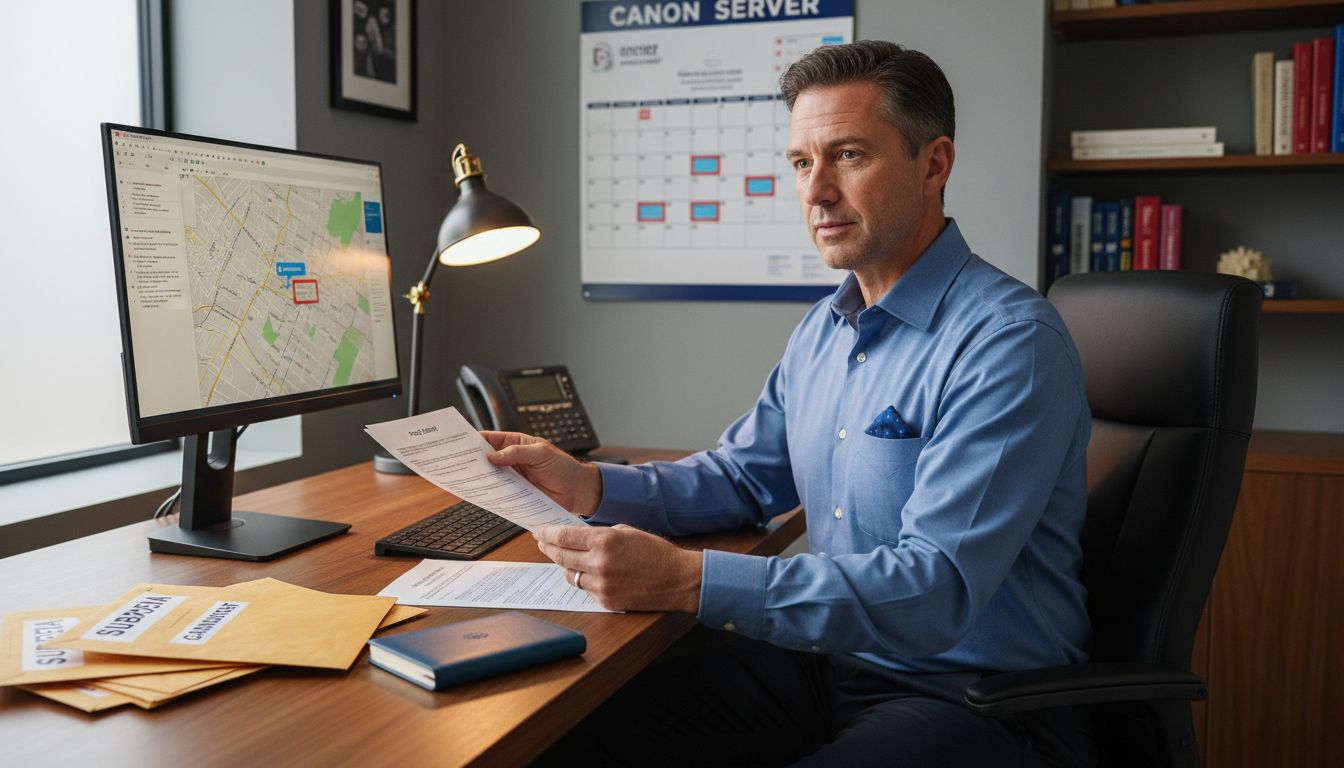
The process serving procedure is a critical legal mechanism designed to ensure all parties receive official notification about legal proceedings. According to Sacramento County Law Library, service is a formal method of delivering court documents that notifies parties about the existence and progression of a legal case.
Professional process servers play a crucial role in executing this procedure with precision and legal compliance. The typical process serving workflow involves several strategic steps to guarantee proper document delivery:
- Locate the intended recipient
- Verify the recipient’s legal address
- Attempt personal delivery
- Document all service attempts
- Provide proof of service to the requesting party
When personal delivery proves challenging, alternative service methods become essential. These might include:
- Leaving documents with a resident adult at the recipient’s address
- Sending documents via certified mail
- Publication service in specific legal circumstances
Professionals seeking deeper insights into navigating these complex requirements can benefit from understanding the role of professional process servers. Each step requires meticulous attention to legal standards, ensuring that document service meets court-mandated protocols and preserves the integrity of legal proceedings.
Legal Rules Governing Document Service in the U.S.
Legal document service in the United States is governed by a complex set of federal and state regulations designed to ensure fair and proper notification. According to Cornell Law School’s Federal Rules of Civil Procedure, Rule 5 provides comprehensive guidelines for serving legal documents, specifying acceptable methods including traditional and electronic means of delivery.
Service regulations vary significantly between civil and criminal proceedings. Federal Criminal Procedure Rule 49 outlines specific requirements for serving documents in criminal cases, establishing precise protocols for who must be served and how service must be conducted. These rules ensure that all parties receive proper legal notification while maintaining procedural integrity.
Key legal requirements for document service include:
- Identifying the correct recipient
- Using court-approved delivery methods
- Maintaining detailed documentation of service attempts
- Ensuring timely and verifiable notification
- Complying with jurisdiction-specific regulations
For professionals navigating these intricate legal requirements, understanding document delivery guidelines becomes crucial. Each jurisdiction may have nuanced rules that can significantly impact the validity of legal notifications, making precise adherence to service protocols essential for maintaining legal proceedings’ legitimacy.
Risks of Improper or Failed Document Service
Improper document service can derail entire legal proceedings with potentially devastating consequences. According to Sacramento County Law Library, a case cannot advance until documents are successfully served, and any procedural mistakes can result in significant case delays or complete dismissal.
Legal complications arising from failed document service can manifest in multiple critical ways. When service protocols are not meticulously followed, courts may invalidate subsequent legal actions, leaving parties without recourse and potentially exposing them to substantial financial and procedural risks. This can create a cascading effect of legal challenges that extend far beyond the initial document delivery attempt.
The most significant risks of improper document service include:
- Complete case dismissal
- Extended legal timelines
- Financial penalties
- Loss of legal standing
- Potential statute of limitations expiration
- Compromised legal strategy
Professionals seeking to mitigate these risks can benefit from understanding the nuances of online legal document delivery. Precise, verifiable, and legally compliant document service remains the foundational element of maintaining judicial integrity and protecting legal rights.
Roles and Responsibilities of Process Servers
Process servers are critical legal professionals responsible for ensuring proper document delivery and notification in legal proceedings. According to Sacramento County Law Library, these professionals must be over 18 years old and cannot be a party to the case they are serving documents for, maintaining strict neutrality and legal compliance.
Professional process servers bear significant responsibilities that extend far beyond simple document delivery. They must meticulously verify recipient identities, document all service attempts, and provide legally admissible proof of service. Their role requires a combination of investigative skills, legal knowledge, and precise procedural understanding to navigate complex service requirements.
Key responsibilities of process servers include:
- Locating and identifying correct document recipients
- Confirming legal addresses and contact information
- Executing personal or alternative service methods
- Maintaining detailed documentation of service attempts
- Providing sworn affidavits of service
- Ensuring compliance with jurisdiction-specific regulations
- Protecting the integrity of legal notification processes
Professionals seeking deeper insights can explore the comprehensive guide to the role of process servers, which offers nuanced understanding of this critical legal profession. Their work represents a fundamental cornerstone of maintaining judicial fairness and protecting procedural rights.
Ensure Your Legal Document Service Meets Every Requirement with Expert Support
Serving legal documents correctly is critical to avoid case delays, dismissals, or costly penalties as detailed in “Why Serve Legal Documents: Complete Guide for 2025.” If you are facing challenges like locating recipients, verifying addresses, or maintaining strict compliance with court rules, you are not alone. Many encounter these exact pain points—missing deadlines, improper service methods, or incomplete proof of delivery—which can put your entire case at risk.
At YM Doc Services, we understand how vital timely and accurate legal document service is for your peace of mind and success. Our professional process servers rigorously follow all legal protocols to ensure your summons, subpoenas, garnishments and other critical papers are delivered precisely and documented thoroughly. We offer comprehensive solutions including process serving, document retrieval, and court filings designed to relieve your stress and protect your rights.
Don’t leave your legal notification to chance. Choose trusted expertise to navigate the complexities of legal document delivery with confidence. Visit YM Doc Services today to learn how we can support your case every step of the way. Explore our detailed legal document delivery guide and discover why working with professional process servers is essential at Role of Process Servers Guide. Act now to secure reliable service that keeps your legal process on track.
Frequently Asked Questions
What is the purpose of serving legal documents?
Serving legal documents ensures that all parties involved in legal proceedings receive official notification, thereby maintaining due process and allowing them the opportunity to prepare and respond to claims.
What types of documents require formal service?
Critical legal documents that require formal service include Summons and Complaint, Subpoenas, Garnishments, Restraining Orders, and Divorce or Child Custody Papers, each serving unique legal purposes within the judicial process.
How does the process serving procedure work?
The process serving procedure involves locating the recipient, verifying their address, attempting personal delivery, documenting service attempts, and providing proof of service, ensuring compliance with legal standards.
What are the risks associated with improper document service?
Improper document service can lead to significant risks such as complete case dismissal, extended timelines, potential financial penalties, loss of legal standing, and compromised legal strategy.
Recommended
We provide GPS-stamped, court-compliant service of process throughout Orange County, Seminole County, and West Volusia County. Licensed Florida process server — FAPPS Member · NAPPS Member · Florida Statutes Chapter 48 Compliant.