
Over half of American adults admit confusion about who can legally prepare court documents. The truth is that legal document assistants play a vital role behind the scenes, supporting attorneys, businesses, and individuals without crossing the line into legal advice. Clearing up these common misunderstandings can save time, money, and frustration for anyone navigating the paperwork maze. Understanding what legal document assistants actually do will help you make smart, confident choices for your legal needs.
Table of Contents
- Legal Document Assistants: Definition and Misconceptions
- Types of Legal Document Services Offered
- How the Process Works for Clients
- Legal Certification and Regulatory Standards
- Cost Benefits Versus Attorneys and DIY
- Risks, Limitations, and Red Flags to Avoid
Key Takeaways
| Point | Details |
|---|---|
| Role of Legal Document Assistants | They provide administrative support for legal tasks without practicing law, focusing on document preparation and compliance. |
| Regulatory Standards | Legal document assistants must adhere to strict regulations, including certification and ongoing compliance, to ensure professionalism. |
| Cost-Effectiveness | Utilizing legal document assistants can save clients 50-80% compared to hiring attorneys for straightforward legal matters. |
| Risks and Limitations | Clients should understand that legal document assistants cannot provide legal advice or representation, focusing only on document preparation. |
Legal Document Assistants: Definition and Misconceptions
Legal document assistants are skilled professionals who provide administrative and technical support for legal tasks without practicing law directly. These professionals help attorneys, businesses, and individuals navigate complex document preparation, filing, and management processes by offering specialized administrative services. Legal document assistants operate within strict legal boundaries, focusing on document preparation, organization, and procedural support.
Contrary to common misconceptions, legal document assistants are not lawyers and cannot provide legal advice or represent clients in court. Their primary role involves preparing standardized legal forms, managing paperwork, and ensuring documents comply with procedural requirements. Legal paperwork fundamentals typically involve complex administrative tasks that require precision and attention to detail.
The responsibilities of legal document assistants encompass several critical functions:
- Drafting and formatting legal documents
- Conducting legal research and document retrieval
- Organizing case files and maintaining comprehensive records
- Assisting with court filing procedures
- Supporting attorneys with administrative workflow management
Professional legal document assistants bring significant value by reducing administrative burdens, minimizing errors, and streamlining legal processes. By understanding the specific limitations and capabilities of these professionals, clients can effectively leverage their expertise while maintaining appropriate professional boundaries. Legal documentation tips can help individuals and businesses maximize the benefits of working with legal document assistants.
Types of Legal Document Services Offered
Legal document services encompass a wide range of specialized administrative support designed to assist attorneys, businesses, and individuals with complex legal documentation needs. Legal process preparation involves intricate document management that requires precision and expertise across multiple practice areas. Legal document assistants provide critical support by preparing and managing documents for various legal scenarios.
According to research, legal document assistants offer comprehensive services across several key domains. Comprehensive legal document assistance typically includes preparing documents for critical legal matters such as:
-
Family Law Documents
- Divorce petitions
- Child custody agreements
- Child support documentation
- Prenuptial agreements
-
Estate Planning Services
- Wills and living trusts
- Estate administration documents
- Probate paperwork
- Trust certifications
-
Business and Commercial Documents
- Business formation paperwork
- Real estate transaction documents
- Contract drafting and review
- Incorporation documents
-
Civil Litigation Support
- Case filing documents
- Legal research compilation
- Court document preparation
- Case management paperwork
Legal document assistants also specialize in additional complex documentation areas, including bankruptcy filings, adoption paperwork, real estate transactions, and personal property assignments. Their expertise ensures that documents are accurately prepared, formatted correctly, and filed with appropriate legal authorities. Legal document template preparation represents a critical service that helps clients navigate complicated legal documentation requirements with professional support and precision.

How the Process Works for Clients
Working with a legal document assistant involves a structured, client-centered approach designed to simplify complex legal documentation processes. Service of process workflow typically begins with an initial consultation where clients share their specific legal documentation needs and objectives. The legal document assistant carefully listens and gathers all necessary information to ensure accurate document preparation.
Clients provide critical details and documentation during the initial stages, and the legal document assistant then transforms this information into professionally formatted legal documents. Process serving for businesses highlights the importance of precise information gathering. The comprehensive process includes several key steps:
-
Initial Consultation
- Discuss client’s specific legal requirements
- Review existing documentation
- Identify necessary document types
-
Information Collection
- Gather comprehensive client details
- Verify accuracy of provided information
- Request supporting documentation
-
Document Preparation
- Draft legal documents based on client information
- Review documents for completeness and accuracy
- Make necessary revisions
-
Document Submission
- Prepare documents for filing
- Advise clients on next steps
- Ensure proper court or administrative submission
Legal document assistants cannot provide legal advice or represent clients in court, but they excel at transforming client information into precise, professional documentation. Their expertise ensures that paperwork is accurately completed, reducing potential errors and streamlining the legal documentation process. Step by step process serving demonstrates the meticulous approach these professionals bring to complex legal documentation challenges.
Legal Certification and Regulatory Standards
Legal document assistants operate within a complex regulatory framework designed to protect client interests and maintain professional standards. Legal document certification requires strict adherence to specific registration and compliance protocols that vary by jurisdiction. These regulatory standards ensure that legal document assistants provide reliable and professional services while maintaining clear boundaries of their professional scope.
In many jurisdictions, legal document assistants must meet rigorous certification requirements. Certified process servers demonstrate the importance of professional credentials. Typical certification standards include:
-
Professional Registration
- County clerk registration
- Valid photo identification
- Comprehensive background checks
-
Financial Requirements
- Mandatory professional liability bond
- Minimum financial guarantees
- Proof of financial responsibility
-
Ongoing Compliance
- Periodic recertification
- Continuing education requirements
- Regular professional standard reviews
The certification process involves significant administrative obligations. Legal document assistants must register with county authorities, typically presenting valid identification and securing a substantial professional bond. Most jurisdictions require a $25,000 bond and mandate registration renewal every two years, ensuring ongoing professional accountability and client protection. These stringent requirements help maintain high professional standards and provide clients with confidence in the legal document assistance services they receive.
Cost Benefits Versus Attorneys and DIY
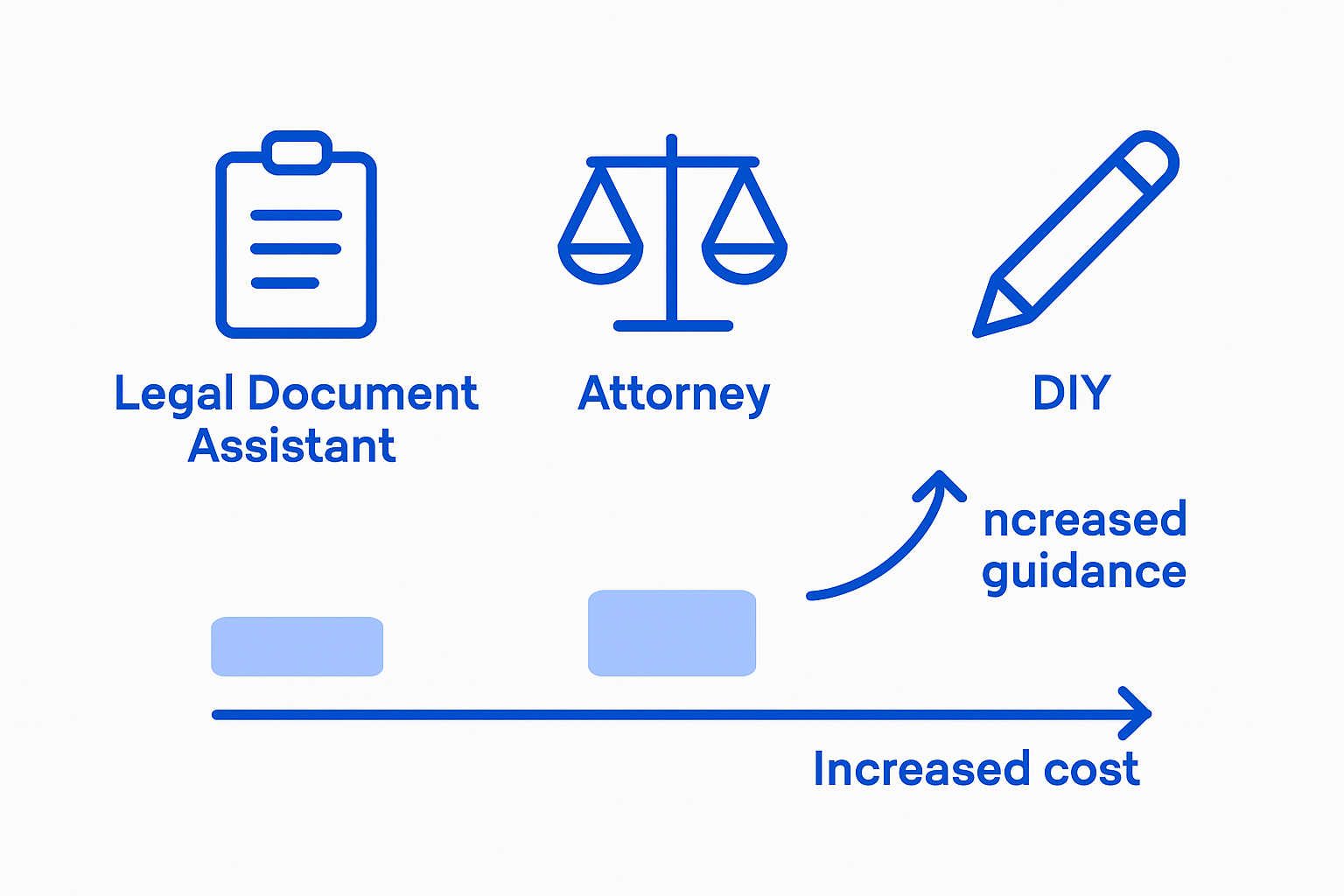
Choosing between legal document assistants, attorneys, and do-it-yourself approaches requires carefully evaluating cost, complexity, and potential risks. Legal paperwork processing tools highlight the range of options available for managing legal documentation. Legal document assistants emerge as a strategic middle ground, offering significant cost savings compared to traditional attorney services while providing more professional support than self-managed approaches.
The financial advantages of using legal document assistants are substantial. Clients can typically save 50-80% compared to full attorney representation, making these services an attractive option for straightforward legal matters. Legal document support solutions demonstrate the cost-effectiveness of professional document assistance. Comparison of approaches reveals distinct financial implications:
-
Attorney Services
- Highest cost option
- Comprehensive legal representation
- Hourly rates ranging $250-$500
-
Legal Document Assistants
- Moderate, fixed pricing
- Professional document preparation
- Costs typically $100-$300 per document
-
Do-It-Yourself Approach
- Lowest upfront cost
- High potential for errors
- Potential hidden expenses from mistakes
While legal document assistants cannot provide legal advice, they offer a critical service for individuals who understand their legal needs but require professional document preparation. Their expertise helps clients navigate complex paperwork efficiently, reducing the risk of costly errors that could arise from self-preparation. The key advantage lies in providing professional-grade document support at a fraction of traditional legal service costs.
Risks, Limitations, and Red Flags to Avoid
Navigating the complexities of legal document assistance requires a clear understanding of potential risks and professional boundaries. Legal document processing strategies emphasize the critical importance of recognizing the specific limitations of legal document assistants. These professionals operate under strict constraints that protect both clients and the legal system from potential misrepresentation.
Legal document assistants face significant professional restrictions that clients must understand. Legal document support solutions highlight the clear boundaries of their professional scope. Key risks and limitations include:
-
Prohibited Professional Actions
- Cannot provide legal advice
- Forbidden from interpreting legal statutes
- Unable to represent clients in court
- Cannot select legal forms for clients
-
Potential Risks
- Incomplete or incorrectly prepared documents
- Lack of personalized legal strategy
- No professional liability for legal outcomes
- Limited recourse for documentation errors
-
Red Flags to Watch
- Promises of legal advice or representation
- Offers to make legal decisions on your behalf
- Guarantees of specific legal outcomes
- Lack of clear professional credentials
Clients must remain vigilant and recognize that legal document assistants provide administrative support, not legal representation. Their role is strictly limited to document preparation and procedural assistance. Attempting to extract legal advice or strategic guidance from these professionals constitutes a significant misunderstanding of their professional capabilities and legal boundaries.
Streamline Your Legal Document Preparation with Professional Support
Handling complex legal paperwork can be overwhelming, especially when you need precise document preparation without legal advice or costly attorney fees. The article “Why Use Legal Document Assistants for Legal Tasks” highlights common challenges such as ensuring accuracy, meeting court filing requirements, and navigating the limits of legal document assistants. If you want to avoid errors, save time, and meet strict deadlines while staying compliant with legal standards, professional administrative assistance is essential.
YM Doc Services specializes in providing reliable solutions that address these exact pain points. Our experts focus on document retrieval, court filings, and process serving to help lawyers, businesses, and individuals manage legal paperwork efficiently and accurately. When you want to reduce stress and avoid costly mistakes, trust our experienced team to support you through every step of the process.
Experience peace of mind by using a service dedicated to professionalism and timeliness. Visit YM Doc Services, learn how our service of process workflow can simplify your legal tasks, and discover the benefits of choosing skilled legal document professionals today.
Take control of your legal paperwork now. Partner with YM Doc Services to receive expert support tailored to your needs. Start by visiting https://ymdocservices.com to place your order or get more information on how we can help you navigate your legal documentation needs before deadlines become a problem.
Frequently Asked Questions
What is the role of a legal document assistant?
Legal document assistants provide administrative and technical support for legal tasks, such as preparing and managing legal documents without practicing law or offering legal advice.
How can legal document assistants save clients money?
Using legal document assistants can lead to significant cost savings, typically ranging from 50-80% compared to traditional attorney services, while still providing professional support for document preparation.
What types of documents can legal document assistants help prepare?
Legal document assistants can help prepare a variety of documents, including family law documents, estate planning services, business formation paperwork, and civil litigation support documents.
What are the limitations of working with a legal document assistant?
Legal document assistants cannot provide legal advice, represent clients in court, interpret legal statutes, or select legal forms on behalf of clients, making it crucial to understand their professional boundaries.

